
Loading, please wait...
LOT 1038
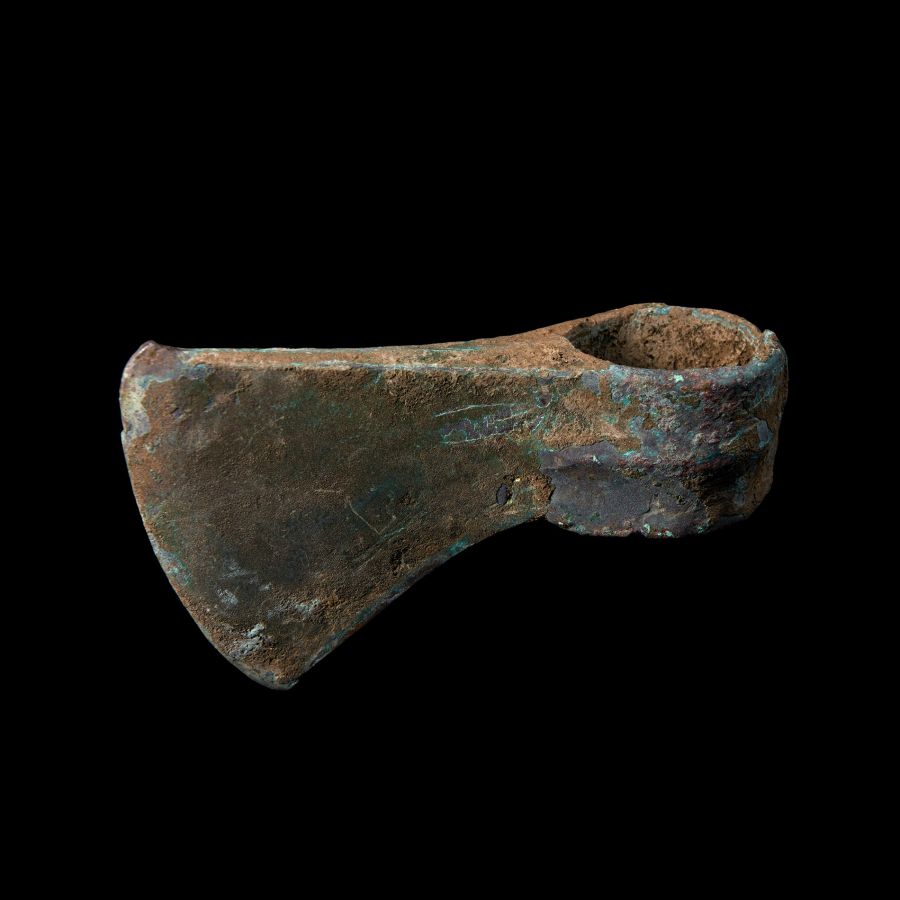
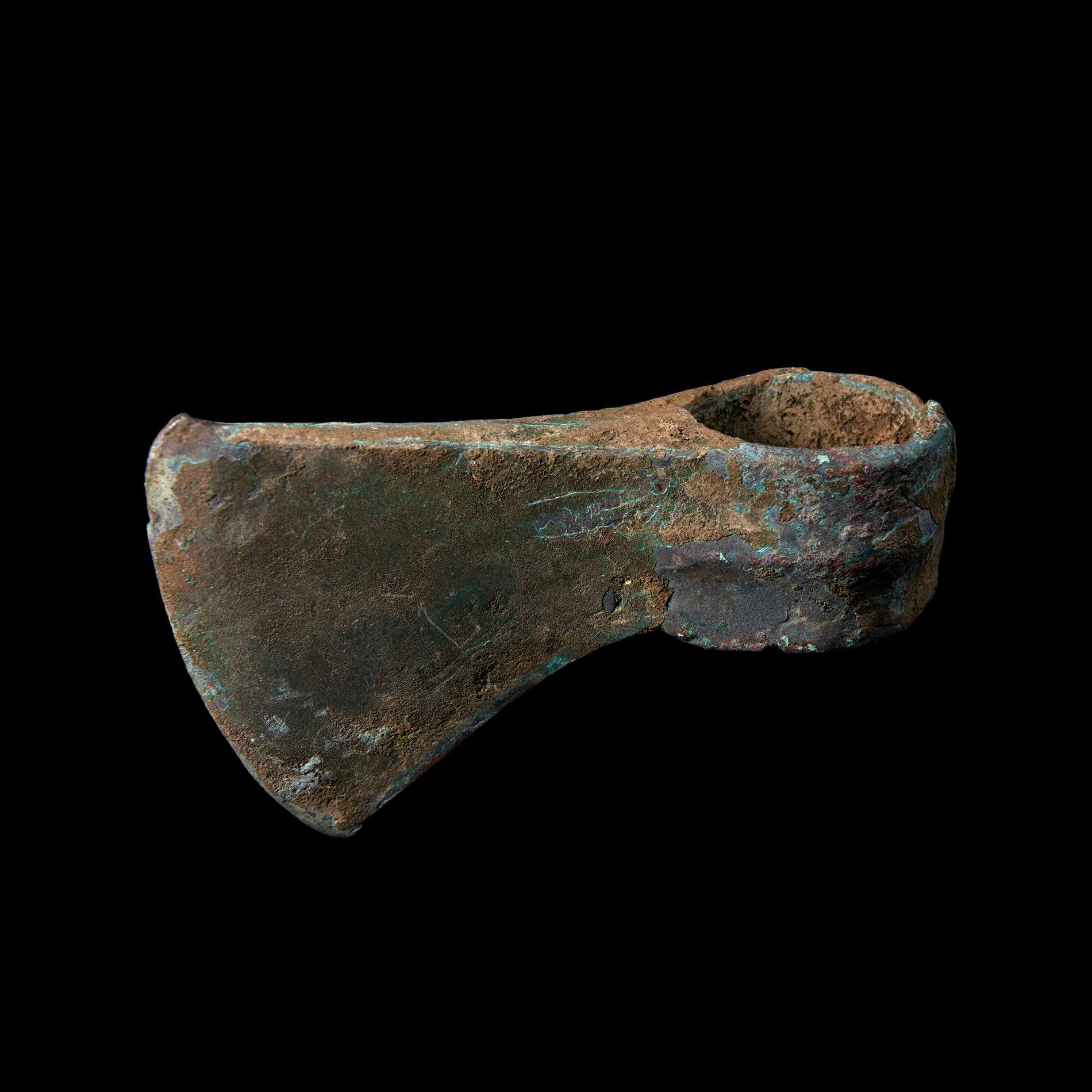
Western Asiatic Socketted Axehead
3RD MILLENNIUM B.C.
5 1/8 in. (545 grams, 13 cm).
A Bronze Age axehead with swept blade, large socket with raised circumferential rib and a vertical rib to the rear. [No Reserve]
ProvenancePrivate UK collection, 1980s-1990s.
Acquired from a UK gallery, circa 2000.
Cf. Gernez, G., L’armament en métal au Proche et Moyen-Orient: des origines a 1750 av. J.C., Paris, 2007, p.155 vol. I, subtype H.2K.C, for the type.
FootnotesThis axe belongs to a group mainly including those of rectangular shape, the blades themselves rectangular or with slightly divergent edges, with a straight or rounded edges.
CONDITIONTimeLine Auctions follows a vetting process to ensure the authenticity and legality of all items, reinforcing our commitment to integrity and responsible trading. Each antiquity, antique, and coin lot undergoes thorough examination by a vetting committee of at least ten external specialists, professional trade association members, scientists, and archaeologists: Our Vetting Process
AUCTIONS:
TimeLine is a leading auction house specialising in antiquities, ancient art, collectables, natural history, coins, medals, and books. Our auctions offer museums, collectors, historians, and enthusiasts the opportunity to acquire unique and historically significant pieces.
-
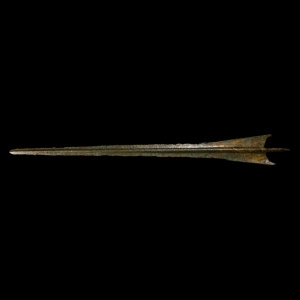
Western Asiatic Dagger Blade with Winged Guards
Late 2nd-mid 1st millennium B.C.Sold for (Inc. bp): £410
A bronze dagger with prominently curved or winged guard, extending out from the ricasso and partly framing the tang, once covered by an organic hilt; the thick midrib extending slightly above the ricasso. 484 grams, 60 cm
Acquired 1980-2015. Ex Abelita family collection.
Many examples of these blades have been excavated in the South Caspian area at Ghalekuti, and in the area of Talish. They have been found primarily in Iron Age graves, although the curves of the guards are reminiscent of the barbed arrow and javelin heads associated with Bronze Age Marlik. This is why some scholars (Dyson) dated them to the second millennium BC and others (Muscarella) to the recent Iron Age. It is possible that this style represents continuity from the Bronze to the Iron Age. -
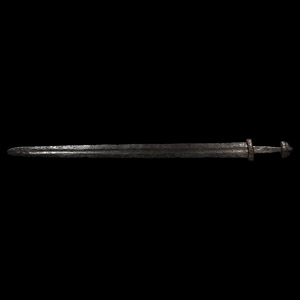
Viking Age Sword with Three-Lobed Pommel
Early 11th century A.D.Sold for (Inc. bp): £4,940
A double-edged cutting sword of Oakeshott Type XII with inlaid hilt and tapering blade with shallow fullers; the lower guard gently curving and decorated with copper inlaid dots, upper guard and three-lobed pommel with similar decoration, traces of silver inlay to the hilt. 720 grams, 90 cm long
Acquired 1971-1972. From the collection of the vendor's father. Property of a London, UK, collector. Accompanied by an academic report by Dr Raffaele D’Amato. This lot has been checked against the Interpol Database of stolen works of art and is accompanied by searcher certificate no.11575-198856.
The sword belongs to the Type XII of the Oakeshott classification (Oakeshott, 1998, pp.37ff.), the characteristics of which are a broad, flat, evenly tapering blade, generally with a good sharp point and tending to widen perceptibly below the hilt. After the publication of the Finnish specimen, Peirce, due to the inlaid inscriptions of this latter, noted a close parallel, both in style and content, with a sword in the Schweizerischen Landesmuseum in Zurich. In the expanded context including the example from Finland, Peirce was able to re-date them to the 11th century. -
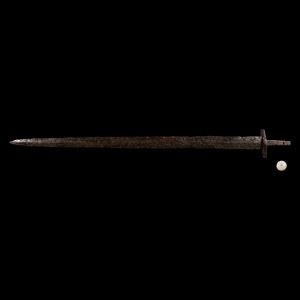
Migration Period Spatha Sword Blade with Sword Bead
Circa 4th-5th century A.D.Sold for (Inc. bp): £572
A double-edged spatha with a lentoid section parallel-sided iron blade with pointed tip; battle nicks to both cutting edges; rhomboid-section cross-guard; a fastening nail on the upper tang; accompanied by a sword bead. 921 grams total, 2.7- 86.5 cm
cleaned and conserved.
Acquired 1971-1972. From the collection of the vendor's father. Property of a London, UK, collector. Accompanied by an academic report by Dr Raffaele D’Amato.
A Migration Period sword, originating from Central Asia, often used by nomadic populations and particularly by the Huns, defined as a Nomadic-Asiatic sword by Menghin, or as a sword with plate guard. The long and thin blade, with a lenticular or lozenge section, was equipped with a guard composed of an iron plate inserted into the tang. Little is known about the scabbard of these swords but it is known that they usually had disc-shaped pommels, and stones hanging from the pommel or hilt. This typology was widespread in Central Europe by the Huns and there are also specimens attested in Gaul in the 5th century.
