
Loading, please wait...
_900x900.jpg "Western Asiatic Polished Stone Macehead")
_200x200.jpg "Western Asiatic Polished Stone Macehead")
.jpg "Western Asiatic Polished Stone Macehead")
LOT 1523
Western Asiatic Polished Stone Macehead
3RD-2ND MILLENNIUM B.C.
3 1/2 in. (377 grams, 91 mm).
With slightly carinated equator to the globular body and tubular shaft.
ProvenanceFrom the collection of North West London, UK, gentleman, early 2000s.
LiteratureSee Gorelik, M., Weapons of Ancient East, IV millennium BC-IV century BC, Saint Petersburg, 2003, pl.XXX, no.47, mace of a deity, detail of the image on the “Stela of Kites” Eanatuma, Ngirsu, mid-3rd millennium B.C.
CONDITIONTimeLine Auctions follows a vetting process to ensure the authenticity and legality of all items, reinforcing our commitment to integrity and responsible trading. Each antiquity, antique, and coin lot undergoes thorough examination by a vetting committee of at least ten external specialists, professional trade association members, scientists, and archaeologists: Our Vetting Process
AUCTIONS:
TimeLine is a leading auction house specialising in antiquities, ancient art, collectables, natural history, coins, medals, and books. Our auctions offer museums, collectors, historians, and enthusiasts the opportunity to acquire unique and historically significant pieces.
LOT 1523
Western Asiatic Polished Stone Macehead
Estimate £100 - 140€120 - 160 (for guidance only)$140 - 190 (for guidance only)
-
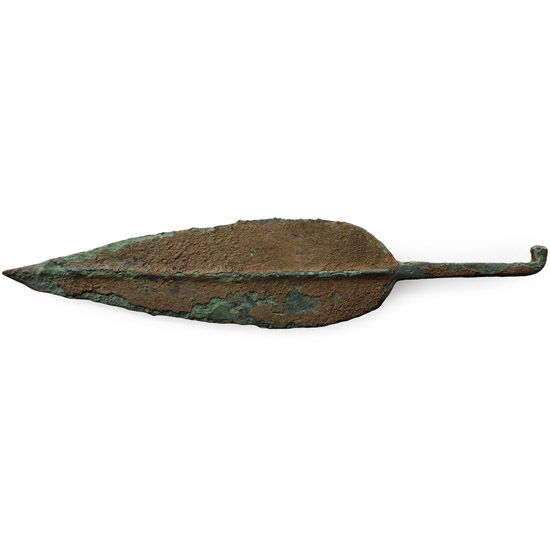
Luristan Bronze Tanged Spearhead
14th-10th century B.C.Estimate: £100 - 140 (+bp*)
Current Winning Bid: £70
Large leaf-shaped blade with a narrow midrib and a rectangular-section tang with bent finial. 275 grams, 30.4 cm
Ex Abelita collection, 1990s. -
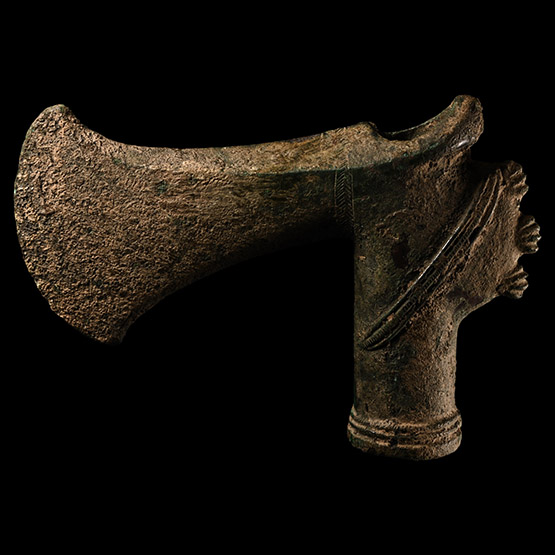
Luristan Socketted Bronze Axe Head Sar-e Tabar
Circa 2200-1600 B.C.Estimate: £500 - 700 (‡+bp*)
Opening Bid: £250
Comprising a wide curving blade and long neck with a band of herringbone decoration at the base, tubular neck with claw-like extension to the rear and a decorative diagonal band to both sides. 308 grams, 10.6 cm
Acquired on the Swiss art market, 1997. Private collection, Europe.
Similar examples of axeheads were produced in Luristan, and early parallels date back to 2200 B.C. They have moulding bands at the base, and the shaft is often crosshatched, showing different lozenge-shaped figures. -
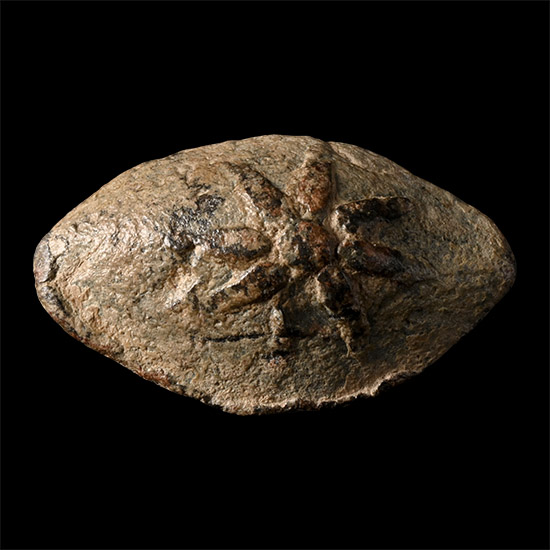
Greek Lead Slingshot with Macedonian Star
3rd-1st century B.C.Sold for (Inc. bp): £182
Biconical in profile with a casting seam and a rayed solar symbol, the so-called Argead Star, on one side. 27.2 grams, 30 mm
Ex German art market, 2000s. Acquired from an EU collector living in London. From the collection of a Surrey, UK, gentleman.
The rayed solar symbol (Argead Star, Vergina Star) is interpreted as the historical royal symbol of the ancient Macedonian Dynasty of the Argeads, with its most famous member being Alexander the Great.
