Loading, please wait...
LOT 1750
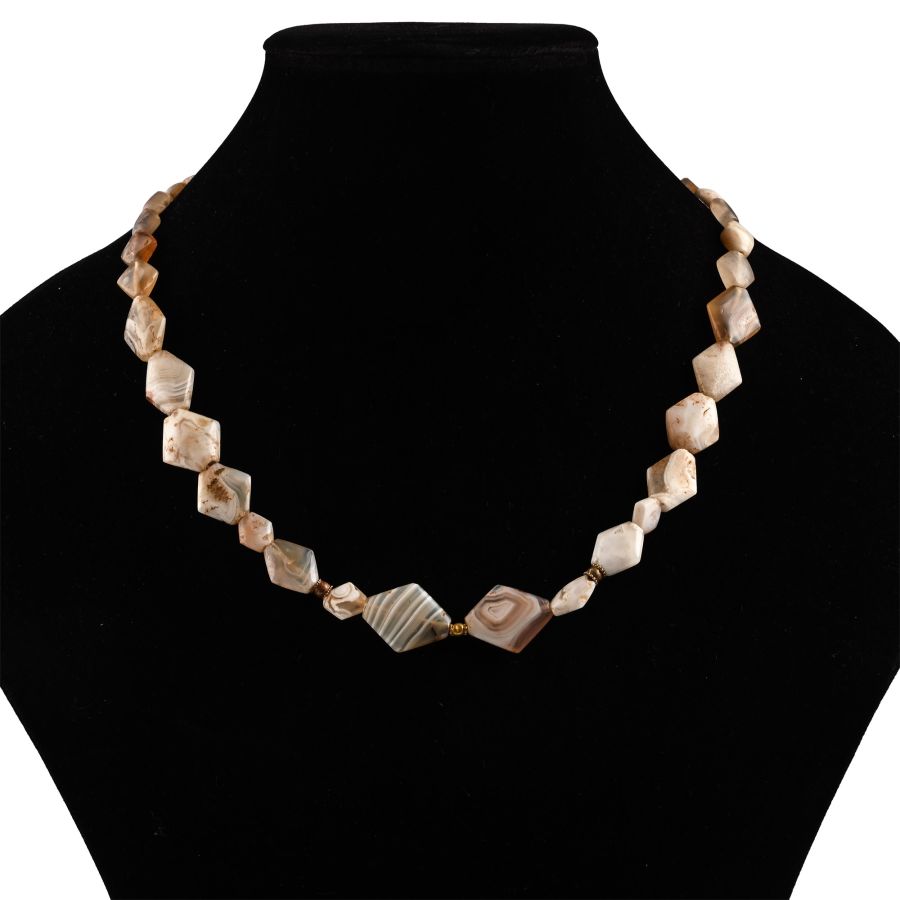
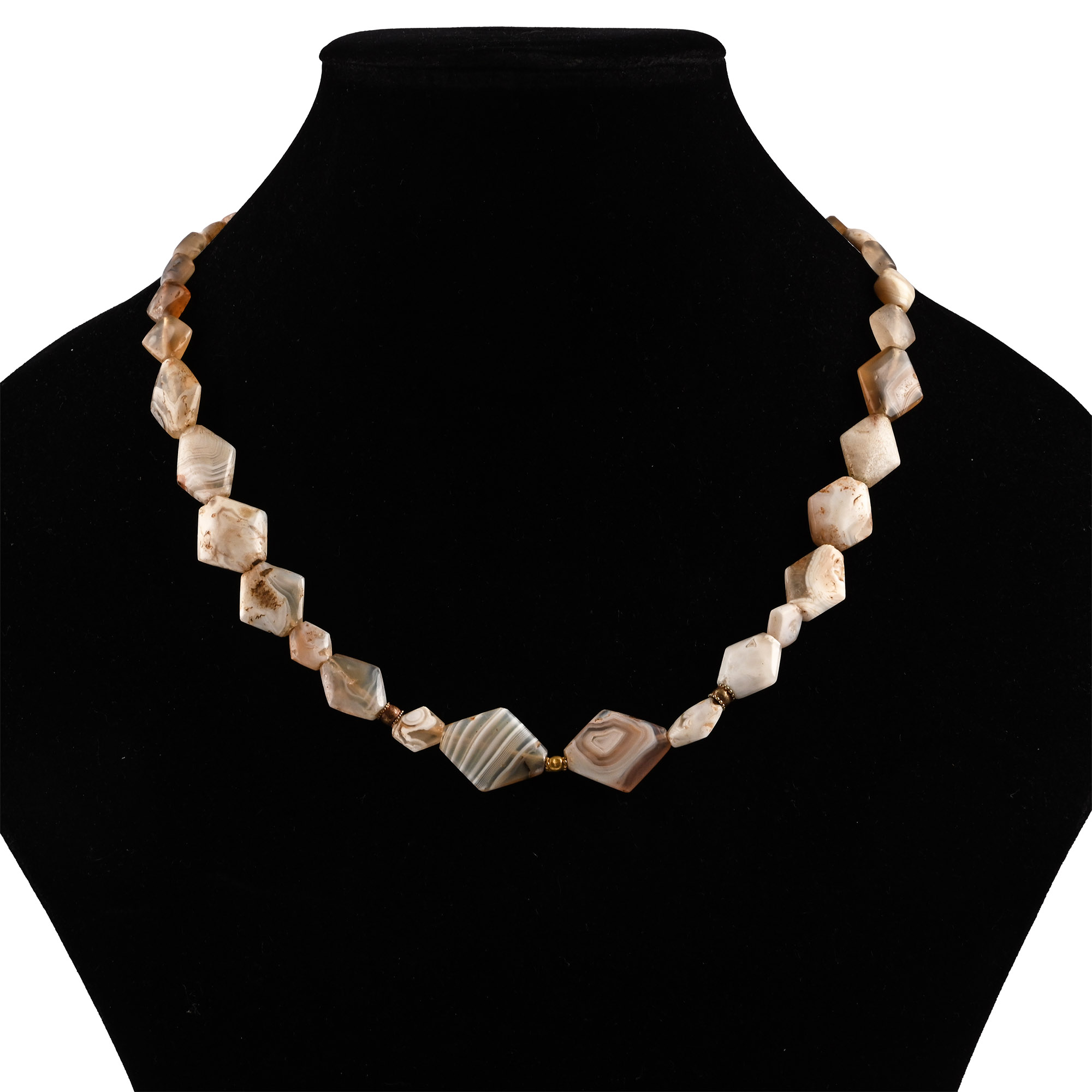
Western Asiatic Pale Agate and Gold Bead Necklace
1ST MILLENNIUM B.C.
19 3/4 in. (42.9 grams, 50 cm).
Restrung group of graduated diamond-shaped beads.
ProvenanceFrom a London gentleman's collection, 1995.
CONDITIONTimeLine Auctions follows a vetting process to ensure the authenticity and legality of all items, reinforcing our commitment to integrity and responsible trading. Each antiquity, antique, and coin lot undergoes thorough examination by a vetting committee of at least ten external specialists, professional trade association members, scientists, and archaeologists: Our Vetting Process
AUCTIONS:
TimeLine is a leading auction house specialising in antiquities, ancient art, collectables, natural history, coins, medals, and books. Our auctions offer museums, collectors, historians, and enthusiasts the opportunity to acquire unique and historically significant pieces.
LOT 1750
Western Asiatic Pale Agate and Gold Bead Necklace
Estimate £400 - 600€460 - 700 (for guidance only)$540 - 810 (for guidance only)
-
Western Asiatic Bronze Arrowhead Collection
2nd-1st millennium B.C.Sold for (Inc. bp): £247
Comprising tanged arrowheads, four with large elongated triangular blades and raised midrib, sharp central groove, one triangular type with barbed shoulders and flat tang, six with barbed shoulders and cylindrical stem with handle for the shaft; two with squared shoulders and rectangular stem with handle for the shaft, one with leafed blade, two with barbed shoulder and flat tang, one with flat blade, one with short triangular head and handle for the shaft, and another with short tang and trilobate blade with raised midrib. 221 grams total, 4.2-13.6 cm
London, UK, collection, 1990s.
Some of these arrowheads seem to belong to the type V, subcategory types A, B, C and D according to the classification of Khorasani and Negahban. In the four categories of triangular bronze arrowheads from Luristan, Marlik, and Northern Iran, individuated by Negahban, subtypes C and D of type V are larger arrow or javelin heads, C with barbed shoulders and D with round shoulders. Most of them were cast in moulds. -
Western Asiatic Alabaster Vessel with Lug Handles
2nd-1st millennium B.C.Estimate: £180 - 240 (+bp*)
Opening Bid: £90
Carved bag-shaped body with two lateral unpierced lug handles at the shoulder, flared rim to the mouth. 984 grams, 12.5 cm
Ex William Ohly, 1883-1955. Ex Abbey Museum, Barnet, by descent. -
Middle Assyrian Brick-Shaped Tablet with Funerary Inscription for Adad-Shumu-lesir’s Tomb
1363-912 B.C.Sold for (Inc. bp): £5,200
A rectangular brick-shaped tablet, inscribed in cuneiform script across three vertical faces, with a single column to the fourth and a continuation of text across the top surface; the inscription a funerary curse relating to the tomb of Adad-šumu-lešir, warning against interference with the burial, reading in part: 'As for a stranger, or somebody who would approach that tomb, or would bring up a corpse out of it and bury his own within, or would touch the silver inside - Adad, Šamaš, or Nergal will fill his house and field with shortage, collapse, and murder. He will repay the property of that tomb sevenfold, dedicating it to Šuriha. For the offspring of Adad-šumu-lešir he shall be undone for taking out and bringing down objects in the tomb, and for burying another body within it. Month Kalmartu, third day, eponymy of Aššur-mušezib.' 333 grams, 14.3 cm
Acquired in 1996. Private collection, Switzerland, thence by descent. Private collection, since the late 1990s. This lot has been checked against the Interpol Database of stolen works of art and is accompanied by a search certificate number no.12872-241667.
This Middle Assyrian brick-shaped tablet bears a funerary inscription for the tomb of Adad-shumu-lesir, a name that reflects devotion to the storm god Adad, an important deity in the Assyrian pantheon. Tablets of this kind were often placed within or near tombs as a lasting record of the individual and to mark ownership or dedication of the burial space. The brick-like form reflects the architectural traditions of Mesopotamia, where inscribed bricks were commonly used in both building and commemorative contexts. Such inscriptions not only honoured the deceased but also served to preserve their name and memory, which was believed to be essential for the afterlife. Objects like this provide valuable insight into Assyrian funerary practices and the importance placed on remembrance and identity beyond death.