Loading, please wait...

Western Asiatic Ornate Gold Bead Western Asiatic Ornate Gold Bead Western Asiatic Ornate Gold Bead
Use mousewheel to zoom in and out, click to enlarge
Details

LOT 1437

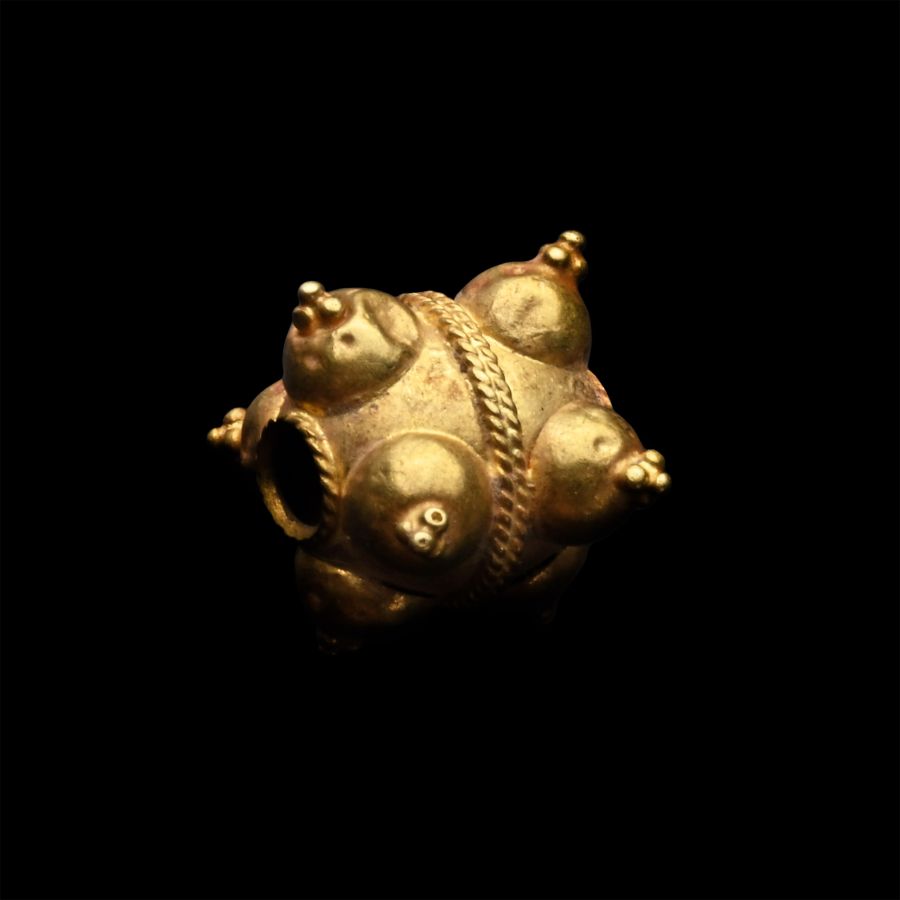
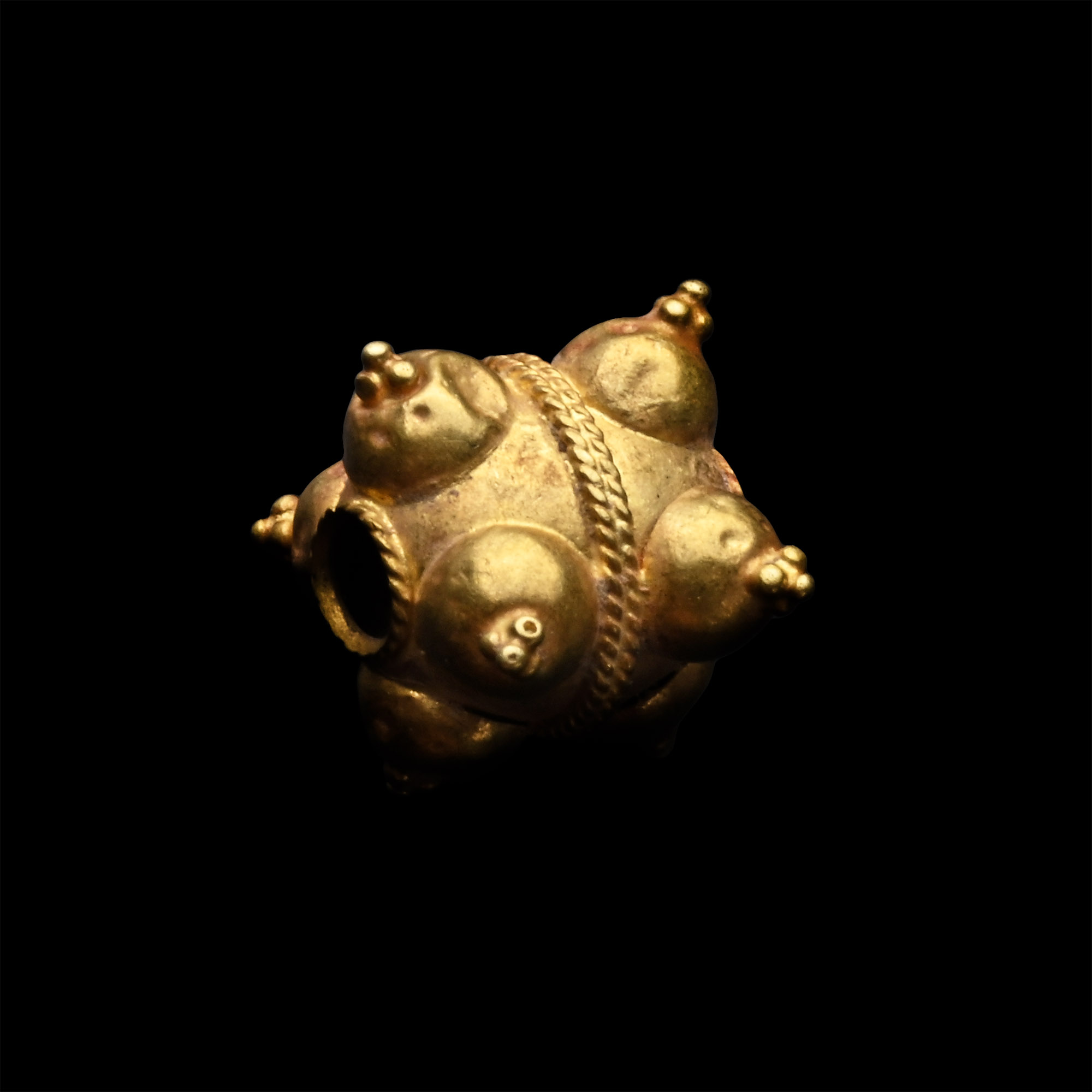
Western Asiatic Ornate Gold Bead

1ST MILLENNIUM B.C.

1/4 in. (0.44 grams, 8 mm).

Composed of two hemispheres connected with a double filigree band, each hemisphere with four projecting bosses surmounted by granules.

Provenance

Ex late Japanese private collection, 1970-2010.

Accompanied by a previously illustrated catalogue card with provenance.

CONDITION
VETTING:

TimeLine Auctions follows a vetting process to ensure the authenticity and legality of all items, reinforcing our commitment to integrity and responsible trading. Each antiquity, antique, and coin lot undergoes thorough examination by a vetting committee of at least ten external specialists, professional trade association members, scientists, and archaeologists: Our Vetting Process


AUCTIONS:

TimeLine is a leading auction house specialising in antiquities, ancient art, collectables, natural history, coins, medals, and books. Our auctions offer museums, collectors, historians, and enthusiasts the opportunity to acquire unique and historically significant pieces.

LOT 1437

Western Asiatic Ornate Gold Bead

Estimate £100 - 140€120 - 160 (for guidance only)$140 - 190 (for guidance only)

Opening Bid
£50 (EUR 58; USD 68) +BP*

Sign in to Bid

Please enter a e-mail
Please enter a password
Or Create Account here.
Please confirm to accept TC and Privacy policy

Bids: 0
RELATED LOTS
  • Aramaic Terracotta Magical Incantation Bowl
    Aramaic Terracotta Magical Incantation Bowl
    Circa 4th-8th century A.D.

    Estimate: £500 - 700 (+bp*)

    Bids: 7   |   Current Bid: £450

    Flat-based bowl, inscribed in spiral from the bottom inner wall to the rim with Aramaic text. 360 grams, 17.6 cm


    Private collection, 1980s. UK private collection before 2000. Acquired on the UK art market. Private collection, London, UK

    Aramaic incantation bowls are particular to the Sasanian period and have been found in the regions of modern Iraq. These simple ceramic bowls, also known as magic bowls, each contain an Aramaic inscription, written in ink, which spirals from the centre. The bowls seem to have played an important part in domestic life. For example, during excavation in Nippur in 1889, one or more incantation bowls were found in each house together with domestic artefacts, most often in doorways or under floorboards in the corner of rooms. The bowls are predominantly apotropaic, and the inscriptions tend to protect their owners from misfortunes such as childbirth, illness and evil spirits.

    Lot Details

  • Western Asiatic Basalt Tablet with Cuneiform Inscription
    Academically Important
    Western Asiatic Basalt Tablet with Cuneiform Inscription
    2nd-1st millennium B.C.

    Estimate: £2,000 - 3,000 (‡+bp*)

    Opening Bid: £1,000

    Architectural fragment with rectangular band to one edge, carved decorative detailing with inscription. 7.85 kg, 32.6 cm


    Private collection, Europe, thence by descent. Private collection, since the late 1980s. This lot has been checked against the Interpol Database of stolen works of art and is accompanied by a search certificate number no.12521-231989.

    Amid the many architectural, sculptural, and textual riches of Assyria and Mesopotamia, the broken pieces of basalt bearing fragmentary cuneiform inscriptions have received little attention, but are of fundamental importance. Despite being quite fragmentary, these broken pieces of basalt are the remains of an important witness to the Assyrian imperial presence in the Near East.

    Lot Details

  • Large West Central Asian Bronze Greek Cross Seal Matrix
    Large West Central Asian Bronze Greek Cross Seal Matrix
    Circa 2300-1800 B.C.

    Estimate: £30 - 40 (+bp*)

    Opening Bid: £5

    Handled stamp seal with Greek cross design, accompanied by an old scholarly note, typed and signed by W.G. Lambert, late Professor of Assyriology, University of Birmingham, 1970-1993, which states: 'Stamp Seal of Bronze 28 x 17 x 35 mm. This had originally the shape of four Greek crosses based on a central small circle, but three are broken off and missing, only one remains. Above the circle is a tall stalk handle with round pierced loop on the top. the circle and crosses are compartmented. This comes from west central Asia and dates to c. 2300-1800 B.C. What remains is in good condition, and the pattern of the whole can easily be reconstructed.' 14.8 grams, 35 mm


    Acquired in the late 1980s-early 1990s. Ex property of a West London businessman. Academically researched and catalogued by the late Professor Lambert in the early 1990s. Accompanied by a copy of a scholarly report, numbered T-189, typed and signed by Professor Wilfrid George Lambert.

    Lot Details