
Loading, please wait...


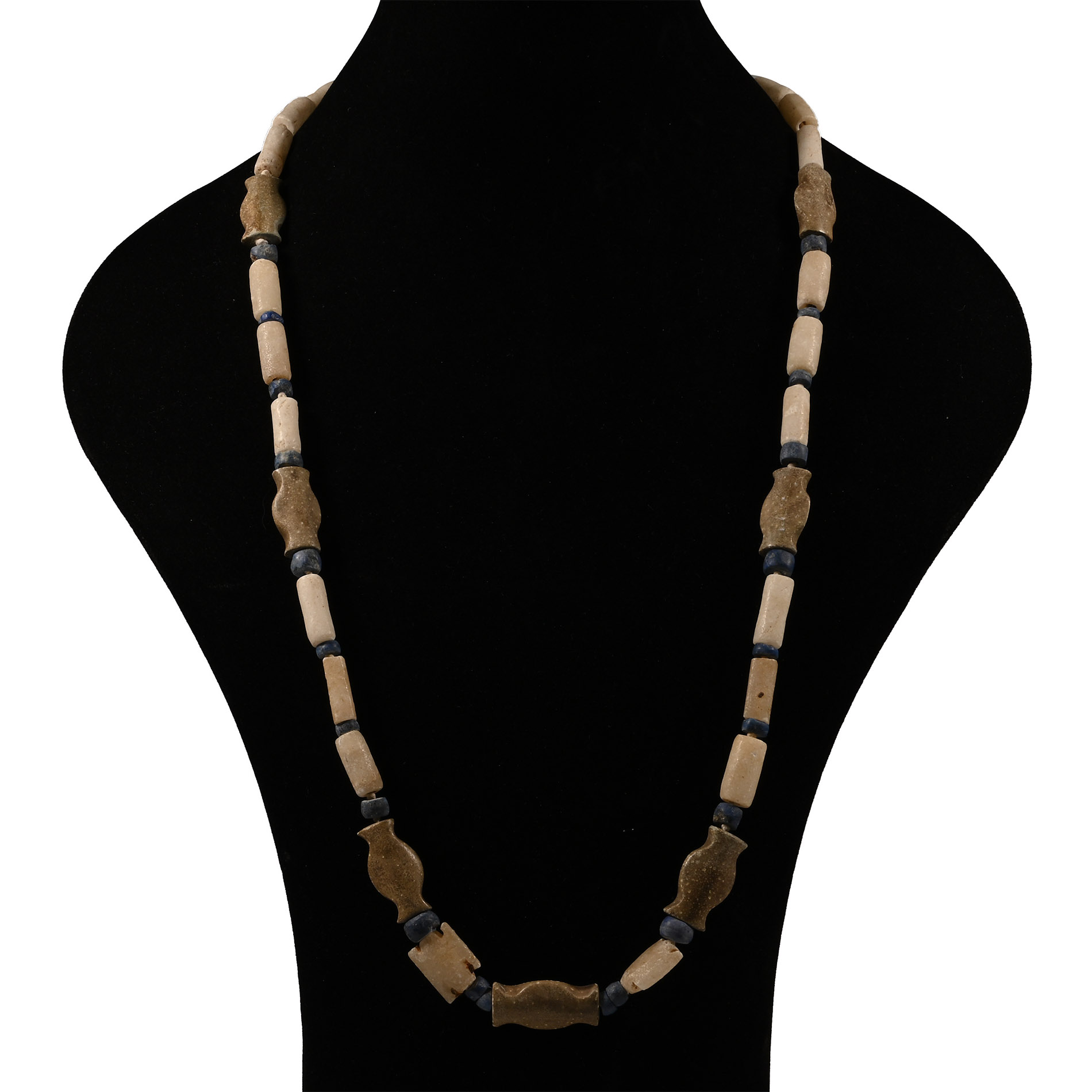
LOT 1315
Western Asiatic Lapis Lazuli and Alabaster Bead Necklace
1ST MILLENNIUM B.C.
32 1/4 in. (98 grams, 82 cm).
Restrung necklace of tubular stone beads with interstitial oblate lapis lazuli beads and lentoid-section beads with scooped edges.
ProvenanceFrom a Paris collection, France.
Ex French gallery, 1970-1990.
Accompanied by a previous cataloguing card.
TimeLine Auctions follows a vetting process to ensure the authenticity and legality of all items, reinforcing our commitment to integrity and responsible trading. Each antiquity, antique, and coin lot undergoes thorough examination by a vetting committee of at least ten external specialists, professional trade association members, scientists, and archaeologists: Our Vetting Process
AUCTIONS:
TimeLine is a leading auction house specialising in antiquities, ancient art, collectables, natural history, coins, medals, and books. Our auctions offer museums, collectors, historians, and enthusiasts the opportunity to acquire unique and historically significant pieces.
LOT 1315
Western Asiatic Lapis Lazuli and Alabaster Bead Necklace
Sold for (Inc. bp): £169
-
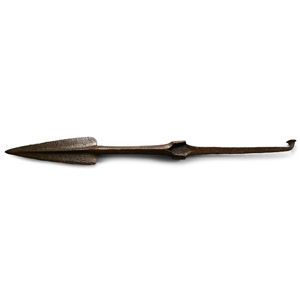
Western Asiatic Bronze Spearhead
19th century B.C.Estimate: £250 - 350 (+bp*)
Opening Bid: £130
With short ridged and tapered foliate blade, collared shaft and a square-section tapered tang bent at the tip. 190 grams, 33.5 cm
Acquired 1980-2015. Ex Abelita family collection.
A spearhead with stemmed tip was in use during the 3rd to first half of the 2nd millennium, in the Near and Middle East, in India, the Caucasus and Central Asia, and the main types developed in Mesopotamia in the middle of the 3rd millennium B.C. A facetted blade on a three-dimensional pin with a leaf-shaped blade on a flat handle, sometimes with holes for rivets, spread practically unchanged to the Caucasus and Bactria. -
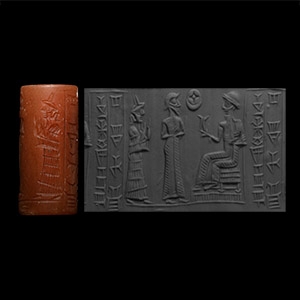
Mesopotamian Stone Cylinder Seal with Presentation Scene
2nd-1st millennium B.C. or laterSold for (Inc. bp): £1,170
With seated figure with one hand extended holding a vessel towards a standing bearded figure with fringed robe, and standing female in pointed headdress and flounced robe, both arms bent and hands raised; disc with crescent above, two columns of cuneiform text to the rear; supplied with a museum-quality impression. 8.6 grams, 28 mm
Ex S. collection, London, UK, 1980s-2000s. -
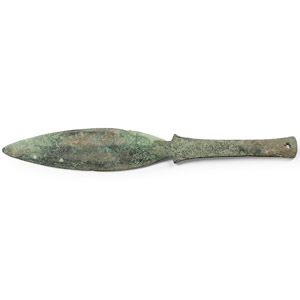
Central Asian Bronze Blade
12th-8th century B.C.Estimate: £100 - 140 (+bp*)
Opening Bid: £50
With elongated handle, hole for fixing organic material, guard with lateral projections and ogival blade with shallow central mid-rib. 154 grams, 27.5 cm
Acquired 1980-2015. Ex Abelita family collection.
