
Loading, please wait...
_900x900.jpg "Western Asiatic Integral Hilted Bronze Short Sword")
_200x200.jpg "Western Asiatic Integral Hilted Bronze Short Sword")
.jpg "Western Asiatic Integral Hilted Bronze Short Sword")
LOT 1792
Western Asiatic Integral Hilted Bronze Short Sword
LATE 3RD-2ND MILLENNIUM B.C.
17 1/8 in. (713 grams, 43.5 cm).
With a broad, lentoid-section flat blade, rounded tip, sloping sides, well marked shoulders with wide but short tang.
ProvenanceAcquired 1980-2015.
Ex Abelita family collection.
Cf. Inassa, M., 'Daggers in ancient Mesopotamia' in Journal of Archaeological Research and Studies, vol.2, March 2018, pp.1-27, fig.1, p.26.
FootnotesThe sword finds similarity with a one from the Royal Cemetery of Ur. This is the most primitive form of dagger, consisting of a simple, pointed blade having slightly convex outline shoulders sloping to a short tang which has no rivets, and was probably hafted to wood with bitumen.
CONDITIONTimeLine Auctions follows a vetting process to ensure the authenticity and legality of all items, reinforcing our commitment to integrity and responsible trading. Each antiquity, antique, and coin lot undergoes thorough examination by a vetting committee of at least ten external specialists, professional trade association members, scientists, and archaeologists: Our Vetting Process
AUCTIONS:
TimeLine is a leading auction house specialising in antiquities, ancient art, collectables, natural history, coins, medals, and books. Our auctions offer museums, collectors, historians, and enthusiasts the opportunity to acquire unique and historically significant pieces.
-
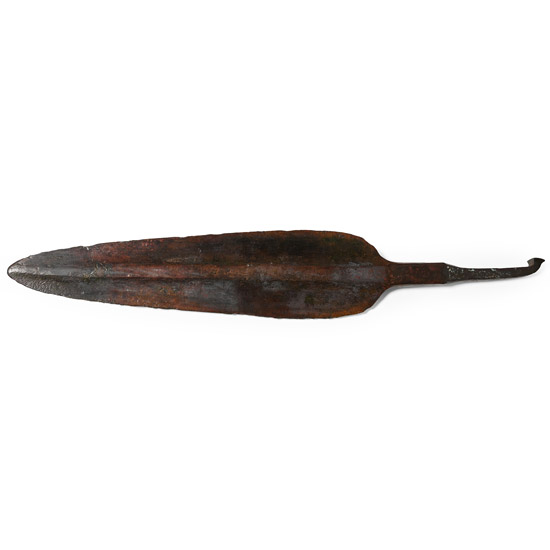
Western Asiatic Bronze Spear Blade
2nd-1st millennium B.C.Estimate: £200 - 300 (+bp*)
Opening Bid: £100
Comprising a triangular blade with a broad midrib, a short neck and a square-section tang with a bent finial. 309 grams, 32.6 cm
Ex Abelita family collection, 1980s-2000s. -
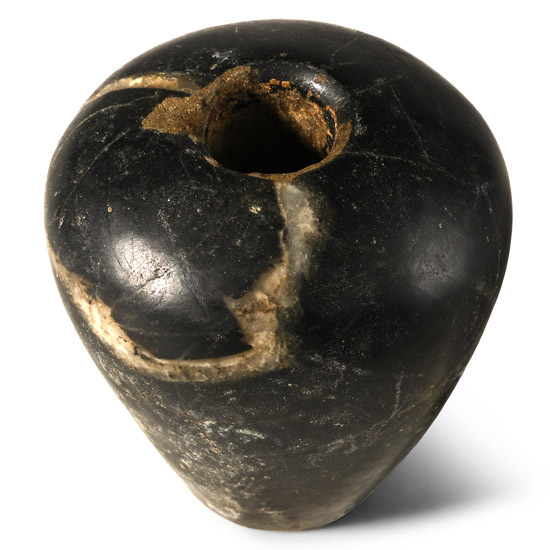
Western Asiatic Polished Stone Macehead
3rd-2nd millennium B.C.Sold for (Inc. bp): £117
Ovoid body with a round socket. 233 grams, 63 mm
From the collection of a London, UK, gentleman, 1990s. -
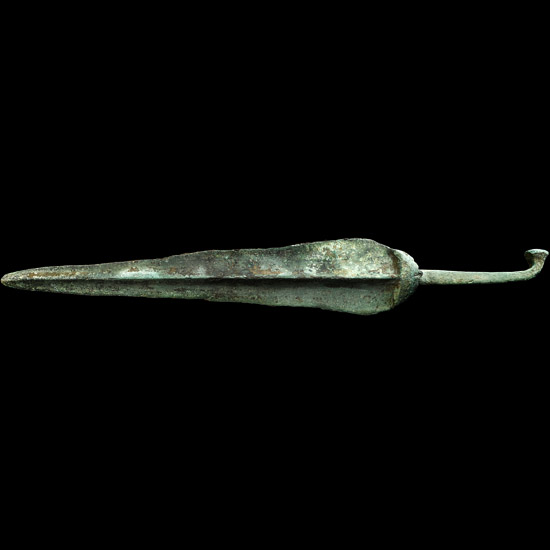
Western Asiatic Bronze Tanged Spearhead
Early 2nd millennium B.C.Sold for (Inc. bp): £182
Slender blade with raised midrib and rectangular-section tang with clubbed finial. 370 grams, 34 cm
Ex Abelita family collection, 1980s-2000s.
A certain number of similar blades, some considered to be spearheads and others to be daggers, all with bent tang, derived from Tepe Hissar Culture III. Some of them, like our specimen, have a button terminal, others have a plain, pointed terminal. The general dating of these specimens is fixed to the early 2nd millennium B.C.
