
Loading, please wait...

LOT 1591
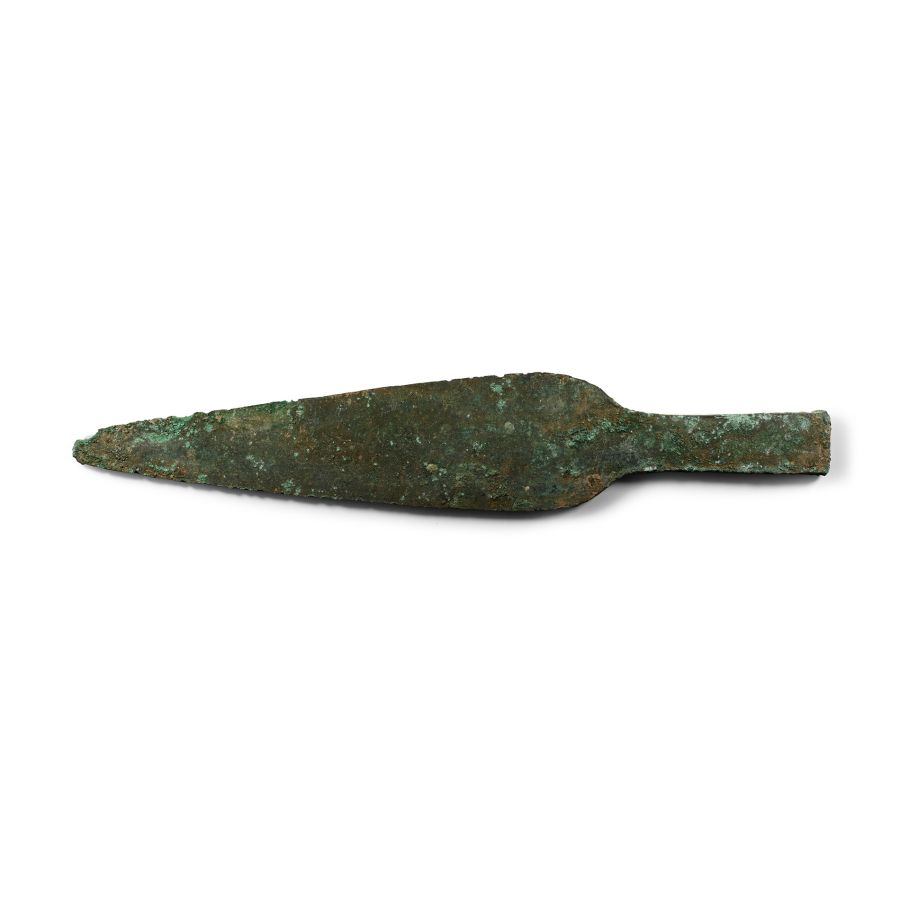
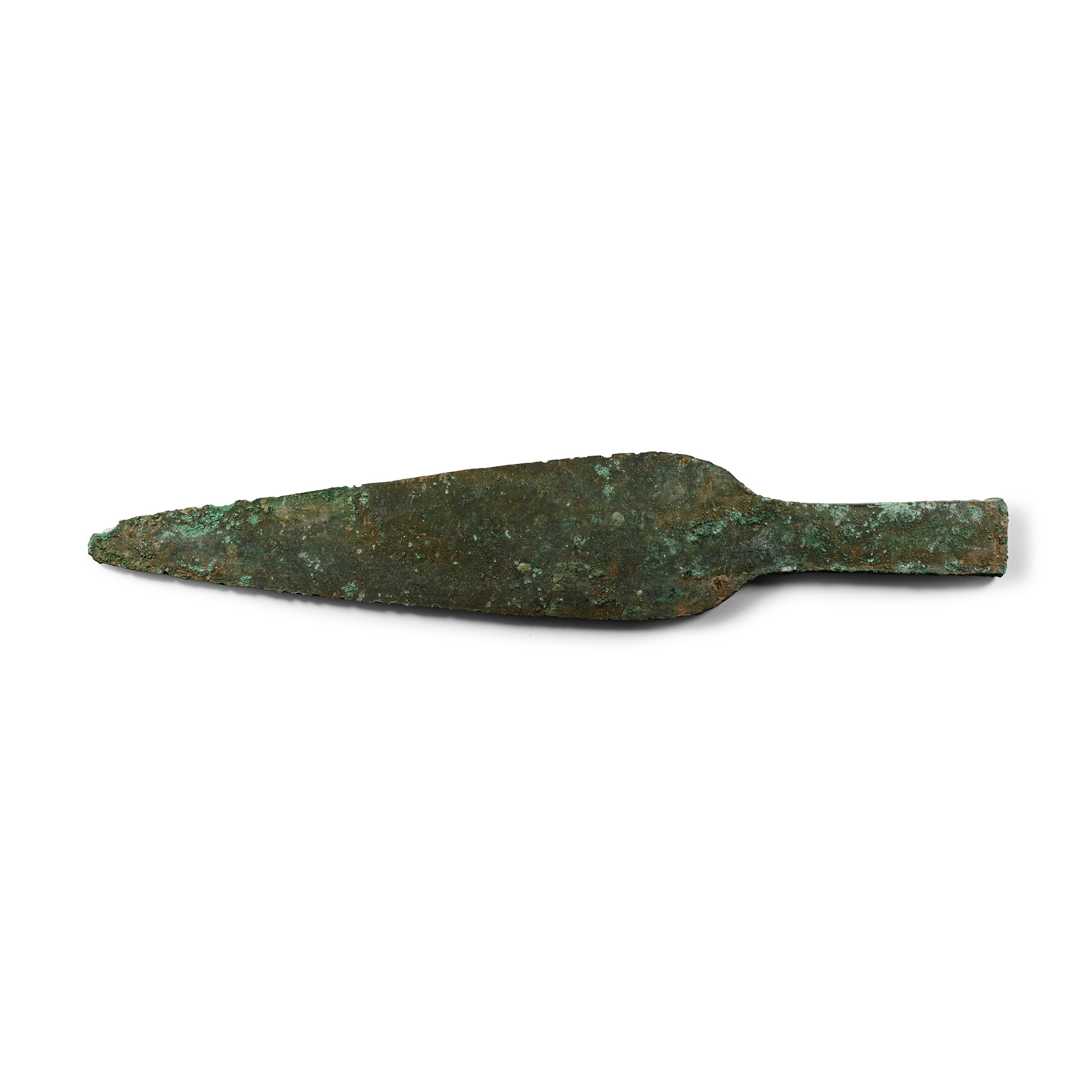
Western Asiatic Integral Hilted Bronze Short Sword
LATE 3RD-2ND MILLENNIUM B.C.
17 1/8 in. (713 grams, 43.5 cm).
With a broad, lentoid-section flat blade, rounded tip, sloping sides, well marked shoulders with wide but short tang.
ProvenanceAcquired 1980-2015.
Ex Abelita family collection.
This lot is accompanied by an illustrated lot declaration signed by the Head of the Antiquities Department, Dr Raffaele D’Amato.
Cf. Inassa, M., 'Daggers in ancient Mesopotamia' in Journal of Archaeological Research and Studies, vol.2, March 2018, pp.1-27, fig.1, p.26.
FootnotesThe sword finds similarity with a one from the Royal Cemetery of Ur. This is the most primitive form of dagger, consisting of a simple, pointed blade having slightly convex outline shoulders sloping to a short tang which has no rivets, and was probably hafted to wood with bitumen.
CONDITIONTimeLine Auctions follows a vetting process to ensure the authenticity and legality of all items, reinforcing our commitment to integrity and responsible trading. Each antiquity, antique, and coin lot undergoes thorough examination by a vetting committee of at least ten external specialists, professional trade association members, scientists, and archaeologists: Our Vetting Process
AUCTIONS:
TimeLine is a leading auction house specialising in antiquities, ancient art, collectables, natural history, coins, medals, and books. Our auctions offer museums, collectors, historians, and enthusiasts the opportunity to acquire unique and historically significant pieces.
LOT 1591
Western Asiatic Integral Hilted Bronze Short Sword
Estimate £250 - 350€290 - 410 (for guidance only)$340 - 470 (for guidance only)
-
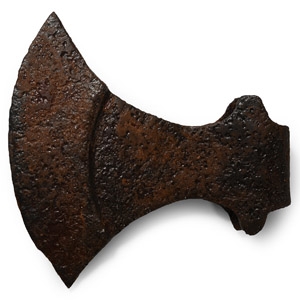
Viking Age Iron Broad Axehead
Circa 9th-12th century A.D.Sold for (Inc. bp): £182
With a curving reinforced blade, narrow socket with lateral spurs. 303 grams, 13 cm
Ex North American private collection, 1970s-1990s. This lot is accompanied by an illustrated lot declaration signed by the Head of the Antiquities Department, Dr Raffaele D’Amato. -
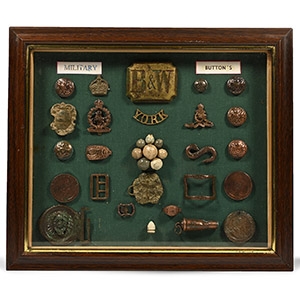
Post Medieval Cased 'Manchester Area' Militaria and Other Artefact Collection
18th-20th century A.D.Sold for (Inc. bp): £33
Including cap badges, cartwheel pennies, snake-buckle, buttons and other items, mounted in a glazed wooden frame. 1.1 kg, 29.5 x 35 cm
From the private collection of a Manchester, UK, detectorist, 1990s. This lot is accompanied by an illustrated lot declaration signed by the Head of the Antiquities Department, Dr Raffaele D’Amato. -
.jpg)
Viking Battle Axe Head with Silver Inlays
Northern Europe, 9th-11th century A.D.Sold for (Inc. bp): £8,970
With short, cylindrical socket to rear, narrow neck, flared blade with curved cutting edge; underside of the blade swept in a gentle curve; short flanges above and below the rear of the socket; decorated overall with finely engraved silver inlays forming two dragons and interlace patterns (probably not original); provided with a display stand. 390 grams, 15.7 cm (813 grams total, 26.2 cm high including stand)
Acquired 1982 in Kaliningrad and transported to Riga in 1986, moved to East Berlin in 1988, and again to Germany in 2000, then UK in 2014. Ex West London collection. Accompanied by a copy of an Art Loss Register certificate no.S00141022. Accompanied by an academic report by Dr Raffaele D'Amato. This lot has been checked against the Interpol Database of stolen works of art and is accompanied by search certificate number no.12476-228759. This lot has been cleared against the Art Loss Register database, and is accompanied by an illustrated lot declaration signed by the Head of the Antiquities Department, Dr Raffaele D’Amato.
