
Loading, please wait...

LOT 1440
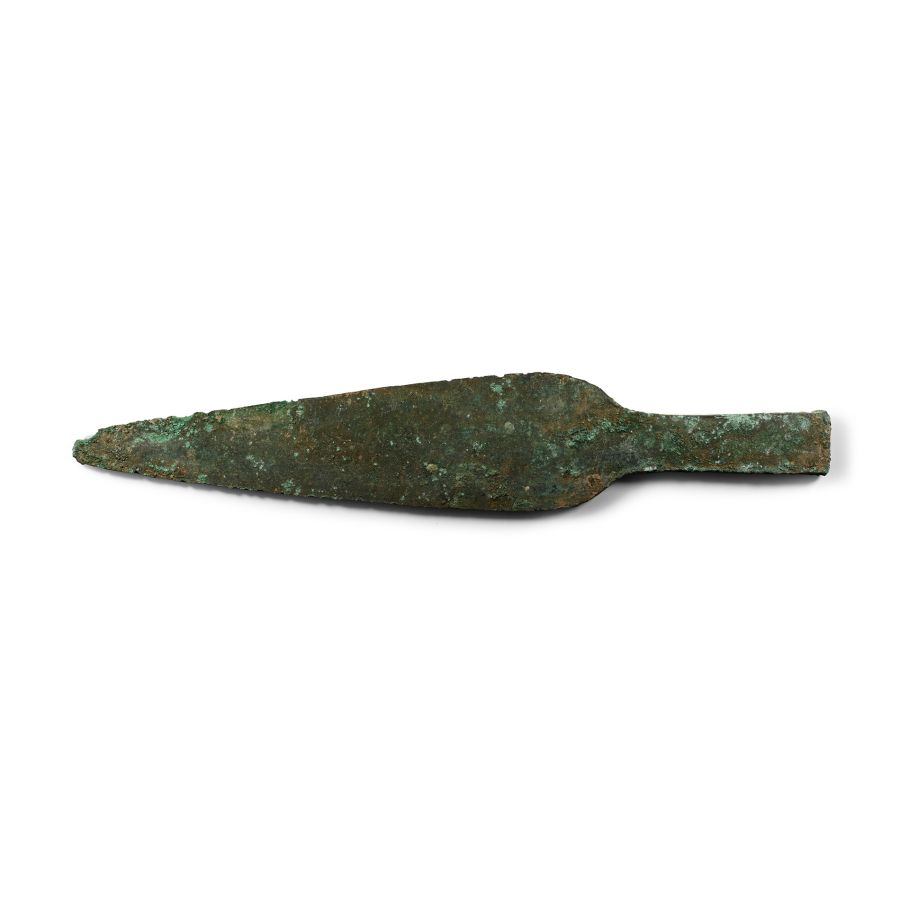
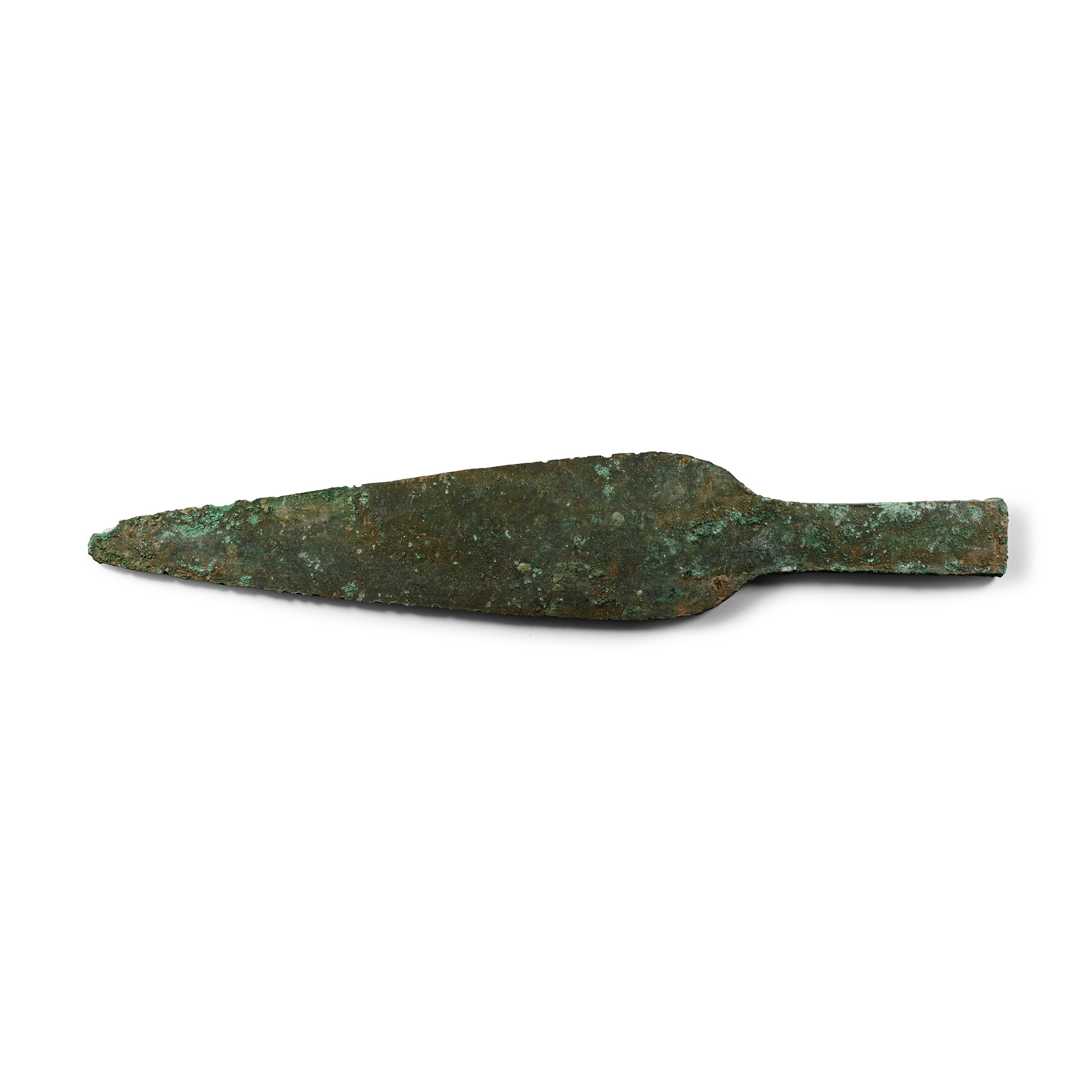
Western Asiatic Integral Hilted Bronze Short Sword
LATE 3RD-2ND MILLENNIUM B.C.
17 1/8 in. (713 grams, 43.5 cm).
With a broad, lentoid-section flat blade, rounded tip, sloping sides, well marked shoulders with wide but short tang.
ProvenanceAcquired 1980-2015.
Ex Abelita family collection.
Cf. Inassa, M., 'Daggers in ancient Mesopotamia' in Journal of Archaeological Research and Studies, vol.2, March 2018, pp.1-27, fig.1, p.26.
FootnotesThe sword finds similarity with the one from the Royal Cemetery of Ur. This is the most primitive form of dagger, consisting of a simple, pointed blade having slightly convex outline shoulders sloping to a short tang which has no rivets, and was probably hafted to wood with bitumen.
CONDITIONTimeLine Auctions follows a vetting process to ensure the authenticity and legality of all items, reinforcing our commitment to integrity and responsible trading. Each antiquity, antique, and coin lot undergoes thorough examination by a vetting committee of at least ten external specialists, professional trade association members, scientists, and archaeologists: Our Vetting Process
AUCTIONS:
TimeLine is a leading auction house specialising in antiquities, ancient art, collectables, natural history, coins, medals, and books. Our auctions offer museums, collectors, historians, and enthusiasts the opportunity to acquire unique and historically significant pieces.
LOT 1440
Western Asiatic Integral Hilted Bronze Short Sword
Estimate £250 - 350€290 - 410 (for guidance only)$340 - 470 (for guidance only)
-
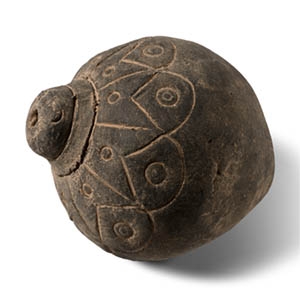
Byzantine 'Greek Fire' Ceramic Fire Bomb or Hand Grenade
9th-11th century A.D.Sold for (Inc. bp): £208
Piriform missile with domed filler-hole, tongue-shaped petals radiating from the filler-hole, each with an annulet and a ring-and-dot motif, intended to be filled with explosive liquid and wick, used as a hand grenade. 448 grams, 10.7 cm
From a specialist London, UK, arms and armour collection, 1990s. Accompanied by an academic paper by military specialist Dr Raffaele D'Amato, dated 15 July 2019 and titled 'Eastern Roman Empire - Greek Fire Bomb or Hand Grenade (μεσαίον kακάβιον) 9th-11th century AD'.
Apart from the use of siphons or manual flame-throwers called cheirosiphona, special corps of Roman soldiers employed terracotta grenades, in the form of small jars, abundantly evidenced in archaeological excavations. They were called μεσαία kακαβιά or κυτροκακάβια where the former had a bulbous shape and the latter a more cylindrical form. -
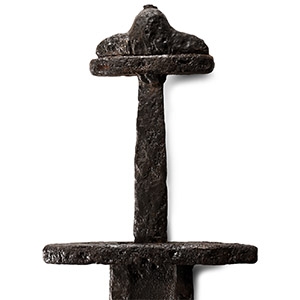
Viking Iron Sword with Three-Lobed Pommel
10th-11th century A.D.Sold for (Inc. bp): £3,510
Comprising a two-edged blade with broad fuller and rounded tip, narrow lower guard with rounded outer ends, broad tang, lobed pommel of Type U with cocked-hat profile and lower guard, traces of silvering. 848 grams, 92 cm
From the private collection of a London gentleman, from his grandfather's collection formed before the early 1970s. Accompanied by an academic report by Dr Raffaele D’Amato. This lot has been checked against the Interpol Database of stolen works of art and is accompanied by search certificate number no.12356-225922.
Petersen considered this type of Viking sword similar to the previous types R and S, but with differences in the pommel and cross-guard. The traces of silver ornaments on the guard and pommel are artistically consistent with archaeological examples of decorative work from the geographic region or estimated cultural point of origin, probably Eastern Scandinavia or the Baltic areas. -
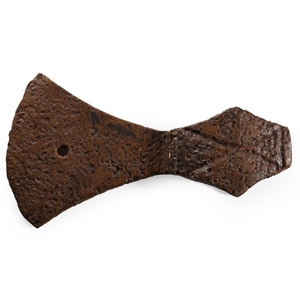
Viking Age Pierced Iron Axehead
Circa 9th-11th century A.D.Sold for (Inc. bp): £169
With broad blade and curved edge, stepped shoulder to the socket with lateral flanges and hammer-face to rear; blade with circular hole behind the edge. 265 grams, 14.8 cm
Ex North American collection, 1970s-1990s.
