
Loading, please wait...
LOT 0230
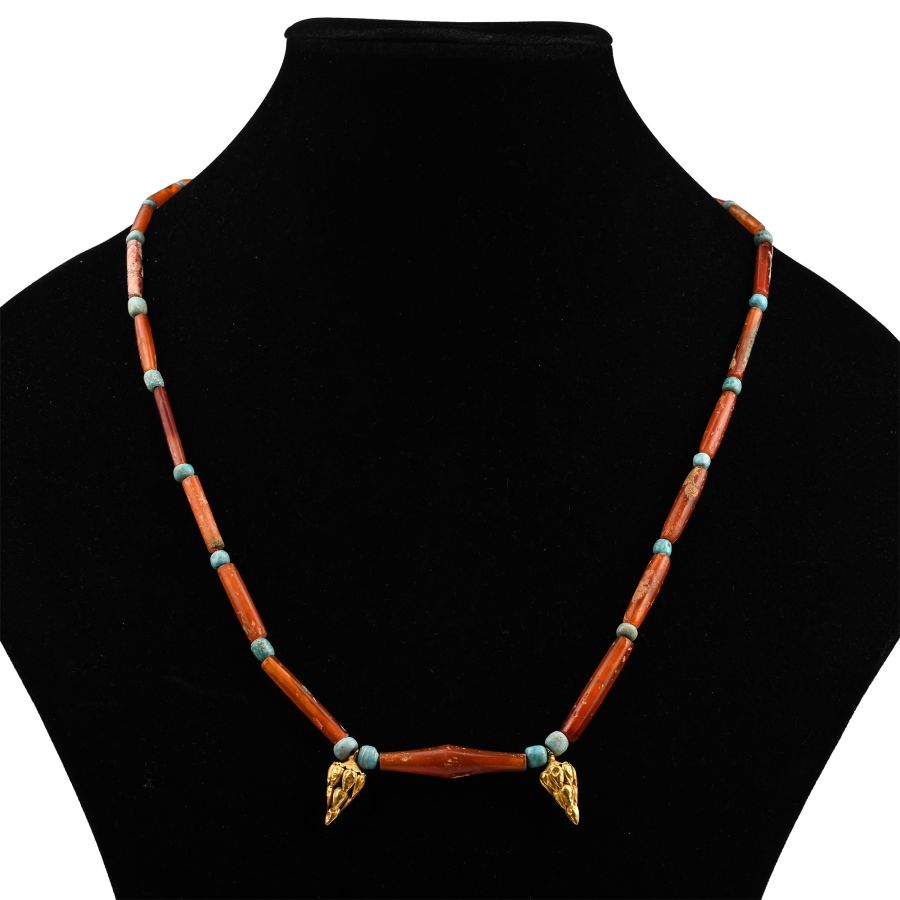
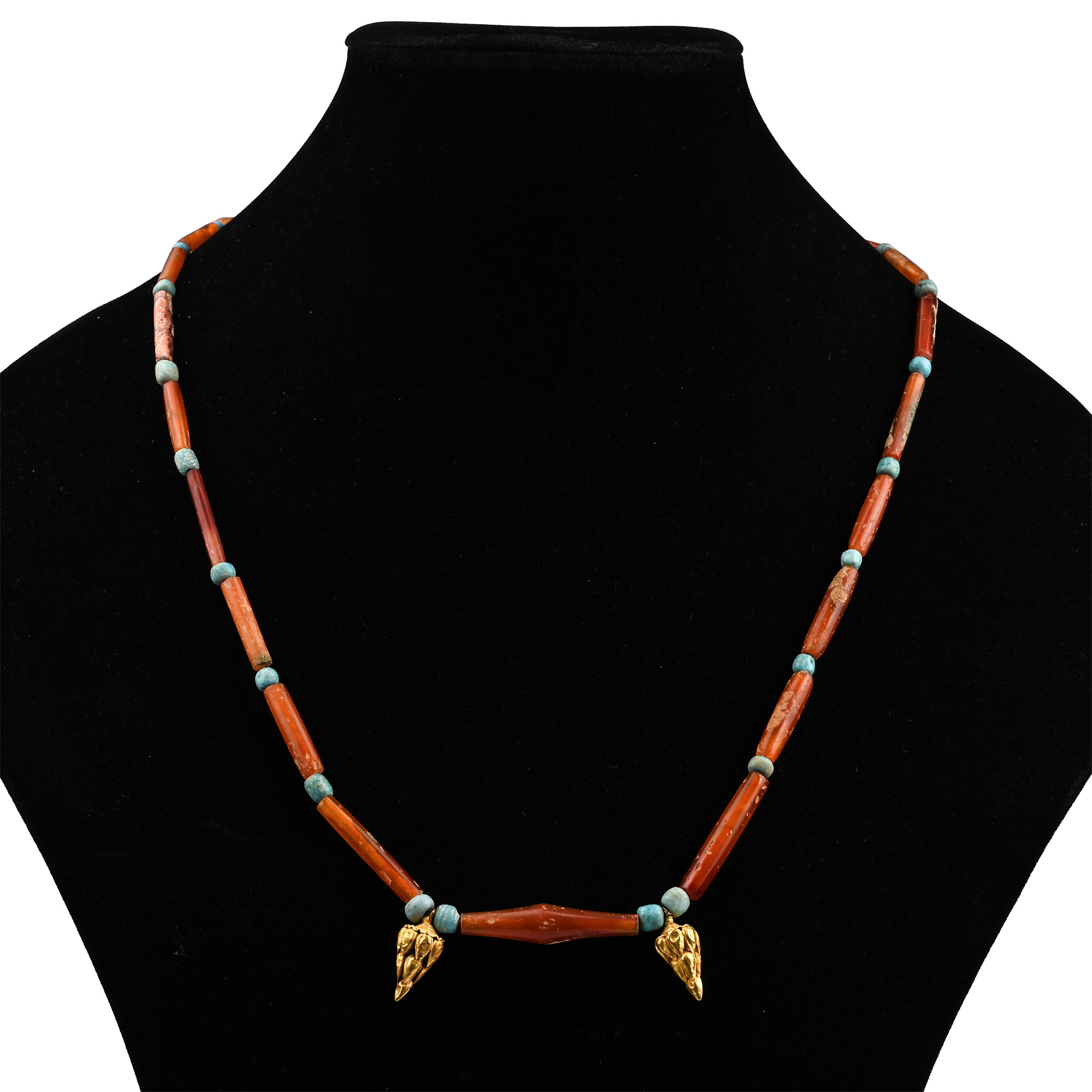
Western Asiatic Gold Necklace with Carnelian Beads and Gold Grape Pendants
1ST-2ND CENTURY A.D.
23 3/8 in. (26.12 grams, 59.5 cm).
Restrung group of tubular carnelian beads and turquoise spacer beads, with biconical centrepiece and two hollow-formed gold cluster drops.
ProvenanceAcquired before 1983.
Ex London gallery, 1990s.
Private collection, London, UK.
TimeLine Auctions follows a vetting process to ensure the authenticity and legality of all items, reinforcing our commitment to integrity and responsible trading. Each antiquity, antique, and coin lot undergoes thorough examination by a vetting committee of at least ten external specialists, professional trade association members, scientists, and archaeologists: Our Vetting Process
AUCTIONS:
TimeLine is a leading auction house specialising in antiquities, ancient art, collectables, natural history, coins, medals, and books. Our auctions offer museums, collectors, historians, and enthusiasts the opportunity to acquire unique and historically significant pieces.
LOT 0230
Western Asiatic Gold Necklace with Carnelian Beads and Gold Grape Pendants
Estimate £1,000 - 1,400€1,160 - 1,620 (for guidance only)$1,350 - 1,890 (for guidance only)
-
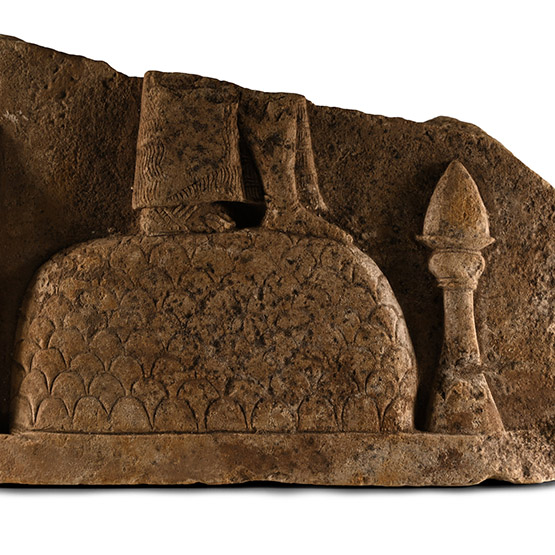
Neo-Assyrian Stone Relief with Standing Figure
9th-8th century B.C.Sold for (Inc. bp): £3,900
Corner fragment from a high-relief pictorial panel with raised border; domed dais with low-relief scaled detailing; lower legs and sandaled feet in advancing pose with ankle-length open-fronted robe, horizontal woven texture and curled fleece; high-relief stele with flared base, bulbous upper and sugar-loaf finial; pitted surface, with tooling to reverse. 2.81 kg, 24.3 cm
Ex German collection, c.1980. with Toufic Arakji, Hamburg, 1997. Private collection, Europe. Accompanied by an academic report by Dr Raffaele D'Amato. This lot has been checked against the Interpol Database of stolen works of art and is accompanied by search certificate no.12579-232134.
Stylistically, the figure seems to be linked to the kingdom of Ashurnasirpal II (883-859 B.C.) or his son Shalmaneser III (858-824 B.C.). The exposed lower leg with exaggerated musculature is seen in many Assyrian and Babylonian depictions of divine and heroic figures. The position of the figure, corresponding to some reliefs kept in the Louvre, where a spirit is worshipping a poppy flower (Houston, 1954, pl.V.1), and the high-relief carving, strongly refer to a cult scene. -
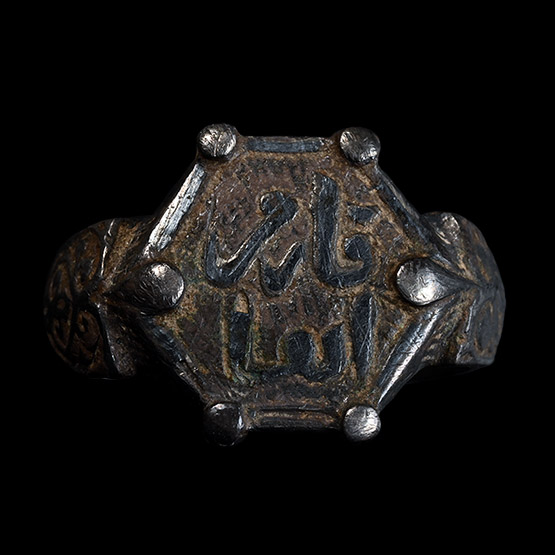
Western Asiatic Silver Ring with Niello
12th-13th century A.D. or laterSold for (Inc. bp): £455
With carinated hoop, heater-shaped plaques to the shoulders, hexagonal bezel with pellet to each angle and reserved calligraphic legend. 9.03 grams, 23.84 mm overall, 19.40 mm internal diameter (approximate size British P, USA 7 1/2, Europe 16.23, Japan 15)
From a central European collection. Mr S.A., acquired in 1992. Thence by descent, family collection, since the late 1990s. -
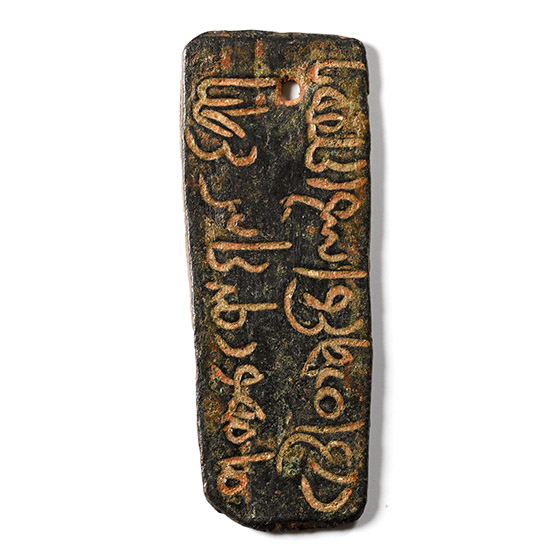
Personal Bronze Tag of Zahra Governor of Esphahan
14th century A.D.Sold for (Inc. bp): £364
A medieval period flat-section rectangular plaque pierced at the broad end with incised calligraphic legend: 'Zahra the splendid or the radiant governor of Esphahan ...', Zaraa or Zahra is a female name which also refers to boundless beauty (ذرع اصفهانی واسع الخلیفه با ما معمور). 10.6 grams, 51 mm
From the collection of a gentleman, acquired on the London art market in the 1990s.
