
Loading, please wait...
_900x900.jpg "Western Asiatic Gold Necklace with Agate Beads")
_200x200.jpg "Western Asiatic Gold Necklace with Agate Beads")
_900x900.jpg "Western Asiatic Gold Necklace with Agate Beads")
_200x200.jpg "Western Asiatic Gold Necklace with Agate Beads")
.jpg "Western Asiatic Gold Necklace with Agate Beads")
.jpg "Western Asiatic Gold Necklace with Agate Beads")
LOT 0267
Western Asiatic Gold Necklace with Agate Beads
3000-2800 B.C.
31 1/2 in. (163 grams, 80 cm long).
Restrung necklace of agate beads and flat leaf-shaped gold plaques with oblate carnelian spacers.
ProvenanceAcquired in the late 1980s-early 1990s.
Important North West London collection.
Accompanied by a copy of a French cultural passport no.229806.
This lot has been checked against the Interpol Database of stolen works of art and is accompanied by search certificate no.11968-210482.
TimeLine Auctions follows a vetting process to ensure the authenticity and legality of all items, reinforcing our commitment to integrity and responsible trading. Each antiquity, antique, and coin lot undergoes thorough examination by a vetting committee of at least ten external specialists, professional trade association members, scientists, and archaeologists: Our Vetting Process
AUCTIONS:
TimeLine is a leading auction house specialising in antiquities, ancient art, collectables, natural history, coins, medals, and books. Our auctions offer museums, collectors, historians, and enthusiasts the opportunity to acquire unique and historically significant pieces.
LOT 0267
Western Asiatic Gold Necklace with Agate Beads
Estimate £10,000 - 14,000€11,600 - 16,240 (for guidance only)$13,500 - 18,900 (for guidance only)
-

Assyrian Clay Cuneiform Brick
13th century B.C.Sold for (Inc. bp): £4,420
Roughly tabular and bearing impressed cuneiform text arranged in vertical columns to five of its six faces. 682 grams, 17.5 cm
Ex French art market. with Boisgirard & Associés, Paris, 14 February 2005, lot 246. Private Swiss collection since 2005. This lot has been checked against the Interpol Database of stolen works of art and is accompanied by search certificate no.11638-198993. -
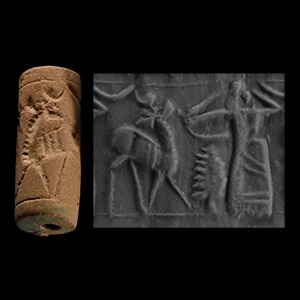
Western Asiatic Frit Cylinder Seal with Hunting Scene
2nd-1st millennium B.C.Sold for (Inc. bp): £208
With incised design of a standing figure in fringed garment drawing his bow against an antelope, fronds in the field. 11 grams, 37 mm
Acquired 1970s-1996. Property of a North American collector; collection no.072. London collection, 2016. -
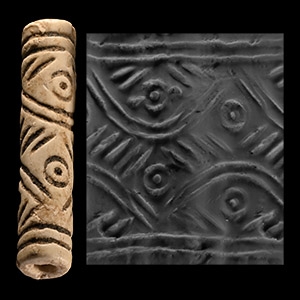
Western Asiatic Stone Geometric Cylinder Seal
Circa 3rd millennium B.C.Sold for (Inc. bp): £130
With geometric pattern of concentric lines and pellets. 8.12 grams, 52 mm
Acquired 1970s-1996. Property of a North American collector, collection no.073. London collection, 2016.
