
Loading, please wait...
LOT 1365
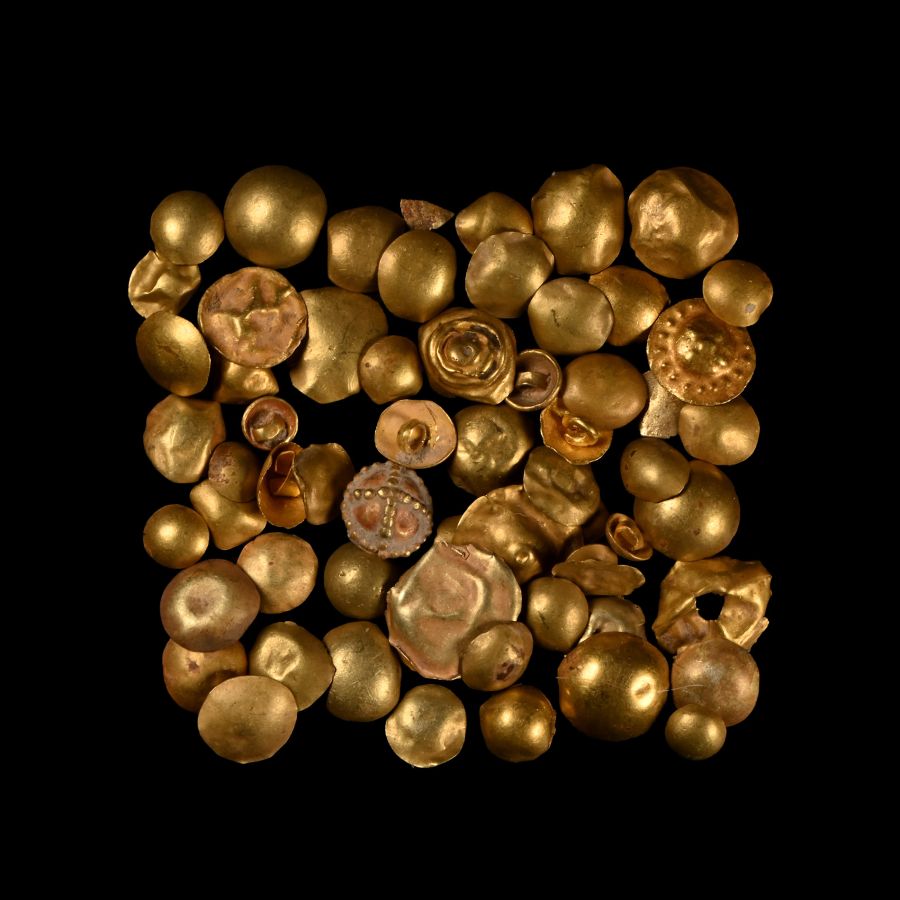
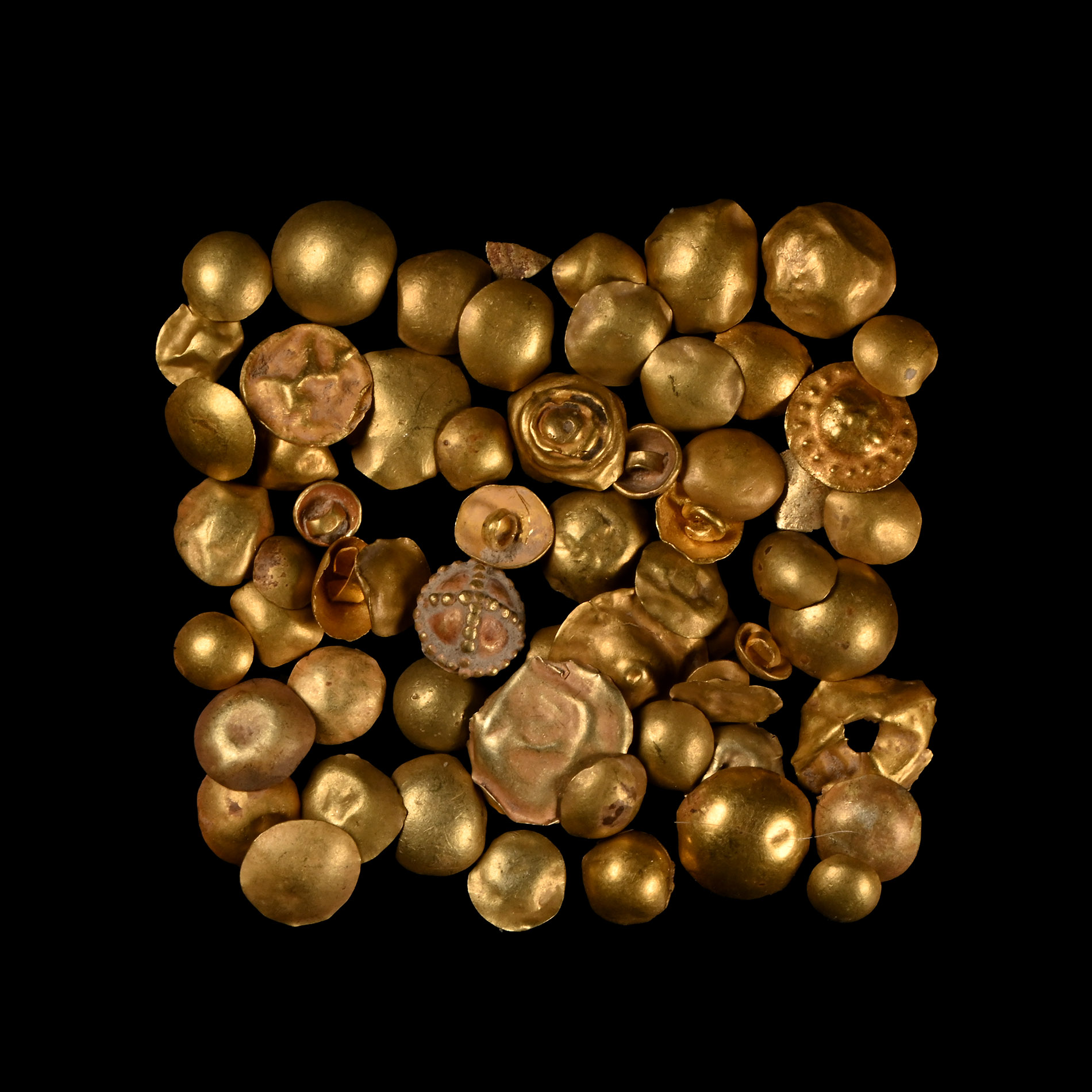
Western Asiatic Gold Looped Bead and Mount Group
1ST MILLENNIUM B.C. AND LATER
1/8 - 3/8 in. (5.58 grams total, 3-7 mm).
Mainly comprising domed sheet-gold beads or mounts, each with a loop to the reverse. [62]
ProvenanceEx property of a late Japanese collector, 1970-2000s.
This lot has been cleared against the Art Loss Register database, and is accompanied by an illustrated lot declaration signed by the Head of the Antiquities Department, Dr Raffaele D'Amato.
TimeLine Auctions follows a vetting process to ensure the authenticity and legality of all items, reinforcing our commitment to integrity and responsible trading. Each antiquity, antique, and coin lot undergoes thorough examination by a vetting committee of at least ten external specialists, professional trade association members, scientists, and archaeologists: Our Vetting Process
AUCTIONS:
TimeLine is a leading auction house specialising in antiquities, ancient art, collectables, natural history, coins, medals, and books. Our auctions offer museums, collectors, historians, and enthusiasts the opportunity to acquire unique and historically significant pieces.
-
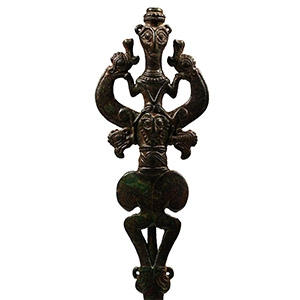
Luristan Bronze 'Master of Animals' Finial
8th-7th century B.C.Sold for (Inc. bp): £2,470
A bifacial sceptre head formed as a Master of Animals atop a collared tubular stem with flared foot; the finial composed of two addorsed birds standing on their backs looking up towards two birds' heads facing down and joined to slender crescentic arms representing slender beasts with ridged backs and roaring mouths, each in the grip of the Master standing crowned between them; the Master with tubular body, animal-like ears, prominent nose above a small mouth and wearing collars, neck rings and tiered headdress; waisted socket below; mounted on a display stand. 399 grams, 32.3 cm (526 grams total, 34.5 cm including stand)
Acquired between 1965-2020. Private collection, London. This lot has been cleared against the Art Loss Register database, and is accompanied by an illustrated lot declaration signed by the Head of the Antiquities Department, Dr Raffaele D'Amato.
The small head belongs to the tubular idols with protomes of second type of ‘Master of Animals’, probably being a finial standard. This type, according to Chausidis, came to be with the gradual transformation of the ‘zoomorphic standards with a human head, whereby the front legs of the animals became integrated into the tubular pillar of the standards. It gradually began to be cast with the other elements, representing the neck and torso of the central anthropomorphic character that retained the two-faced feature of the previous type. The necks and heads of the animal pair separated from the rest of their bodies, which, in turn, gradually lost their original form and acquired new meanings. -

Bactrian Stone Bowl with Two Lions and Female Figure
3rd-2nd millennium B.C.Sold for (Inc. bp): £7,800
Drum-shaped steatite vessel with reserved frieze to the outer face: two lions advancing, each preceded by a rectangle with incised grid; seated female with long hair and fur-textured garment, offering a fruit to the first lion; palm tree to her rear; shallow socket to each of the eyes and the female's chest to accept an inlay panel. 695 grams, 11.7 cm
Acquired from a gallery in France, held in the UK since 1982, thence by descent. Private collection, London. This lot has been checked against the Interpol Database of stolen works of art and is accompanied by a search certificate number no.12557-230774. This lot has been cleared against the Art Loss Register database, and is accompanied by an illustrated lot declaration signed by the Head of the Antiquities Department, Dr Raffaele D'Amato. -
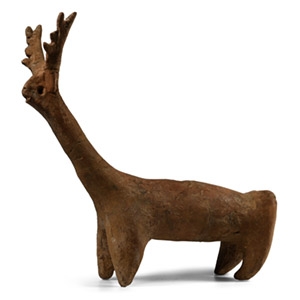
Amlash Terracotta Rhyton
2nd-1st millennium B.C.Sold for (Inc. bp): £572
In the form of a standing stag with tubular body, flared rump with pendant tail, four stub legs, large crescentic antlers, flat muzzle, and dimpled eyes, filling hole to middle of back, small spout at mouth. 825 grams, 24.3 cm wide
with a London, UK gallery 1971-early 2000s. Private collection, London. This lot has been cleared against the Art Loss Register database, and is accompanied by an illustrated lot declaration signed by the Head of the Antiquities Department, Dr Raffaele D'Amato.
