
Loading, please wait...
_900x900.jpg "Western Asiatic Gold and Carnelian Bead Necklace")
_200x200.jpg "Western Asiatic Gold and Carnelian Bead Necklace")
.jpg "Western Asiatic Gold and Carnelian Bead Necklace")
LOT 1110
Western Asiatic Gold and Carnelian Bead Necklace
1ST MILLENNIUM B.C. AND LATER
16 3/4 in. (56.8 grams, 42.5 cm long).
Comprising a graduated group of tabular carnelian beads with interstitial collars of gold granulation and some moulded glass hexagonal tabular-shaped beads; centrepiece a biconvex oval with speckled surface; restrung.
ProvenanceEx property of the late Mr S.M., London, UK, 1970-1990s, thence by descent.
Accompanied by a previous cataloguing card.
This lot has been cleared against the Art Loss Register database, and is accompanied by an illustrated lot declaration signed by the Head of the Antiquities Department, Dr Raffaele D'Amato.
TimeLine Auctions follows a vetting process to ensure the authenticity and legality of all items, reinforcing our commitment to integrity and responsible trading. Each antiquity, antique, and coin lot undergoes thorough examination by a vetting committee of at least ten external specialists, professional trade association members, scientists, and archaeologists: Our Vetting Process
AUCTIONS:
TimeLine is a leading auction house specialising in antiquities, ancient art, collectables, natural history, coins, medals, and books. Our auctions offer museums, collectors, historians, and enthusiasts the opportunity to acquire unique and historically significant pieces.
-
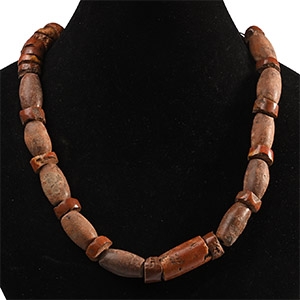
Ceramic and Stone Bead Necklace String
20th century A.D.Sold for (Inc. bp): £13
Comprising large ellipsoid beads interspersed with roughly annular beads; restrung. 168 grams, 45 cm
Ex collection of a late London gentleman, 1970-1990s. This lot has been cleared against the Art Loss Register database, and is accompanied by an illustrated lot declaration signed by the Head of the Antiquities Department, Dr Raffaele D'Amato. -
.jpg)
Old Babylonian Haematite Cylinder Seal
2nd millennium B.C.Sold for (Inc. bp): £442
Frieze depicting a kneeling huntsman with inverted spear and khopesh facing a rampant ibex with head turned away, crouching gryphon with forelegs raised, bird in flight preying on a recumbent ibex; supplied with a museum-quality impression. 3.24 grams, 15 mm
From the 'S' collection, acquired 1970-1990s. The collection was seen and studied by W.G.Lambert, late Professor of Assyriology at the University of Birmingham, 1970-1993. This lot has been cleared against the Art Loss Register database, and is accompanied by an illustrated lot declaration signed by the Head of the Antiquities Department, Dr Raffaele D'Amato. -
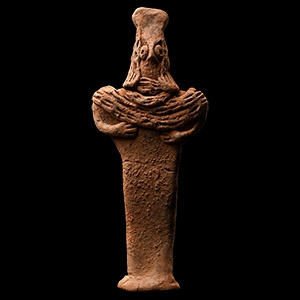
Syro-Hittite Terracotta Fertility Figure
1500-900 B.C. or laterSold for (Inc. bp): £234
Standing female deity (Astarte?), wearing a long robe and a broad textured necklace; arms bent and hands placed on the abdomen; beaked facial features with applied eyes and single spur to the rear. 158 grams, 18.5 cm
Acquired in Paris, France, in 1988. From the collection of G.M.R.H., London, UK. This lot has been cleared against the Art Loss Register database, and is accompanied by an illustrated lot declaration signed by the Head of the Antiquities Department, Dr Raffaele D'Amato.
