Loading, please wait...

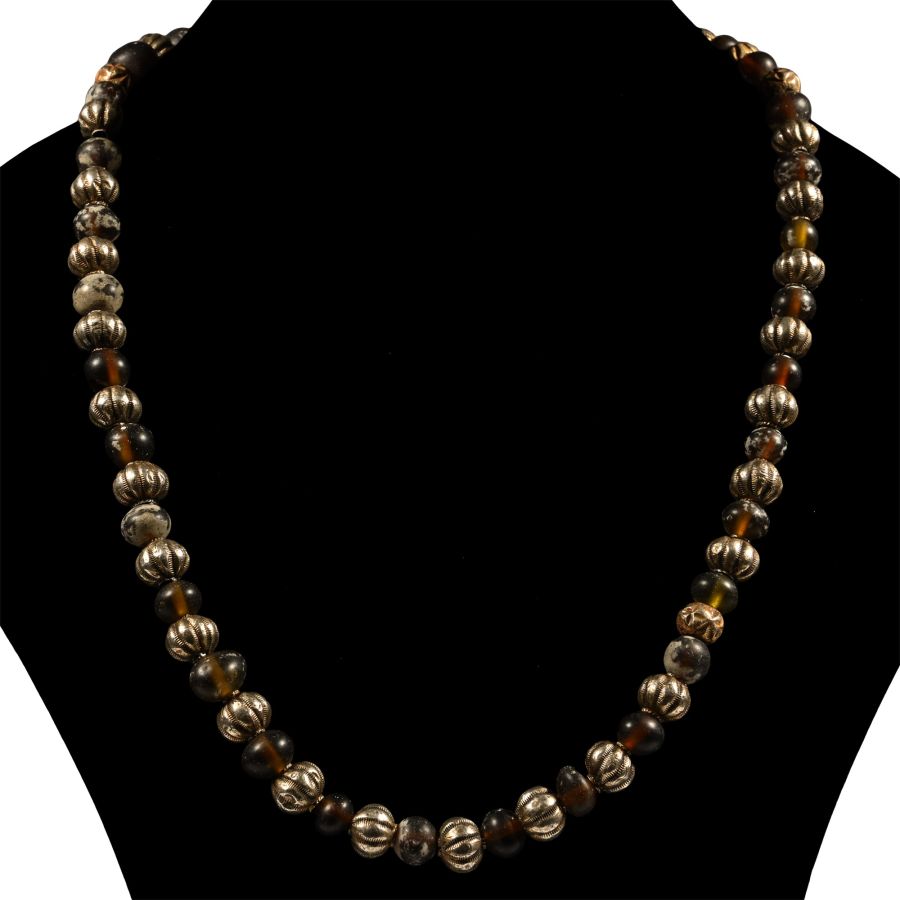
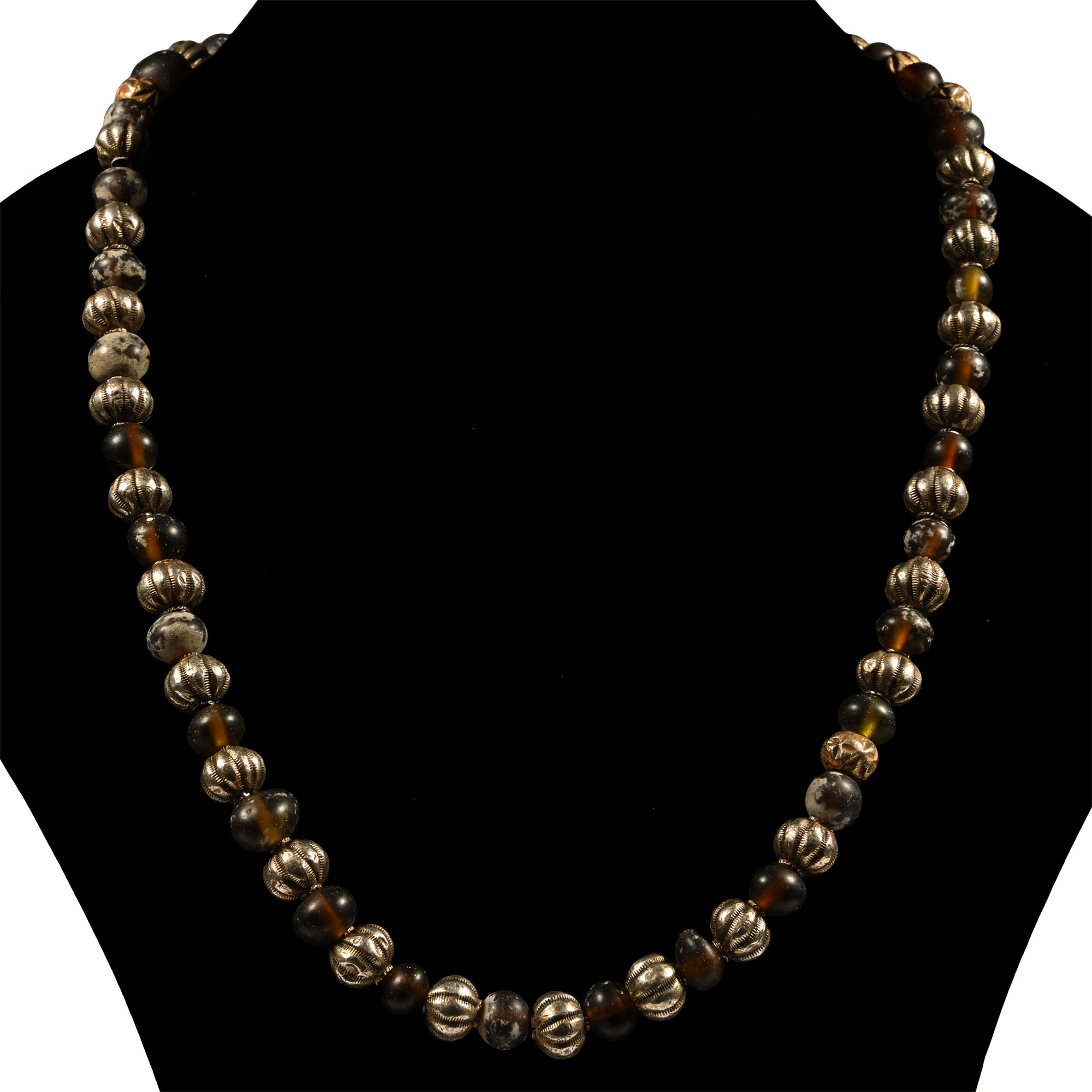
Western Asiatic Glass and Silver Bead Necklace Western Asiatic Glass and Silver Bead Necklace Western Asiatic Glass and Silver Bead Necklace
Use mousewheel to zoom in and out, click to enlarge
Details

LOT 1431

Western Asiatic Glass and Silver Bead Necklace

1ST MILLENNIUM A.D. AND LATER

22 5/8 in. (94 grams, 57.5 cm).

Restrung, composed of brown oblate glass beads with silver melon beads between; garnet and blue glass spool-shaped bead finials. [No Reserve]

Provenance

Previously acquired on the UK art market in the 1990s.
Ex property of a London, UK, gentleman.
Property of a Californian, USA, collector.
This lot has been cleared against the Art Loss Register database, and is accompanied by an illustrated lot declaration signed by the Head of the Antiquities Department, Dr Raffaele D'Amato.

CONDITION
VETTING:

TimeLine Auctions follows a vetting process to ensure the authenticity and legality of all items, reinforcing our commitment to integrity and responsible trading. Each antiquity, antique, and coin lot undergoes thorough examination by a vetting committee of at least ten external specialists, professional trade association members, scientists, and archaeologists: Our Vetting Process


AUCTIONS:

TimeLine is a leading auction house specialising in antiquities, ancient art, collectables, natural history, coins, medals, and books. Our auctions offer museums, collectors, historians, and enthusiasts the opportunity to acquire unique and historically significant pieces.

LOT 1431

Western Asiatic Glass and Silver Bead Necklace

Sold for (Inc. bp): £85

Print page

RELATED LOTS
  • Bactrian Stone Bowl with Two Lions and Female Figure
    Bactrian Stone Bowl with Two Lions and Female Figure
    3rd-2nd millennium B.C.

    Sold for (Inc. bp): £7,800

    Drum-shaped steatite vessel with reserved frieze to the outer face: two lions advancing, each preceded by a rectangle with incised grid; seated female with long hair and fur-textured garment, offering a fruit to the first lion; palm tree to her rear; shallow socket to each of the eyes and the female's chest to accept an inlay panel. 695 grams, 11.7 cm


    Acquired from a gallery in France, held in the UK since 1982, thence by descent. Private collection, London. This lot has been checked against the Interpol Database of stolen works of art and is accompanied by a search certificate number no.12557-230774. This lot has been cleared against the Art Loss Register database, and is accompanied by an illustrated lot declaration signed by the Head of the Antiquities Department, Dr Raffaele D'Amato.

    Lot Details

  • Jemdet Nasr Type Cylinder Seal with Figures
    Jemdet Nasr Type Cylinder Seal with Figures
    3rd millennium B.C.

    Estimate: £400 - 600 (+bp*)

    Opening Bid: £200

    Drum-shaped with drilled frieze of scenes depicting a seated figure on a segmented seat. 27.4 grams, 23 mm


    From the 'S' collection, acquired 1970-1990s. The collection was seen and studied by W.G. Lambert, late Professor of Assyriology at the University of Birmingham, 1970-1993. This lot has been cleared against the Art Loss Register database, and is accompanied by an illustrated lot declaration signed by the Head of the Antiquities Department, Dr Raffaele D'Amato.

    Lot Details

  • Levantine Black Stone Cylinder Seal with Walking Men
    Levantine Black Stone Cylinder Seal with Walking Men
    1300-1000 B.C.

    Sold for (Inc. bp): £572

    Cylinder with fractured upper end; accompanied by a copy of an old scholarly note, typed and signed by W.G. Lambert, late Professor of Assyriology, University of Birmingham, 1970-1993, which states: ' Cylinder Seal of Black Stone, 41.5 x 19.5 mm. This seal is cone-shaped -- narrower at the top than the bottom -- and is engraved both around the sides and on the bottom. The top is broken off, and this would have contained a hole for carrying on a string. Around the sides a row of four walking men is depicted. They are shown in schematized shape, especially the heads which are round blobs with a point at one side for the nose. Three hold rods in their raised hand, the fourth grips a branch with the aid of the figure walking in front of him. All four have three horizontal cuts across their bodies from waist to thighs, and in three cases something flows out behind ending in a curve at the end, perhaps intended as part of their dress, a ribbon for example. This frieze is contained within lines above and below. On the base appears a standing quadruped with a small head and long curving tail. This is an extremely rare type of cylinder-stamp seal, Levantine in origin, and dating from c. 1300-1000 B.C. It is larger than most cylinder seals. The closest parallel is in the collection of the Dukes of Northumberland, now in the Museum of Oriental Art, University of Durham, published in Iraq 41 (1979) p.33f. and pl.xii, no.110.'; accompanied by a museum-quality impression. 26.58 grams, 42 mm


    UK private collection, acquired 1980-1983. Accompanied by a copy of a scholarly note, typed and signed by Professor Wilfrid George Lambert in August 1991. This lot has been cleared against the Art Loss Register database, and is accompanied by an illustrated lot declaration signed by the Head of the Antiquities Department, Dr Raffaele D'Amato.

    Lot Details

Stay up-to-date with the latest from TimeLine Auctions by joining our mailing list