
Loading, please wait...


LOT 1323
Western Asiatic Four-Sided Amulet with Figures and Stars
4TH-3RD MILLENNIUM B.C.
5/8 in. (2.11 grams, 16 mm).
Rectangular amulet featuring a standing stylised figure holding a kopesh on both larger sides, one narrow side with a crescent moon and three stars, the other narrow side with a large star. [No Reserve]
ProvenanceFrom the private collection of a European gentleman (1942-2024), formed since the 1970s.
LiteratureCf. a cylinder seal with figures of similar style and stars in van Dijk The Form, Function and Symbolism of Standards in Ancient Mesopotamia during the Third and Fourth Millennia BCE: An Iconographical Study, Stellenbosch, 2016, cat.no. ED41, from Ur.
CONDITIONTimeLine Auctions follows a vetting process to ensure the authenticity and legality of all items, reinforcing our commitment to integrity and responsible trading. Each antiquity, antique, and coin lot undergoes thorough examination by a vetting committee of at least ten external specialists, professional trade association members, scientists, and archaeologists: Our Vetting Process
AUCTIONS:
TimeLine is a leading auction house specialising in antiquities, ancient art, collectables, natural history, coins, medals, and books. Our auctions offer museums, collectors, historians, and enthusiasts the opportunity to acquire unique and historically significant pieces.
LOT 1323
Western Asiatic Four-Sided Amulet with Figures and Stars
Sold for (Inc. bp): £260
-
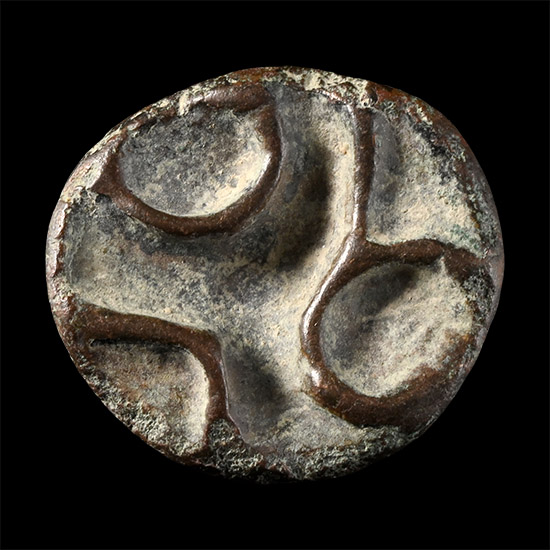
West Central Asian Bronze Chess Piece Type Seal Matrix with Interlocking Design
Circa 2200-1800 B.C.Sold for (Inc. bp): £33
Discoid stamp seal with segmented face and tall handle; accompanied by an old scholarly note, typed and signed by W.G. Lambert, late Professor of Assyriology, University of Birmingham, 1970-1993, which states: 'Stamp Seal of Bronze 19 x 18 x 34 mm. This was originally round, with flat face and slightly convex back on which is mounted a tall stalk handle with ridges around it and an oval loop on the top. The design, done in raised lines, consists of two interlocking pairs of strokes, each with a curve in it, and some short strokes act as fillers. This comes from west central Asia and dates to c. 2200-1800 B.C. About two thirds of the rim are now missing, and the handle is worn down, but a fair amount remains and is in good condition.' 9.76 grams, 23 mm
Acquired in the late 1980s-early 1990s. Ex property of a West London businessman. Academically researched and catalogued by the late Professor Lambert in the early 1990s. Accompanied by a copy of a scholarly report, numbered T-849, typed and signed by Professor Wilfrid George Lambert. -
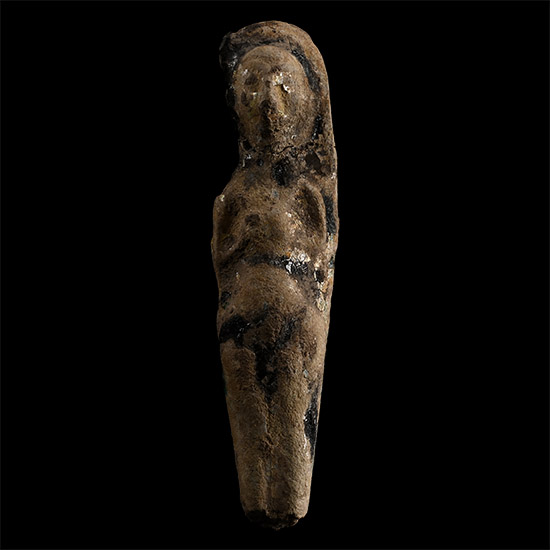
Western Asiatic Glazed Terracotta Fertility Figure
Late 1st millennium B.C.Estimate: £100 - 140 (+bp*)
Opening Bid: £56
Modelled in the half-round; D-shaped in section with applied black pigment detailing to hair and midriff; some iridescence. 23.2 grams, 92 mm
Ex private collection, London, UK, 1969-1999. -
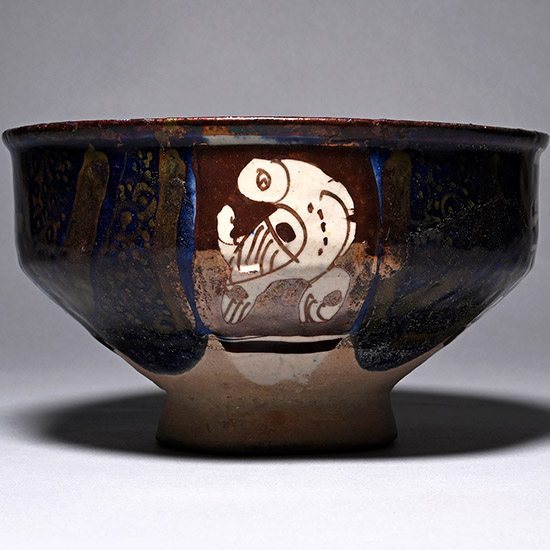
Western Asiatic Cobalt-Blue Footed Ceramic Bowl
9th century A.D.Estimate: £3,000 - 4,000 (+bp*)
Current Winning Bid: £2,000
With a carinated sidewall, rolled and everted rim, shallow foot, partial lustre-glaze to the surface with four trapezoidal panels: two with a reserved regardant bird and two with a tracery motif; restored. 498 grams, 18.5 cm
Private collection, Japan, acquired prior to 1982. Private collection, UK. This lot has been checked against the Interpol Database of stolen works of art and is accompanied by a search certificate number no.12724-235155.
