
Loading, please wait...
LOT 0940
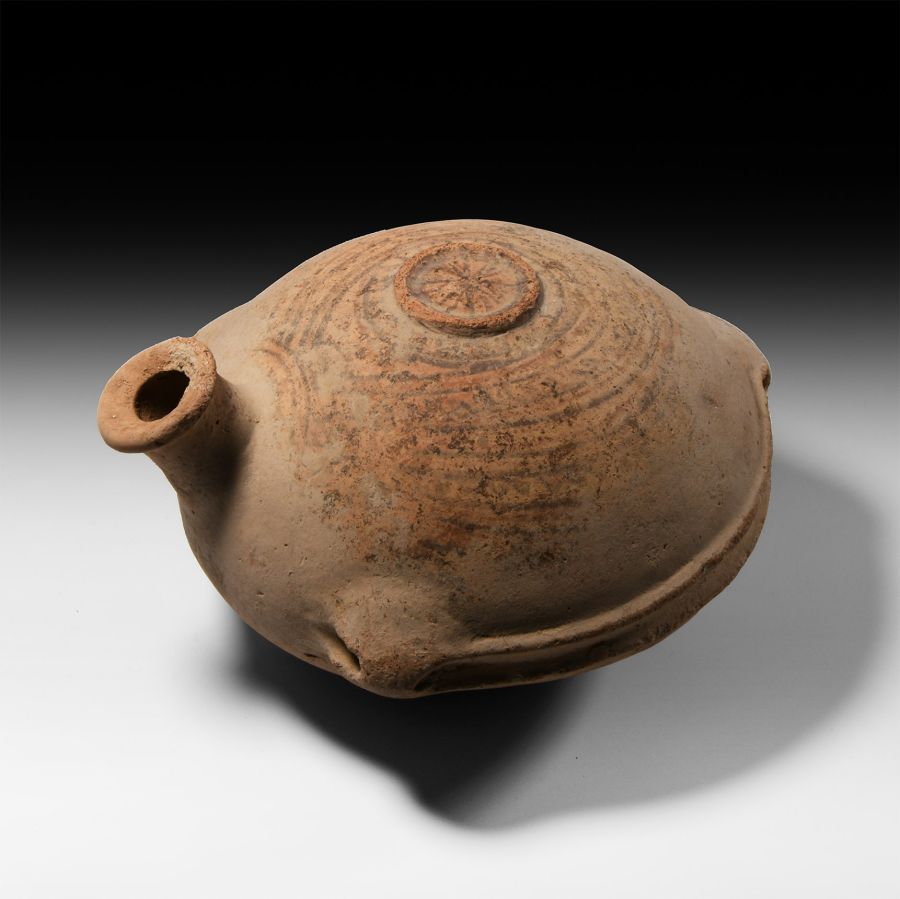
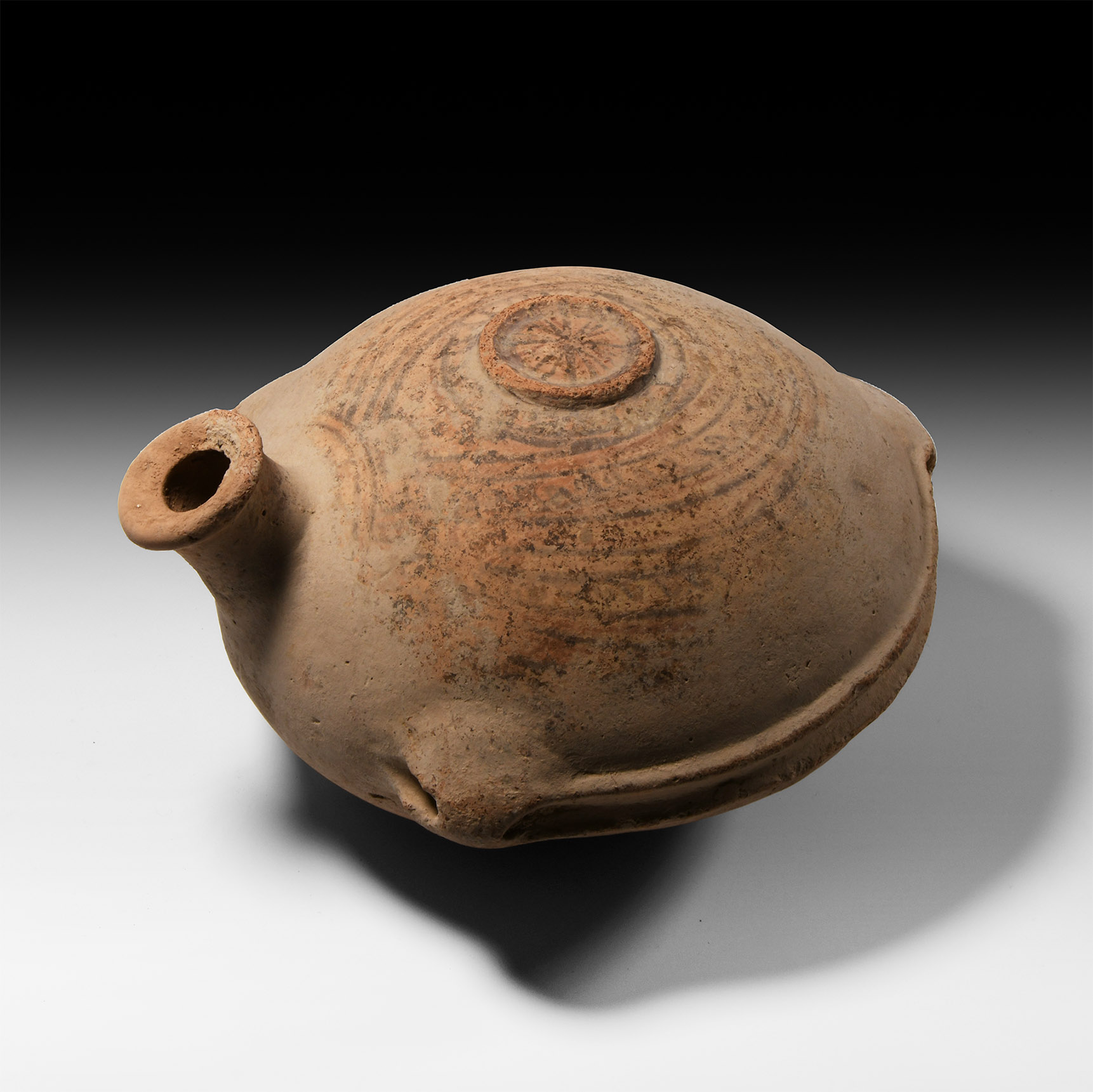
Western Asiatic Flask with Star Design
1ST MILLENNIUM B.C.
10 1/4 in. (1.4 kg, 26 cm wide).
A ceramic flask of lentoid form with u-section medial channel incorporating three suspension lugs, short spout with rounded rim, central raised ring to the upper face decorated with a stylised star, the body with concentric roundels.
ProvenanceAcquired 1980-2015.
Ex Abelita family collection.
TimeLine Auctions follows a vetting process to ensure the authenticity and legality of all items, reinforcing our commitment to integrity and responsible trading. Each antiquity, antique, and coin lot undergoes thorough examination by a vetting committee of at least ten external specialists, professional trade association members, scientists, and archaeologists: Our Vetting Process
AUCTIONS:
TimeLine is a leading auction house specialising in antiquities, ancient art, collectables, natural history, coins, medals, and books. Our auctions offer museums, collectors, historians, and enthusiasts the opportunity to acquire unique and historically significant pieces.
LOT 0940
Western Asiatic Flask with Star Design
Estimate £150 - 200€170 - 230 (for guidance only)$200 - 270 (for guidance only)
-
.jpg)
Western Asiatic Gold Earring Group
Late 1st millennium B.C.-early 1st millennium A.D.Estimate: £400 - 600 (+bp*)
Opening Bid: £222
A mixed group of seven gold hoop earrings comprising: an example composed of a coiled wire and bead bezel; one with hollow-formed capsule-shaped bulb decorated with a medial twisted wire collar; a crescentic hoop with granulated pyramids to the lower edge and one loop; hollow-formed crescentic earring with coiled collars; a flat-section crescent with hook-and-eye closure; a hollow-formed crescent-shaped earring with expanded central section and remains of hinge closure; hoop with single granulations to lower body, triangular plaque below, dangle comprising gold granulated beads and pearl and facetted blue bead, possibly of stone; including fragmentary examples. 6.69 grams total, 10-27 mm
Fine condition.
Acquired 1970-2010. Collection of a late Japanese gentleman. -
.jpg)
Seljuk Period Openwork Door Fitting
13th-14th century A.D.Sold for (Inc. bp): £598
A pair of bronze openwork discoid door 'bosses' or handle mounting plates, each with a central dome inscribed around the neck, procession of birds with spread wings below, geometric band, openwork interlace motif, egg-and-dart style shaped circumference. 1.4 kg total, 24 cm wide each
From a UK private collection. An old Christie's label to verso: '656/8673'. -
Western Asiatic Mixed Bead Group
Circa 1st millennium B.C.Estimate: £100 - 140 (+bp*)
Opening Bid: £50
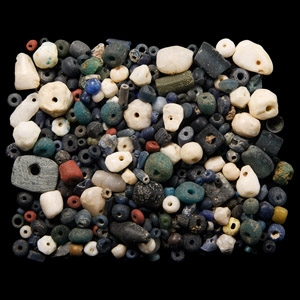
A mixed group of glass, stone and shell beads of oblate, tabular, cylindrical and other types. 88 grams total, 1-18 mm
Acquired 1970-2010. Collection of a late Japanese gentleman.
