
Loading, please wait...
LOT 1040
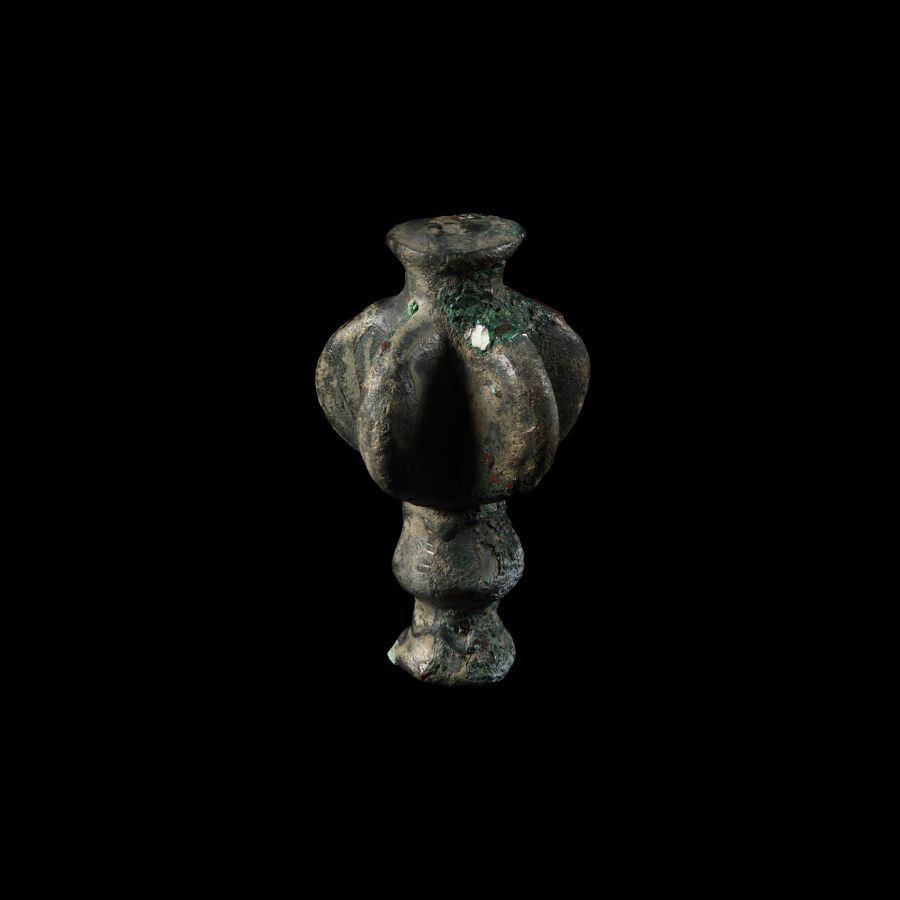
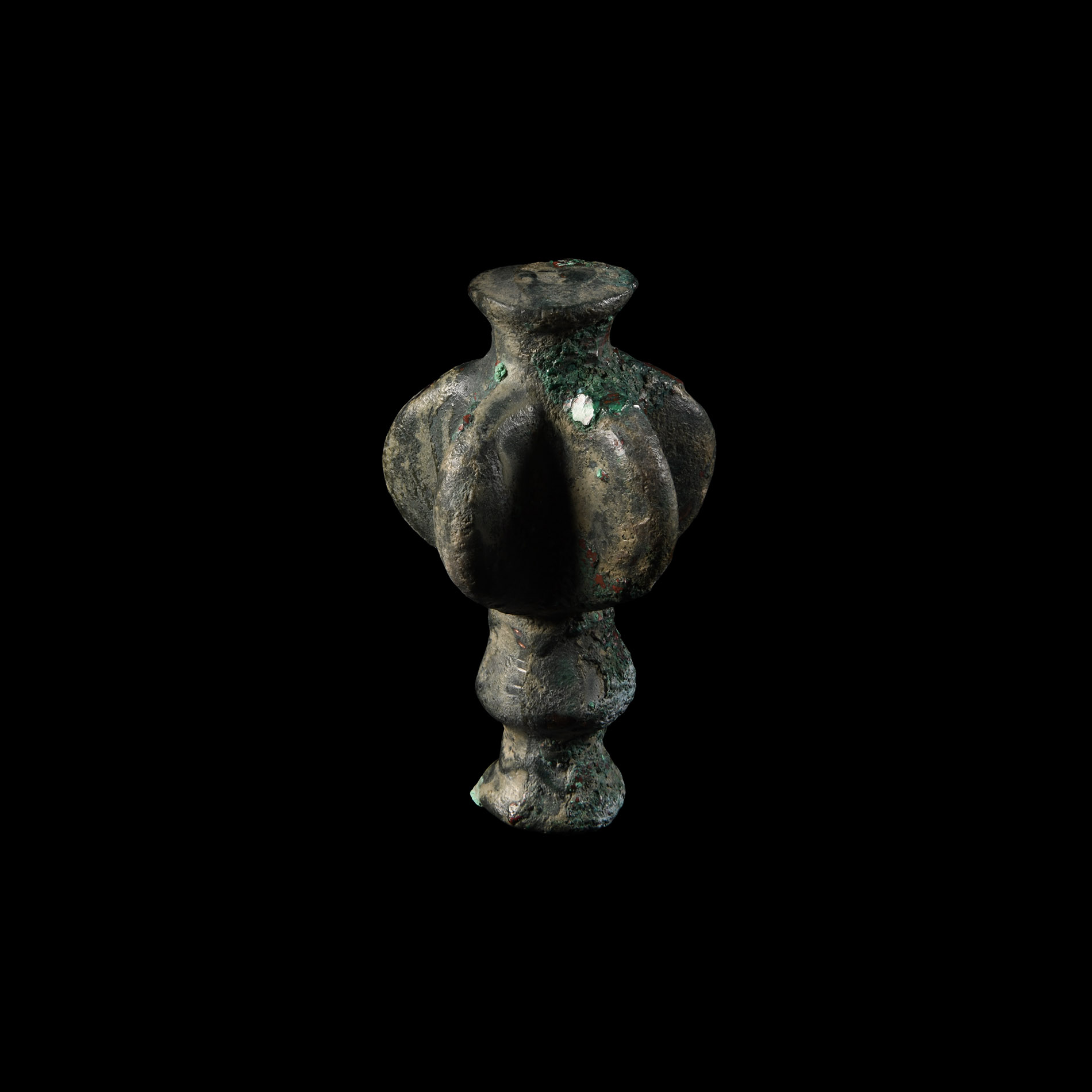
Western Asiatic Flanged Macehead
LATE 3RD MILLENNIUM B.C.
3 1/8 in. (131 grams, 80 mm).
A cylindrical bronze macehead with five D-shaped flanges to the circumference; socket to base. [No Reserve]
ProvenanceEarly 1990s London collection.
Acquired on the UK art market.
From a private collection, Lancashire, UK.
See Gorelik, M., Weapons of Ancient East, IV millennium BC-IV century BC, Saint Petersburg, 2003, pl.XXX, no.61, from Chankhudaro, Hindustan, Accadic territory.
FootnotesBronze maces with a long bronze tubular sleeve appeared in Mesopotamia from the last third of the 3rd millennium B.C., apparently being of Palestinian origin. This type of mace was then spread to Elam and from there to India.
CONDITIONTimeLine Auctions follows a vetting process to ensure the authenticity and legality of all items, reinforcing our commitment to integrity and responsible trading. Each antiquity, antique, and coin lot undergoes thorough examination by a vetting committee of at least ten external specialists, professional trade association members, scientists, and archaeologists: Our Vetting Process
AUCTIONS:
TimeLine is a leading auction house specialising in antiquities, ancient art, collectables, natural history, coins, medals, and books. Our auctions offer museums, collectors, historians, and enthusiasts the opportunity to acquire unique and historically significant pieces.
-
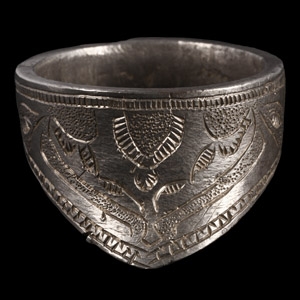
Large Byzantine Silver Archer's Ring
14th-15th century A.D.Sold for (Inc. bp): £715
A substantial silver archer's ring comprising a hoop with reserved triangular ornament on the edges and triangular plaque with foliage motifs, raised central panel with frond motif. 22.61 grams, 34.77 mm overall, 25.16 mm internal diameter
Acquire in the 1990s. Ex Cambridgeshire, UK, collection.
Archer rings in Late Byzantium and the medieval Balkans were connected with the employment of the powerful composite bow, but very often, in 14th century, they were rank symbol for aristocratic noblemen. Archaeological findings of archers’ rings originate mainly from fortified towns, including mining centres. Many were made in bone, simple in design and undecorated. In contrast, the ones made in bronze and silver were usually decorated in rather uniform style, consisting of floral motifs on the head, mostly tulip and foliage, and linear motifs around the edges. This decoration combined Turkish, Central European and Eastern Roman traditional patterns. -
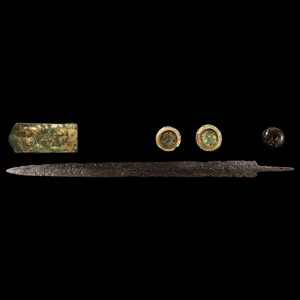
Migration Period Spatha Sword Blade with Fittings
Circa 4th-5th century A.D.Sold for (Inc. bp): £1,950
A military assemblage comprising: a double-edged spatha with a lentoid parallel-sided iron blade and pointed tip, battle nicks to both cutting edges; long tang with a bronze fastening rivet in situ; oblate chalcedony pommel; gilt copper-alloy chape scabbard fitting with fastening holes and a pair of round scabbard or baldric fittings. 937 grams total, 5-81.3 cm
Fine condition
Acquired 1971-1972. From the collection of the vendor's father. Property of a London, UK, collector. Accompanied by an academic report by Dr Raffaele D’Amato. This lot has been checked against the Interpol Database of stolen works of art and is accompanied by a search certificate number no.11587-198852.
Prestigious swords with richly trimmed sheaths, guards and hilts of the Great Migration Period on the Cimmerian Bosphorus are very few, although some specimens have been excavated from Kerch, Phanagoria, Hermonassa and Dzhurga-Oba. They were either custom-made or received as war booty. This sword belongs to a group of spathae of late Roman typology spread among the Germanic and Nomad foederati, and garrison troops of the Northern Black Sea and Bosphorus. -
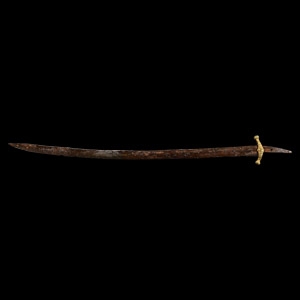
Khazar Sabre with Gilt Cross Guard with Face
9th century A.D.Sold for (Inc. bp): £2,286
A single-edged hand-forged sabre with a gently curving blade, an iron band welded beneath the cross guard, together with a tongue along the side of the blade; the separate gilt cross guard with spherical ornamented finials to the quillons, the central panel with a stylised face flanked by a pair of leaping lions biting the top of the head, the other side with a lozenge within a ropework frame. 610 grams, 80.5 cm
Fine condition.
Acquired 1971-1972. From the collection of the vendor's father. Property of a London, UK, collector. Accompanied by an academic report by military specialist Dr Raffaele D'Amato. This lot has been checked against the Interpol Database of stolen works of art and is accompanied by search certificate no.114437-196034.
This exceptional sabre shows similarity with examples from the Caucasus and Kuban regions. The blade could be Khazar-Magyar, and certainly its best parallels are the specimens from Verchne-Szaltovo area. According to M. Gorelik, some of these sabres were produced by the Kabarians, a breakaway tribe from the Khazar State, who formed an alliance with the Magyars. The extra band welded beneath the quillons, together with the side tongue, not only protected the scabbard from being cut by the blade but, more importantly, defended the warrior’s fingers which were wrapped around the quillons when fighting.
