
Loading, please wait...
LOT 1054
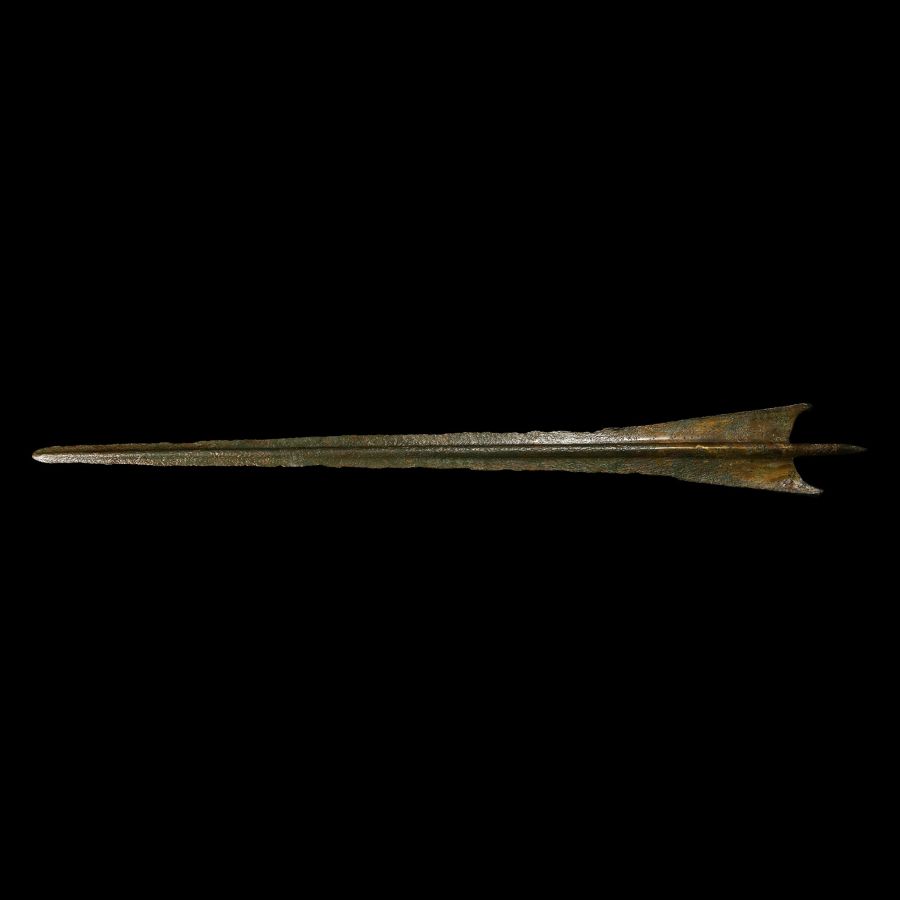
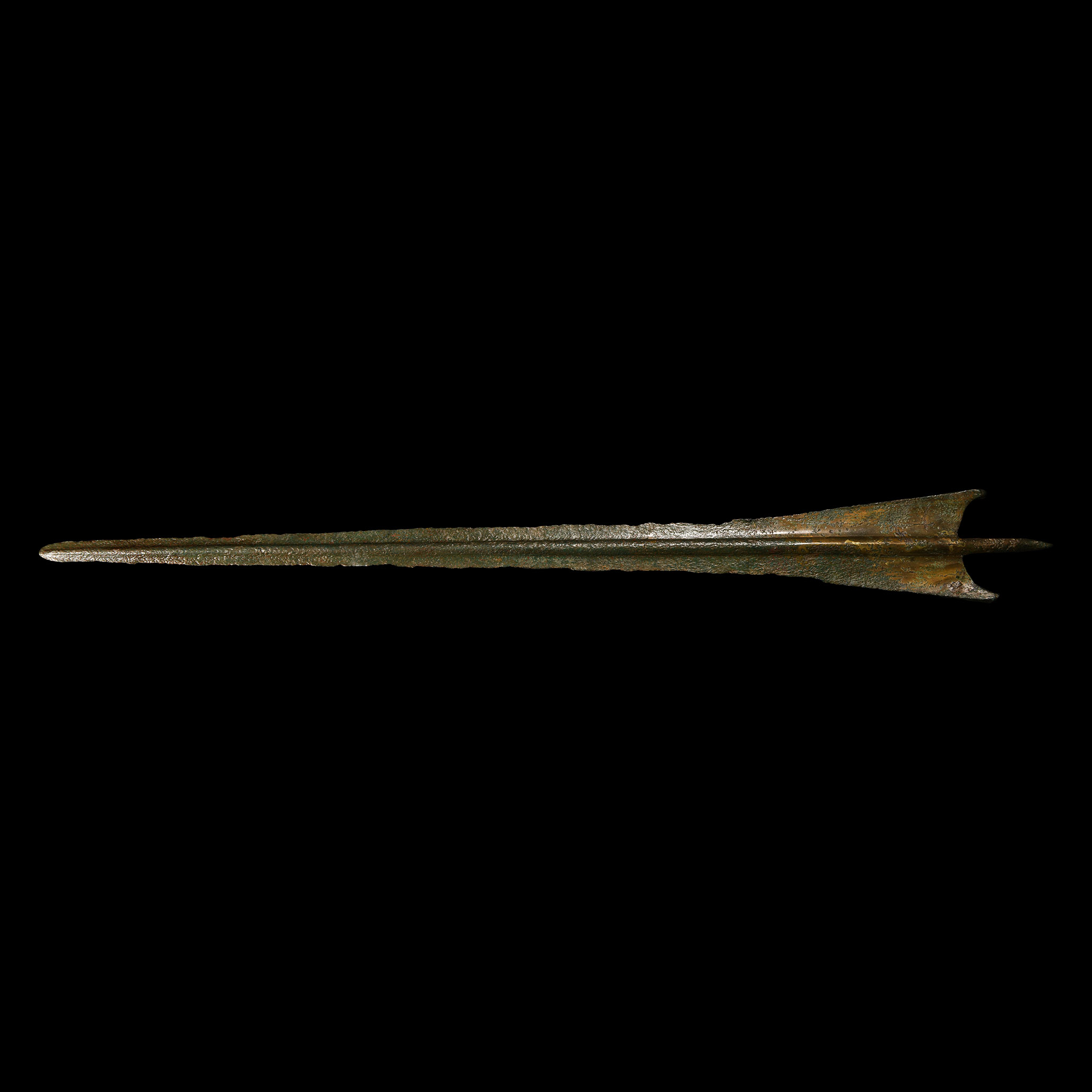
Western Asiatic Dagger Blade with Winged Guards
LATE 2ND-MID 1ST MILLENNIUM B.C.
23 5/8 in. (484 grams, 60 cm).
A bronze dagger with prominently curved or winged guard, extending out from the ricasso and partly framing the tang, once covered by an organic hilt; the thick midrib extending slightly above the ricasso.
ProvenanceAcquired 1980-2015.
Ex Abelita family collection.
Cf. Muscarella, O.W., Bronze and Iron: Ancient Near Eastern Artifacts in The Metropolitan Museum of Art, New York, 1988, item 165, for type.
FootnotesMany examples of these blades have been excavated in the South Caspian area at Ghalekuti, and in the area of Talish. They have been found primarily in Iron Age graves, although the curves of the guards are reminiscent of the barbed arrow and javelin heads associated with Bronze Age Marlik. This is why some scholars (Dyson) dated them to the second millennium BC and others (Muscarella) to the recent Iron Age. It is possible that this style represents continuity from the Bronze to the Iron Age.
CONDITIONTimeLine Auctions follows a vetting process to ensure the authenticity and legality of all items, reinforcing our commitment to integrity and responsible trading. Each antiquity, antique, and coin lot undergoes thorough examination by a vetting committee of at least ten external specialists, professional trade association members, scientists, and archaeologists: Our Vetting Process
AUCTIONS:
TimeLine is a leading auction house specialising in antiquities, ancient art, collectables, natural history, coins, medals, and books. Our auctions offer museums, collectors, historians, and enthusiasts the opportunity to acquire unique and historically significant pieces.
-
Migration Period Spatha Sword Blade with Fittings
Circa 4th-5th century A.D.Sold for (Inc. bp): £1,950
A military assemblage comprising: a double-edged spatha with a lentoid parallel-sided iron blade and pointed tip, battle nicks to both cutting edges; long tang with a bronze fastening rivet in situ; oblate chalcedony pommel; gilt copper-alloy chape scabbard fitting with fastening holes and a pair of round scabbard or baldric fittings. 937 grams total, 5-81.3 cm
Fine condition
Acquired 1971-1972. From the collection of the vendor's father. Property of a London, UK, collector. Accompanied by an academic report by Dr Raffaele D’Amato. This lot has been checked against the Interpol Database of stolen works of art and is accompanied by a search certificate number no.11587-198852.
Prestigious swords with richly trimmed sheaths, guards and hilts of the Great Migration Period on the Cimmerian Bosphorus are very few, although some specimens have been excavated from Kerch, Phanagoria, Hermonassa and Dzhurga-Oba. They were either custom-made or received as war booty. This sword belongs to a group of spathae of late Roman typology spread among the Germanic and Nomad foederati, and garrison troops of the Northern Black Sea and Bosphorus. -
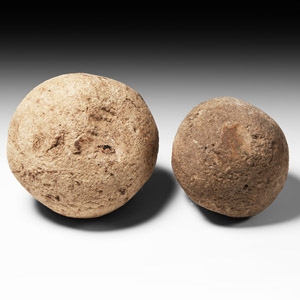
Roman Ballista Catapult Shot Group
1st-3rd century A.D.Sold for (Inc. bp): £156
A pair of differently sized ballistas made from limestone, suitable for use with a catapult type siege weapon. 650 grams total, 55-71 mm
Acquired before 2000. From the collection of a European gentleman living in the UK. -
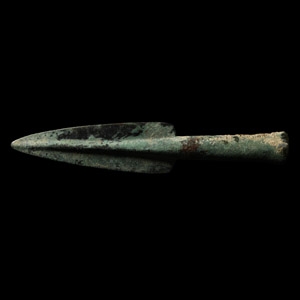
Western Asiatic Socketted Spearhead
9th-7th century B.C.Estimate: £100 - 140 (+bp*)
Opening Bid: £50
A bronze spearhead with short conical socket, triangular-shaped blade with prominent central rib. 81 grams, 15 cm long
Fine condition.
Earlier 20th century Cologne collection, Germany. London Mayfair gallery, UK. Dr D.G. collection, 1990s-2019. Accompanied by an old typed catalogue slip with provenance.
