
Loading, please wait...


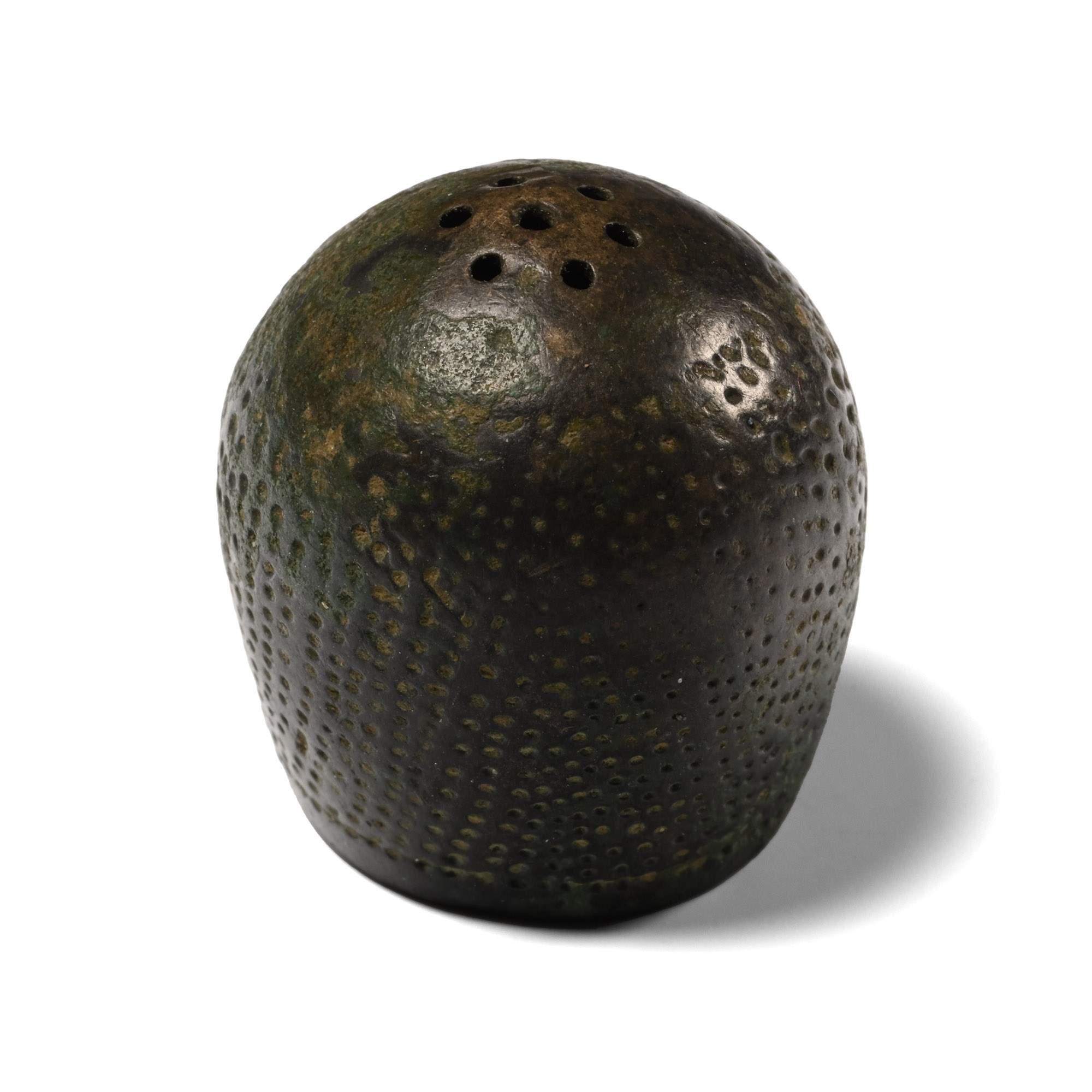
LOT 1465
Western Asiatic Bronze Thimble
13TH CENTURY A.D.
1 1/4 in. (53 grams, 30 mm).
Squat bulb with thickened base, zones of impressed pintillé detailing to the sides, seven piercings at the apex; ‘Turko-Slavic’ type. [No Reserve]
Provenancewith Hirsch Auction, 22 September 2004, no.1350.
Accompanied by a copy of an Art Loss Register certificate no.S00043603.
This lot has been cleared against the Art Loss Register database, and is accompanied by an illustrated lot declaration signed by the Head of the Antiquities Department, Dr Raffaele D'Amato.
TimeLine Auctions follows a vetting process to ensure the authenticity and legality of all items, reinforcing our commitment to integrity and responsible trading. Each antiquity, antique, and coin lot undergoes thorough examination by a vetting committee of at least ten external specialists, professional trade association members, scientists, and archaeologists: Our Vetting Process
AUCTIONS:
TimeLine is a leading auction house specialising in antiquities, ancient art, collectables, natural history, coins, medals, and books. Our auctions offer museums, collectors, historians, and enthusiasts the opportunity to acquire unique and historically significant pieces.
-

Post Achaemenid Silver Bracelet Pair with Figures
Late 1st millennium B.C.Sold for (Inc. bp): £390
Each a C-shaped band with everted rims, applied repoussé strip with geometric and figural frieze, applied hollow-domed studs, reinforced at the finials. 68.4 grams total, 63-69 mm
From a deceased family collection formed in the 1980s; thence by descent. This lot has been cleared against the Art Loss Register database, and is accompanied by an illustrated lot declaration signed by the Head of the Antiquities Department, Dr Raffaele D'Amato. -

Ancient Stone Bead Necklace String
1st millennium B.C. and laterSold for (Inc. bp): £72
Restrung group of graduated tubular, annular, fusiform and other beads in stone, shell, and ceramic beads. 20 grams, 50 cm
UK gallery, early 2000s. This lot has been cleared against the Art Loss Register database, and is accompanied by an illustrated lot declaration signed by the Head of the Antiquities Department, Dr Raffaele D'Amato.
Similar beads were found in the excavations of the royal tombs of Nimrud. Thousands of beads were discovered in the sarcophagi (for example those of Nimrud’s Queens) probably originally composed as wide collars with multiple strands. -

Neo-Babylonian Chalcedony Conoid Stamp Seal with Worshipper
600-350 B.C.Sold for (Inc. bp): £1,950
Thimble-shaped tapering cylinder with convex face; accompanied by a copy of an old scholarly note, typed and signed by W.G. Lambert, late Professor of Assyriology, University of Birmingham, 1970-1993, which states: 'Stamp Seal of Grey Chalcedony 21 x 19.5 x 30 mm. This is a conoid with oval convex face, pierced vertically near the top. The face shows a worship scene: a man in a long robe standing holding up one hand to a stand on which lies the mušhuššu-monster (part lion part snake) on the back of which rise the spade (symbol of the god Marduk) and two styluses (symbol of the god Nabû). There is a lunar crescent in the sky and a two-sign cuneiform inscription behind the man. This is a Late Babylonian seal, c. 600-350 B.C. from Mesopotamia or south-west Iran. The inscription consists of two signs: AN DUH x DUH and is well known on Late Babylonian stamp seals, but the second sign is unknown outside these seal inscriptions. The most probable explanation (based on related seal inscriptions) is that it means: "Cause him to have a god" which means "make him successful," a personal god brings success. The head of the standing figure is chipped, otherwise this seal is in very good condition, and is large for its type.'; accompanied by a museum-quality impression. 18.8 grams, 29.79 mm high
with Christie's, London, 25 April 2001, no.464 [Part]. Accompanied by a copy of a scholarly note, typed and signed by Professor Wilfrid George Lambert in July 2001. Accompanied by copies of the relevant Christie's catalogue pages. This lot has been checked against the Interpol Database of stolen works of art and is accompanied by a search certificate number no.12566-230321. This lot has been cleared against the Art Loss Register database, and is accompanied by an illustrated lot declaration signed by the Head of the Antiquities Department, Dr Raffaele D'Amato.
