
Loading, please wait...
LOT 1533
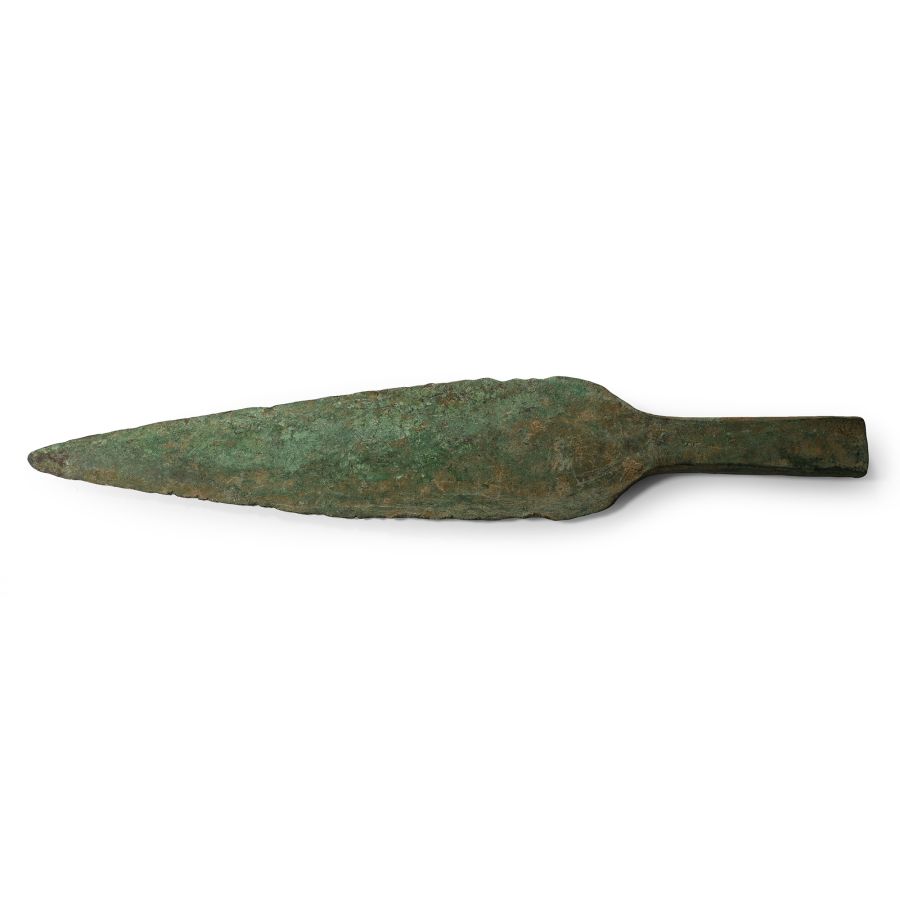
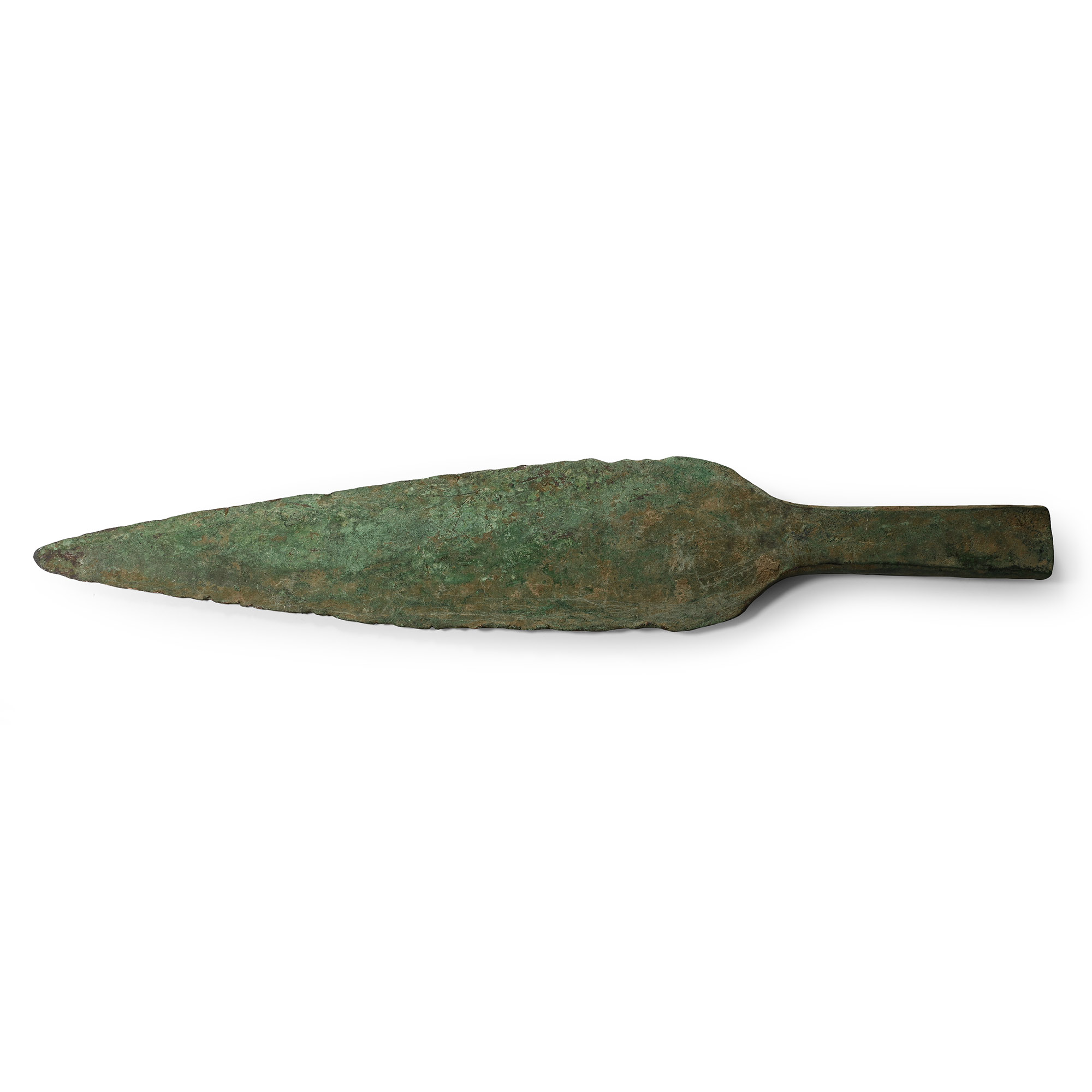
Western Asiatic Bronze Short Sword with Integral Hilt
LATE 3RD-2ND MILLENNIUM B.C.
16 1/2 in. (881 grams, 42 cm).
With a broad, lentoid-section flat blade, rounded tip, sloping sides, well marked shoulders with short, wide tang.
ProvenanceAcquired on the UK art market before 2000.
Property of an Essex, UK, gentleman.
This lot is accompanied by an illustrated lot declaration signed by the Head of the Antiquities Department, Dr Raffaele D’Amato.
Cf. Inassa, M., 'Daggers in ancient Mesopotamia' in Journal of Archaeological Research and Studies, vol.2, March 2018, pp.1-27, fig.1, p.26.
FootnotesThe sword has similarities with a specimen from the Royal Cemetery of Ur. This is the most primitive form of dagger, consisting of a simple, pointed blade having slightly convex outline shoulders sloping to a short tang which has no rivets, and was probably hafted to wood with bitumen.
CONDITIONTimeLine Auctions follows a vetting process to ensure the authenticity and legality of all items, reinforcing our commitment to integrity and responsible trading. Each antiquity, antique, and coin lot undergoes thorough examination by a vetting committee of at least ten external specialists, professional trade association members, scientists, and archaeologists: Our Vetting Process
AUCTIONS:
TimeLine is a leading auction house specialising in antiquities, ancient art, collectables, natural history, coins, medals, and books. Our auctions offer museums, collectors, historians, and enthusiasts the opportunity to acquire unique and historically significant pieces.
LOT 1533
Western Asiatic Bronze Short Sword with Integral Hilt
Estimate £200 - 300€230 - 350 (for guidance only)$270 - 410 (for guidance only)
-
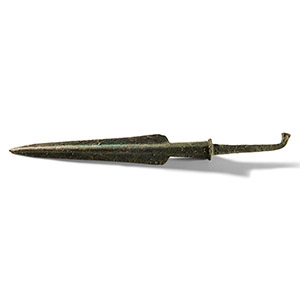
Western Asiatic Tanged Bronze Spearhead
1500-1000 B.C.Estimate: £250 - 350 (‡+bp*)
Opening Bid: £125
With heavily ridged and tapered blade, short collared shaft and tapered bent tang with round stud terminal. 247 grams, 28.5 cm
Acquired in Europe in 1997. European private collection. This lot is accompanied by an illustrated lot declaration signed by the Head of the Antiquities Department, Dr Raffaele D’Amato. -
.jpg)
Scythian Chalcidian Helmet with Embossed Stags
3rd-1st century B.C.Sold for (Inc. bp): £24,700
Chalcidian or Illyrian variant (Caucasian type), constructed from two halves with the right side overlapping the left, embossed ram horns on the brow, with a profile image of a stag to both sides; hinged cheek-pieces with regularly disposed holes to the outer edges; some restoration. 696 grams, 31cm high
Acquired on the European art market, mid-1980s. Private collection, Oxford, UK. From the collection of a London doctor. Accompanied by an academic report by Dr Raffaele D’Amato. This lot has been checked against the Interpol Database of stolen works of art and is accompanied by search certificate number no.12339-228100. This lot has been cleared against the Art Loss Register database, and is accompanied by an illustrated lot declaration signed by the Head of the Antiquities Department, Dr Raffaele D’Amato.
The cultural interchange and the military contacts between the Nomads of Kuban and the Hellenic peoples allowed the Sindo-Meothic, Scythian, or Sarmatian noblemen to equip themselves with such beautiful defensive equipment. The helmet finds its closest parallel in a specimen published by A.E. Negin, belonging to the Puskin Fine Arts Museum of Moscow, originally in the collection of S. Karakowskij (Negin, 2010, p.354 no.6; Hixenbaugh H304). Some of the helmets of this type were modified according to the nomadic (Scythian or Sarmatian) taste, being decorated with religious elements, like the deer. -
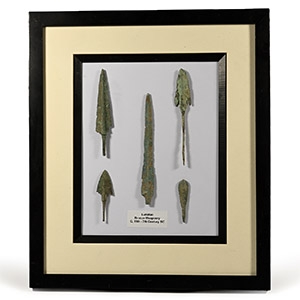
Cased Luristan Arrowhead Collection
Circa 11th-7th century B.C.Sold for (Inc. bp): £39
Including leaf-shaped and barbed types in a glazed frame. 1.1 kg, 33.5 x 38.5 cm
Ex G. While collection, South Wales, 1980s. This lot is accompanied by an illustrated lot declaration signed by the Head of the Antiquities Department, Dr Raffaele D’Amato.
