
Loading, please wait...
_900x900.jpg "Western Asiatic Bronze Personal Seal Matrix for 'modda ibn Abdullah'")
_200x200.jpg "Western Asiatic Bronze Personal Seal Matrix for 'modda ibn Abdullah'")
.jpg "Western Asiatic Bronze Personal Seal Matrix for 'modda ibn Abdullah'")
LOT 1158
Western Asiatic Bronze Personal Seal Matrix for 'modda ibn Abdullah'
14TH CENTURY A.D.
5/8 in. (16.6 grams, 17 mm).
Comprising a domed body rising to a pierced suspension lug, underside with discoid plaque and reversed incuse Arabic legend: 'Modda ibn Abdullah', a personal name also serving as a religious expression roughly translating to, 'Don't be a slave to anyone but Allah'.
ProvenanceFrom the collection of a gentleman, acquired on the London art market in the 1990s.
This lot has been cleared against the Art Loss Register database, and is accompanied by an illustrated lot declaration signed by the Head of the Antiquities Department, Dr Raffaele D'Amato.
TimeLine Auctions follows a vetting process to ensure the authenticity and legality of all items, reinforcing our commitment to integrity and responsible trading. Each antiquity, antique, and coin lot undergoes thorough examination by a vetting committee of at least ten external specialists, professional trade association members, scientists, and archaeologists: Our Vetting Process
AUCTIONS:
TimeLine is a leading auction house specialising in antiquities, ancient art, collectables, natural history, coins, medals, and books. Our auctions offer museums, collectors, historians, and enthusiasts the opportunity to acquire unique and historically significant pieces.
LOT 1158
Western Asiatic Bronze Personal Seal Matrix for 'modda ibn Abdullah'
Sold for (Inc. bp): £286
-
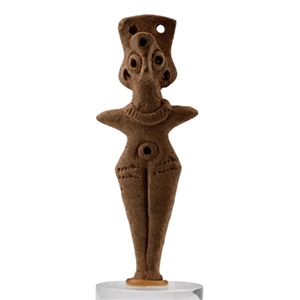
Syro-Hittite Terracotta Fertility Figure
2nd millennium B.C.Sold for (Inc. bp): £338
Flat-section figurine with elaborate pierced headdress, applied annular eyes and navel, pinched nose, applied segmented collar and pointillé detailing to the hips; mounted on a custom-made stand. 169 grams total, 18 cm including stand
Mounted on a perspex column in the 1970s. From the property of late Mr SM, London, UK, 1969-1999. From the private collection of John Meredith, acquired since the 1990s; thence by descent. This lot has been cleared against the Art Loss Register database, and is accompanied by an illustrated lot declaration signed by the Head of the Antiquities Department, Dr Raffaele D'Amato. -
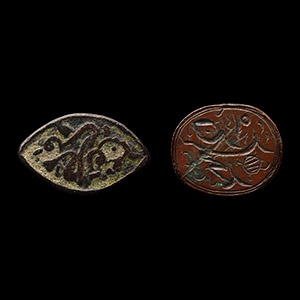
Ottoman Epigraphic Artefact Group
15th-16th century A.D.Sold for (Inc. bp): £156
Comprising: finger ring with scaphoid bezel and reserved Nastaliq script legend; seal or cuff-link part with incised Nastaliq legend. 10.1 grams total, 17-22 mm
From the collection of a gentleman, acquired on the London art market in the 1990s. This lot has been cleared against the Art Loss Register database, and is accompanied by an illustrated lot declaration signed by the Head of the Antiquities Department, Dr Raffaele D'Amato. -
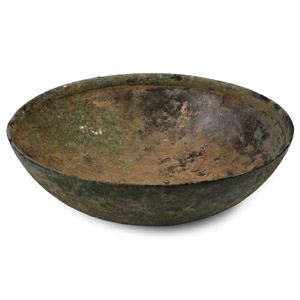
Western Asiatic Bronze Bowl
Late 1st millennium B.C.Sold for (Inc. bp): £46
A shallow bowl with thickened rim and convex base. 224 grams, 17 cm
Ex London, UK, collections, 1990s-2000s. This lot has been cleared against the Art Loss Register database, and is accompanied by an illustrated lot declaration signed by the Head of the Antiquities Department, Dr Raffaele D'Amato.
