
Loading, please wait...
_900x900.jpg "Western Asiatic Bronze Lion Censer Lid")
_200x200.jpg "Western Asiatic Bronze Lion Censer Lid")
.jpg "Western Asiatic Bronze Lion Censer Lid")
LOT 0965
Western Asiatic Bronze Lion Censer Lid
11TH-12TH CENTURY A.D.
5 3/8 in (393 grams total, 13.5 cm high including stand).
Formed with stylised features, an ovoid face, openwork eyes, triangular nose, ears pricked forwards and decorative openwork panels to the neck; mounted on a custom-made display base.
ProvenanceFrench collection, 1960s-early 2000s.
From an important Paris gallery, France.
Cf. The Metropolitan Museum, accession number 51.56, for similar.
FootnotesZoomorphic incense burners were popular during the Seljuk period. When complete, coal and incense could be placed inside the burner and the scented smoke would escape through the pierced areas.
CONDITIONTimeLine Auctions follows a vetting process to ensure the authenticity and legality of all items, reinforcing our commitment to integrity and responsible trading. Each antiquity, antique, and coin lot undergoes thorough examination by a vetting committee of at least ten external specialists, professional trade association members, scientists, and archaeologists: Our Vetting Process
AUCTIONS:
TimeLine is a leading auction house specialising in antiquities, ancient art, collectables, natural history, coins, medals, and books. Our auctions offer museums, collectors, historians, and enthusiasts the opportunity to acquire unique and historically significant pieces.
LOT 0965
Western Asiatic Bronze Lion Censer Lid
Estimate £1,500 - 2,000€1,740 - 2,320 (for guidance only)$2,030 - 2,700 (for guidance only)
-
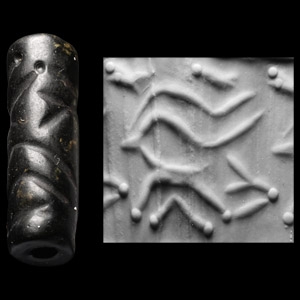
Western Asiatic Haematite Cylinder Seal
2nd-1st millennium B.C.Sold for (Inc. bp): £117
With drilled and incised geometric design. 5.7 grams, 32 mm
Acquired 1970s-1996. Property of a North American collector, collection no.12. London collection, 2016. -
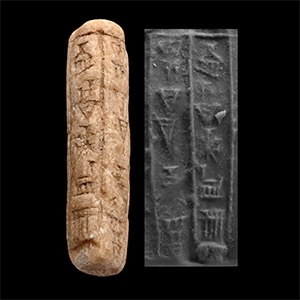
Western Asiatic Stone Cylinder Seal for Nabi-Enlil, son of Ili-zi(?)nni
Circa 1700 B.C.Sold for (Inc. bp): £338
With two columns of cuneiform text, un-drilled: Nabi-Enlil, son of Ili-zi(?)nni; possibly unfinished. 3.8 grams, 34 mm
Acquired 1970s-1996. Property of a North American collector, collection no.082. London collection, 2016. -
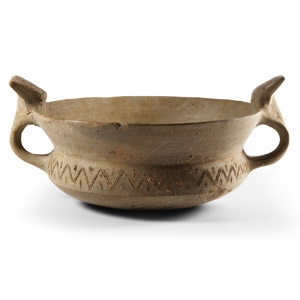
Western Asiatic Double-Handled Terracotta Drinking Vessel
Mid 1st millennium B.C.Estimate: £300 - 400 (+bp*)
Opening Bid: £128
Of squat and carinated form with flared rim, loop handles with serrated thumb pads, incised chevrons with dashed fill around the upper body. 144 grams, 15 cm wide
with a London, UK gallery 1971-early 2000s.
