
Loading, please wait...
LOT 1067
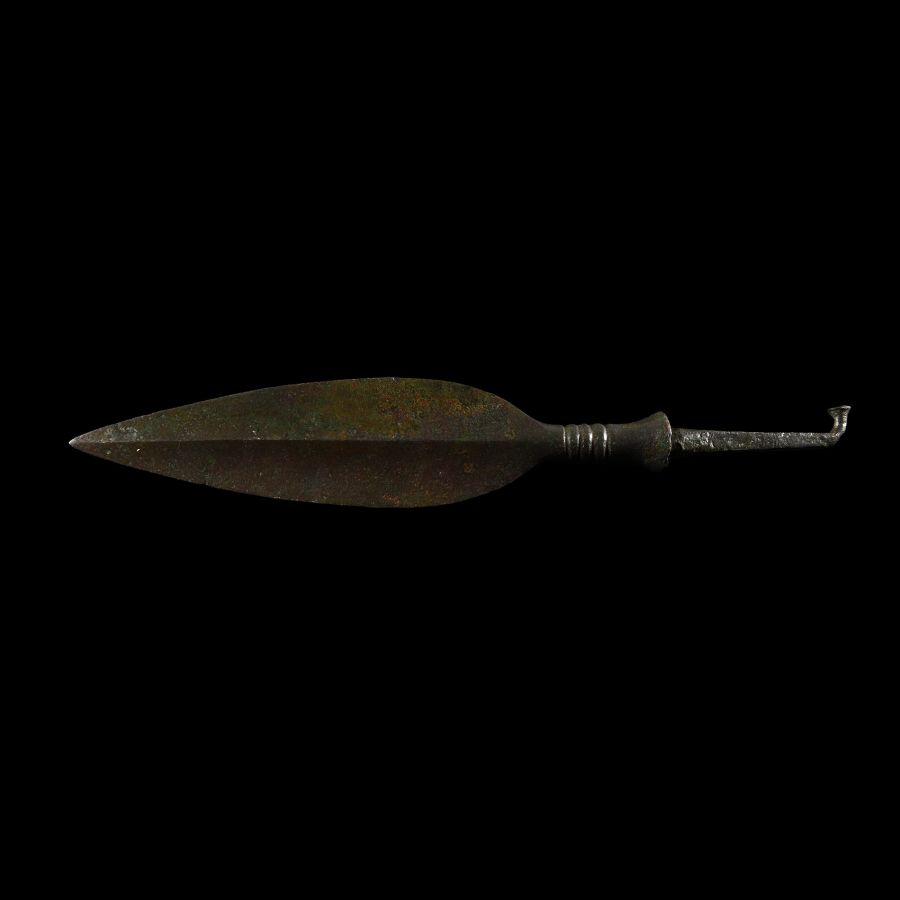
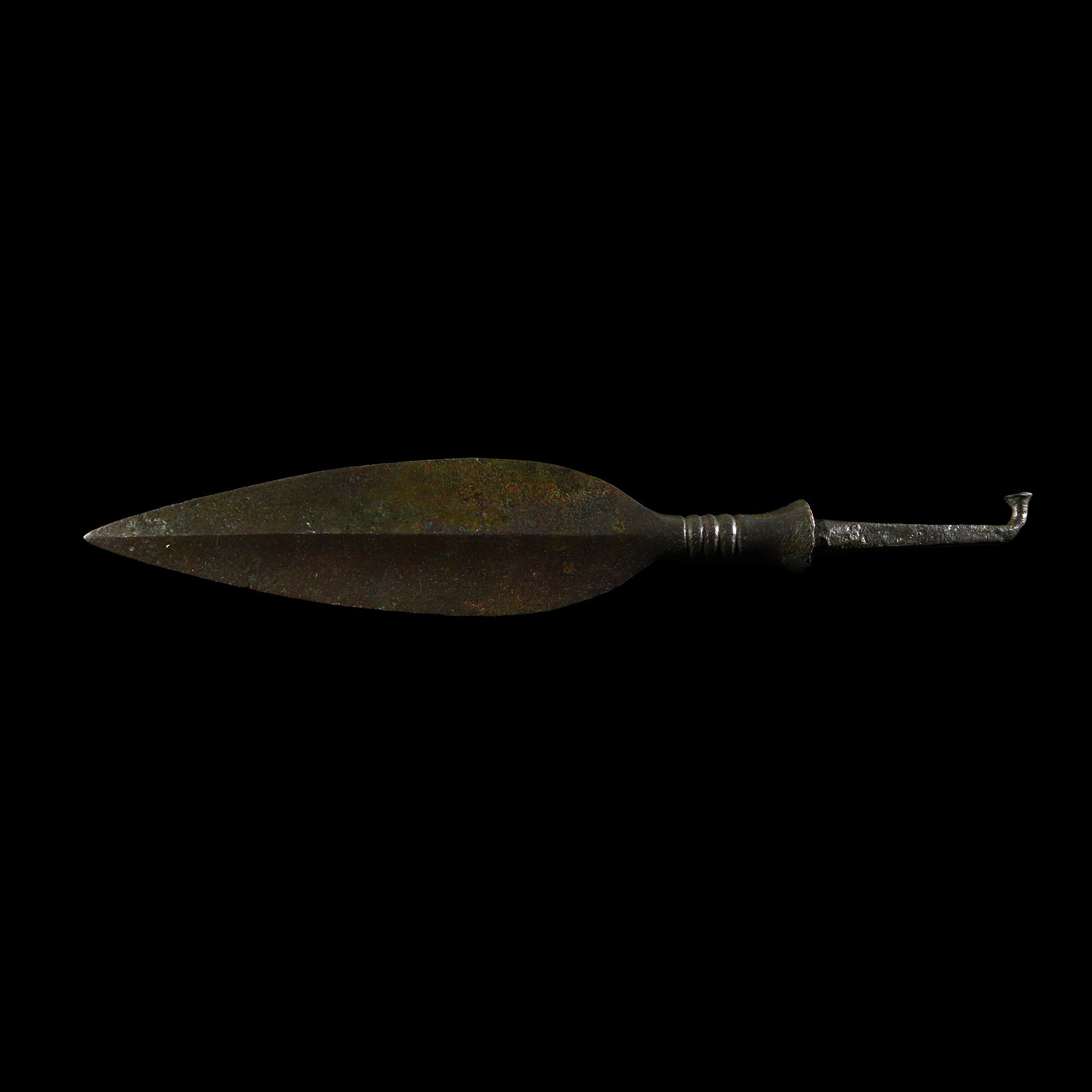
Western Asiatic Bronze Leaf-Shaped Spearhead
EARLY 2ND MILLENNIUM B.C.
9 1/4 in. (134 grams, 23.5 cm).
Having ovate blade with central rib and slender shoulders, cylindrical short shaft marked by circular grooves broading towards the end, encasing a rectangular tang with a bent end.
ProvenanceAcquired 1980-2015.
Ex Abelita family collection.
Cf.Gorelik, M., Weapons of Ancient East, IV millennium BC-IV century BC, Saint Petersburg (2003), pl.XXXIII no.82 (Tepe-Hissar, layer
IIIC) for similar weapon;
In the 3rd millennium until the first half of the 2nd millennium in the Near and Middle East, in India, the Caucasus and Central Asia, a stalked tip was used for the spear heads, and this model developed in Mesopotamia in the middle of the 3rd millennium B.C. The main types were with a facetted blade on a volumetric pin and a leaf-shaped blade on a flat handle with holes for rivets. The same models spread almost unchanged to the Caucasus, Anatolia and Bactria.
CONDITIONTimeLine Auctions follows a vetting process to ensure the authenticity and legality of all items, reinforcing our commitment to integrity and responsible trading. Each antiquity, antique, and coin lot undergoes thorough examination by a vetting committee of at least ten external specialists, professional trade association members, scientists, and archaeologists: Our Vetting Process
AUCTIONS:
TimeLine is a leading auction house specialising in antiquities, ancient art, collectables, natural history, coins, medals, and books. Our auctions offer museums, collectors, historians, and enthusiasts the opportunity to acquire unique and historically significant pieces.
-
Large Luristan Socketted Adze-Axehead
13th-7th century B.C.Sold for (Inc. bp): £208
With central socket and shaft; cutting blade set vertically at a right-angle; the short pick-adze blade arranged horizontally. 1.43 kg, 26 cm
Acquired 1980-2015. Ex Abelita family collection.
The earliest axes-adzes from the 3rd millennium B.C. were weapons and tools furnished with socket holes. Usually the socket is a more secure way of attaching the object to a wooden haft than having a tang. These weapons developed into a plethora of different forms in the 2nd millennium B.C., and the numerous new forms and were used until at least 800 B.C. -
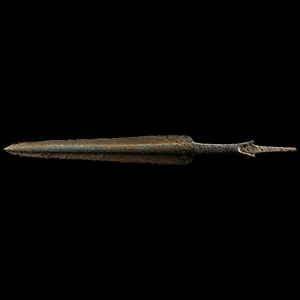
Amlash Type Bronze Spearhead
13th-12th century B.C.Sold for (Inc. bp): £117
Showing a long tapering blade with rounded shoulders and prominent mid-rib, the tang straight and rectangular in section. 411 grams, 40.5 cm
Acquired 1980-2015. Ex Abelita family collection.
The weapon belongs to the type 1 of the Khorasani spearhead classification, mainly from the Marlik or Amlash areas. Similar pieces have been dated by Stutzinger to 1200-1100 B.C., but the period of use is attested to at least until 1000 B.C. -
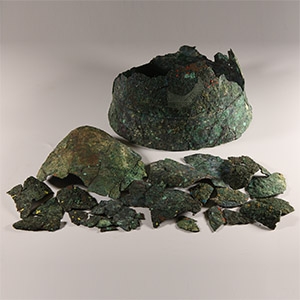
Greek Fragmentary Bronze Pilos Helmet
5th-4th century B.C.Sold for (Inc. bp): £2,015
Conical in shape, comprising a thick hammered bowl and broad rim with carination to the upper edge; remains of crest at brow and rear; a restoration project. 951 grams total, 1-24.5 cm
Ex Axel Guttmann Collection of Ancient Arms and Armour, Germany [1944-2001]. with Hermann Historica, 13 October 2010, lot 2169 [Part].
This type of helmet (called ‘bell-helmet’ by Connolly, 1981, p.70), named pilos after the Greek felt cap (in the Laconian shape, but distinguished from the cap by the noticeable point and the shape of the rim), had a conical shape and was pointed or rounded at the top. Its introduction was linked with the streamlining of Hoplite equipment, and it soon the replaced the closed Corinthian helmet. The helmet was widespread in the Greek and Mediterranean world from the last quarter of the 5th century B.C. and was widely used by continental Greeks, South Italian Greeks and Italic people, Etruscans, and even Romans.
