
Loading, please wait...
LOT 1143
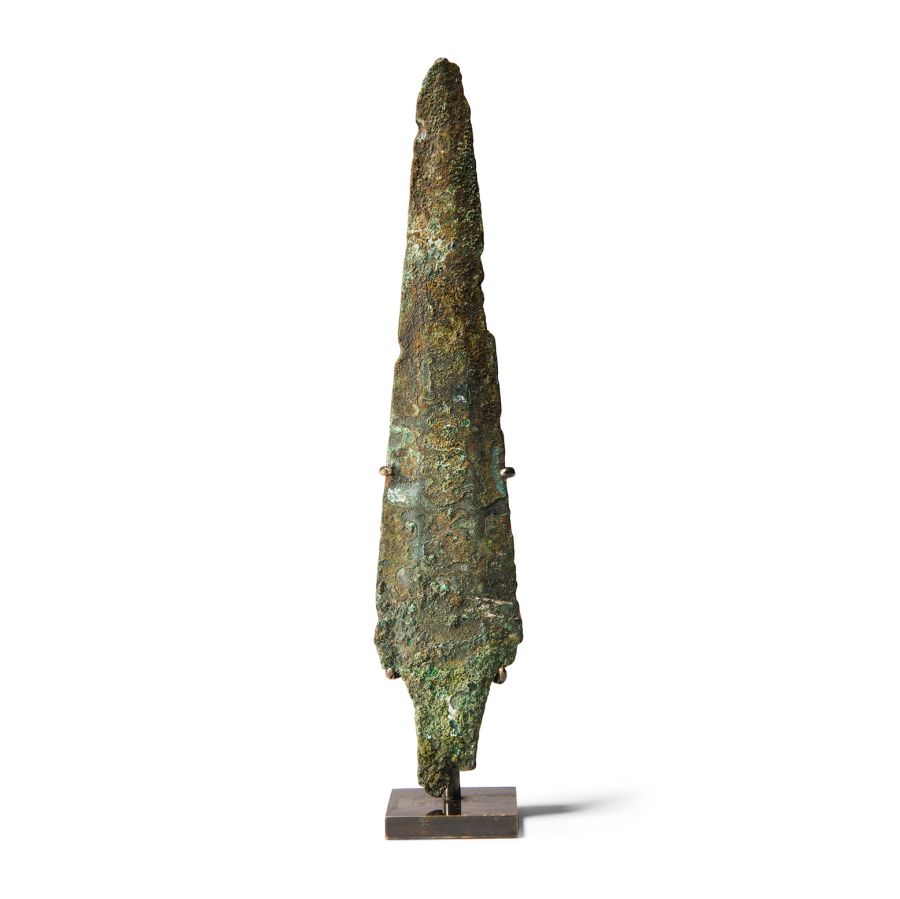
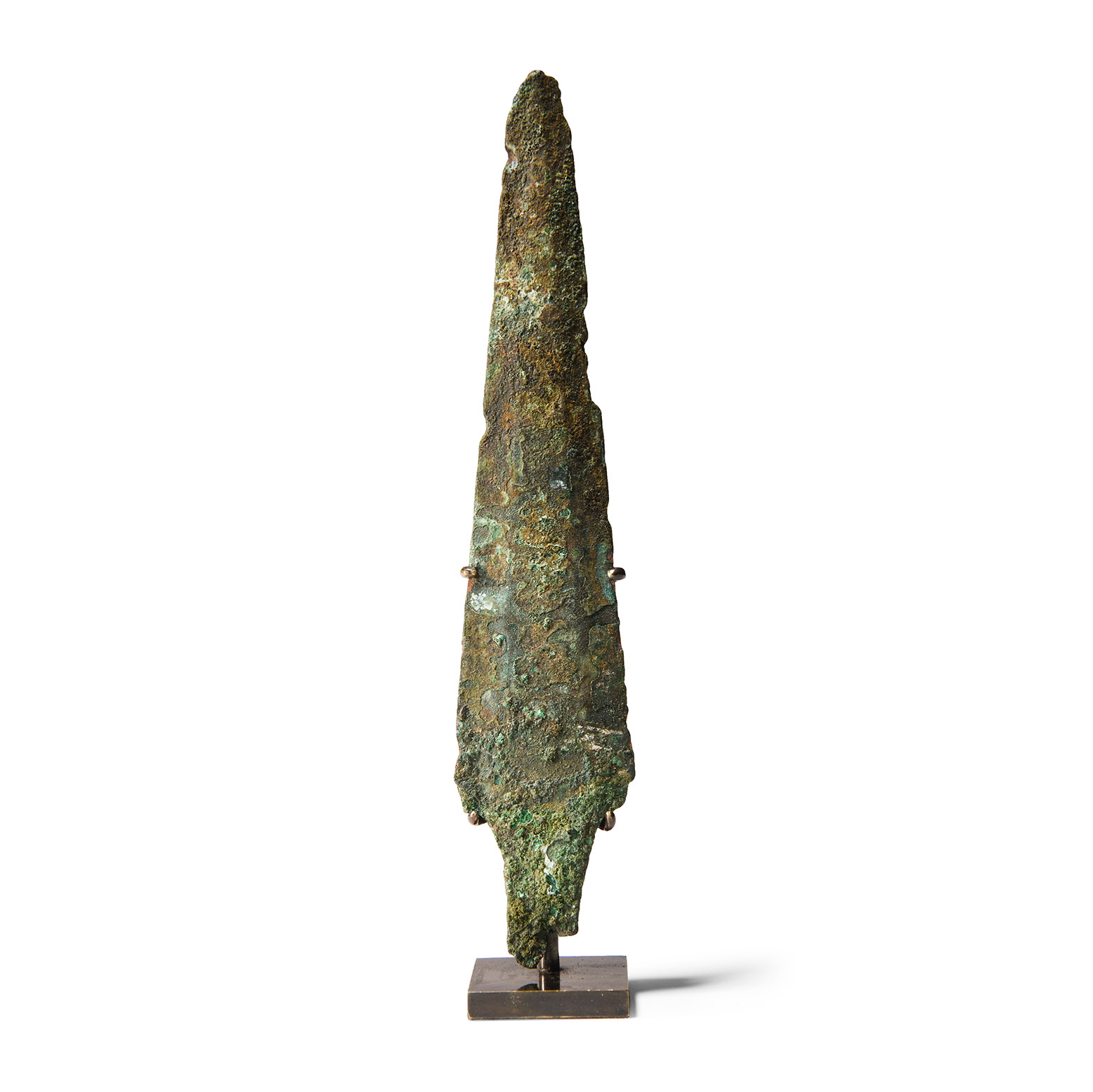
Western Asiatic Bronze Dagger
2ND MILLENNIUM B.C.
6 7/8 in. (128 grams total, 17.6 cm high including stand).
With a narrow pointed blade and wide raised flange down centre, straight sides, well marked shoulders with narrow tang, one hole for rivet.
ProvenanceFrom the possessions of a member of a German princely family, gathered in the late 19th century, until the 1930s.
with Auction House CUSP, Vienna, Auction Antique Art from Asia and from the Eastern Mediterranean, 16 June 2012, lot 75 [Part].
See Maxwell-Hyslop, R., 'Daggers and swords in Western Asia: a Study from Prehistoric Times to 600BC,' in Iraq, Volume 8, 1946, pp.1-65, pl.II, type 12.
FootnotesThe type was technically more advanced than previous types of blades in the Near East, owing to the shape of the weapon, with its slightly convex sides widening out near the point, which combined the advantages of the leaf-shaped and straight-sided forms.
CONDITIONTimeLine Auctions follows a vetting process to ensure the authenticity and legality of all items, reinforcing our commitment to integrity and responsible trading. Each antiquity, antique, and coin lot undergoes thorough examination by a vetting committee of at least ten external specialists, professional trade association members, scientists, and archaeologists: Our Vetting Process
AUCTIONS:
TimeLine is a leading auction house specialising in antiquities, ancient art, collectables, natural history, coins, medals, and books. Our auctions offer museums, collectors, historians, and enthusiasts the opportunity to acquire unique and historically significant pieces.
LOT 1143
Western Asiatic Bronze Dagger
Estimate £200 - 300€230 - 350 (for guidance only)$270 - 410 (for guidance only)
-
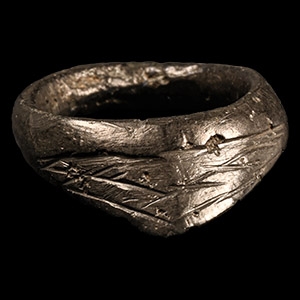
Medieval Child's Bronze Archer's Ring
14th-16th century A.D.Sold for (Inc. bp): £85
Displaying incised dashed lines to the bezel. 3.19 grams, 23.87 mm overall, 14.01 mm internal diameter (approximate size British F 1/2, USA 3, Europe 4.3, Japan 4)
Private collection formed since the 1940s. UK art market. Property of an Essex gentleman. -
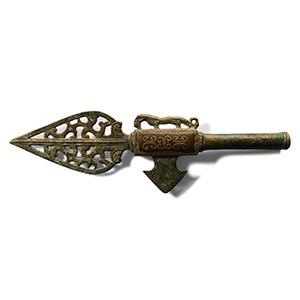
Chinese Style Bronze Ceremonial Halberd Sceptre Head
20th century A.D.Sold for (Inc. bp): £29
The leaf-shaped head displaying sinuous openwork animals on either side, rectangular collar with etched ornament, possibly a nameplate, repeated on both faces, a feline to one side and a flat-section arrow to the other, tubular socket below. 293 grams, 28 cm
Acquired in Germany. Property of RWM Collection.
During the Warring States Period (475-221 B.C.), Chinese warfare evolved. Kings and princes were replaced on the battlefield by infantries lead by military generals. New arms and armour were invented, including the halberd and crossbow. This sceptre head has a spearhead finial that features an openwork motif that is both decorative as well as functional, since it decreases the weight of the bronze, making the spear cheaper to produce and lighter to use. -
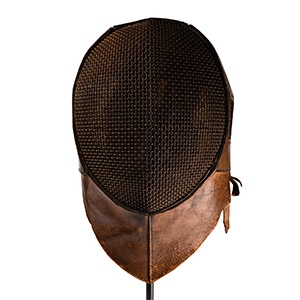
British Leather Fencing Helmet
Circa 1890-1920s A.D.Sold for (Inc. bp): £234
By Lillywhite Frowd Co of London, fitted with neck fringe, stamped buckled securing strap and wire mesh face and ear panels, padded lining internally marked 'broad arrow-over-67' so likely a military issue. 2.0 kg, 39 cm
Acquired from Manfred Schotten Antiques, 2016. The Kusmirek Collection, UK. Accompanied by a copy of Manfred Schotten invoice and listing.
Although masks/helmets of this general form are typically associated with sword fencing, this example is of very heavy construction so possibly for use in protecting while training with a heavier weapon than a foil or epee.
