
Loading, please wait...
LOT 1185
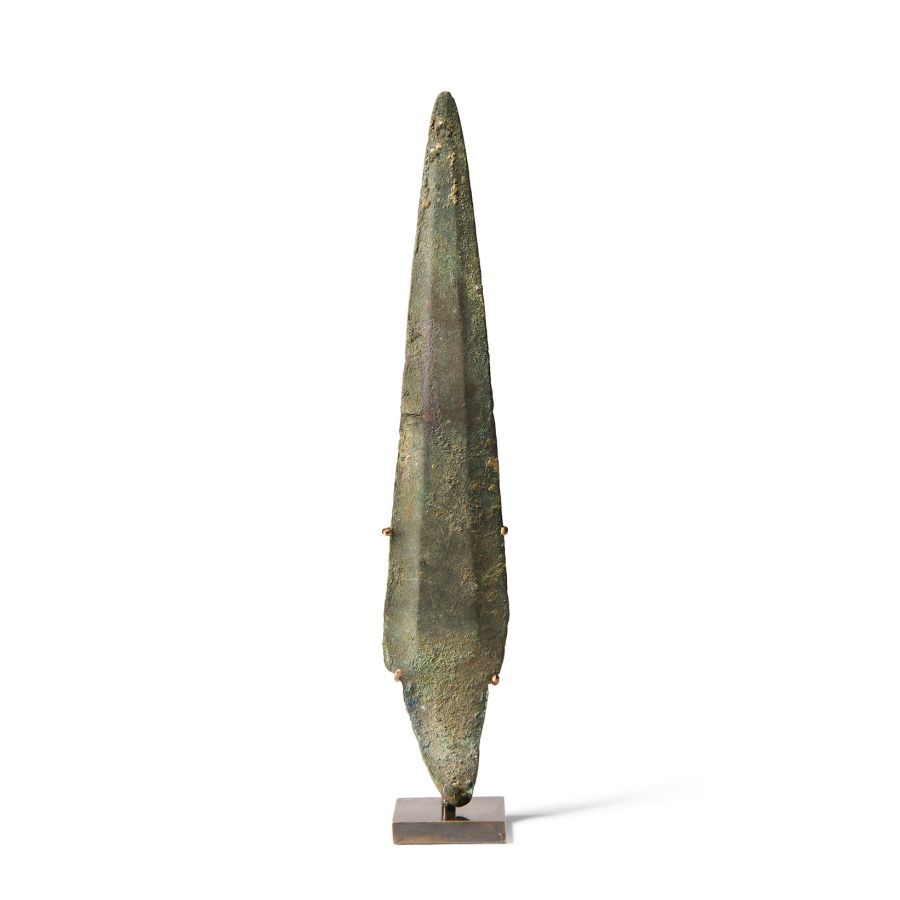
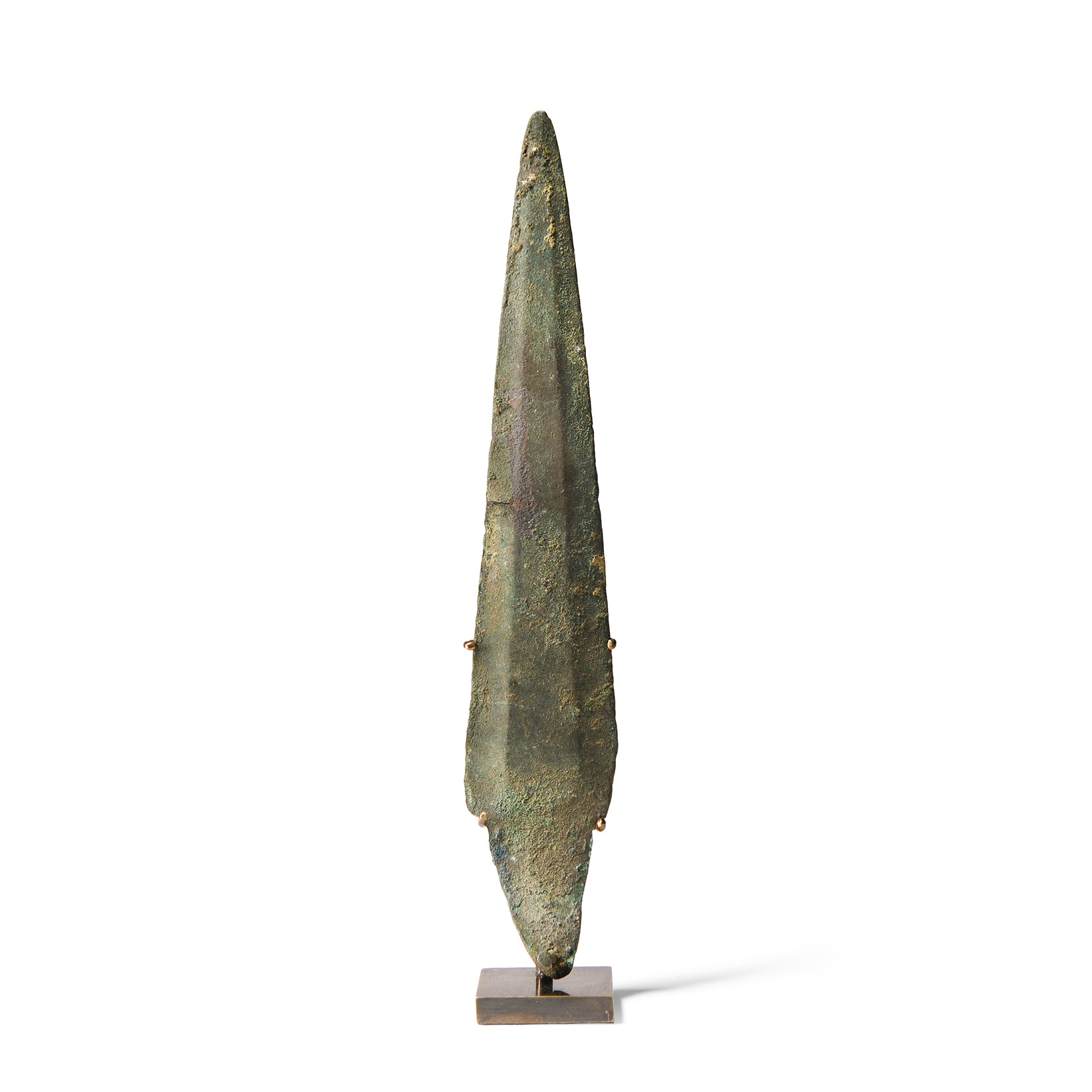
Western Asiatic Bronze Dagger
2ND MILLENNIUM B.C.
8 1/4 in. (149 grams total, 21 cm high including stand).
With narrow pointed blade and wide raised flange down centre, straight sides, well marked shoulders with wide tang, one upper hole for rivet.
ProvenanceFrom the possessions of a member of a German princely family, gathered in the late 19th century, until the 1930s.
with Auction House CUSP, Vienna, Auction Antique Art from Asia and from the Eastern Mediterranean, 16 June 2012, lot 75 [Part].
See Maxwell-Hyslop, R., 'Daggers and swords in Western Asia: a Study from Prehistoric Times to 600BC,' in Iraq, Volume 8, 1946, pp.1-65, pl.II, type 12.
FootnotesThe type was technically more advanced than previous types of blades in the Near East due to its shape and its slightly convex sides widening out near the point, which combined the advantages of the leaf-shaped and straight-sided forms.
CONDITIONTimeLine Auctions follows a vetting process to ensure the authenticity and legality of all items, reinforcing our commitment to integrity and responsible trading. Each antiquity, antique, and coin lot undergoes thorough examination by a vetting committee of at least ten external specialists, professional trade association members, scientists, and archaeologists: Our Vetting Process
AUCTIONS:
TimeLine is a leading auction house specialising in antiquities, ancient art, collectables, natural history, coins, medals, and books. Our auctions offer museums, collectors, historians, and enthusiasts the opportunity to acquire unique and historically significant pieces.
LOT 1185
Western Asiatic Bronze Dagger
Estimate £200 - 300€230 - 350 (for guidance only)$270 - 410 (for guidance only)
-
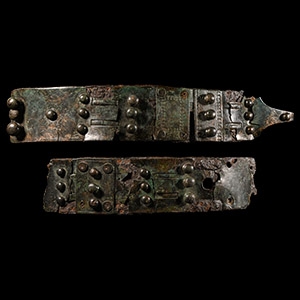
Assyrian Belt Fragment Group
9th-7th century B.C.Sold for (Inc. bp): £442
Comprising two bronze belt sections, each with a ferrous backing; applied sheet-bronze rectangular plates held in place with domed rivets and washers, some decorated with a border of pelleted triangular punchmarks topped with a pellet or ring-and-dot motif; one fragment with finial with remains of a riveted hook, the other with corresponding hole. 609 grams total, 23-30 cm
Ex Axel Guttmann collection. -
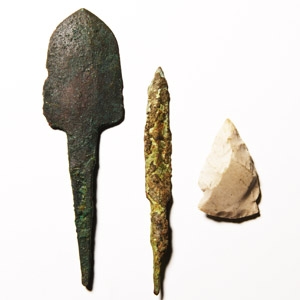
Bronze Age and Other Arrowhead Collection
3rd-1st millennium B.C.Sold for (Inc. bp): £33
The mixed group comprising a knapped stone arrowhead and two tanged copper-alloy arrowheads of different types. 38 grams total, 3.5-10 cm
Acquired on the UK art market, the bronze arrowheads from DRG Coins and Antiquities, Essex, UK. Ex private Merseyside, UK, collection. -
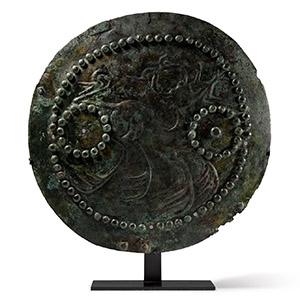
Etrusco-Italic Breastplate with Mythical Animal
5th century B.C.Sold for (Inc. bp): £4,680
Displaying a repoussé horned animal advancing right, two roundels composed of bulbous rivets flanking the animal and encircling the central design; accompanied by a custom-made display stand. 626 grams total, 28.5 cm high including stand
Collection of Jacques and Henriette Schumann, formed between 1950 and 1970. The Schumanns inherited part of their collection from Henriette’s parents, Alice and Fernand Halphen, andjacques’ maternal grandfather, Albert Lehmann. Collection of Jacques and Henriette Schumann, Christie's, Paris, 30th September 2003, lot 85. Accompanied by a copy of a French cultural passport no.107322. This lot has been checked against the Interpol Database of stolen works of art and is accompanied by search certificate number no.11877-207824.
This type of armour, composed from a bronze breast and back plate with hinged shoulder straps, all the parts backed with iron, was used by Etruscans, Hernici, Aequi and Volsci, the feared enemies of early Rome. In particular our item has many parallels with the disc-cuirass (cardiophylax) found in the Necropolis of Alfadena.
