
Loading, please wait...
LOT 1091
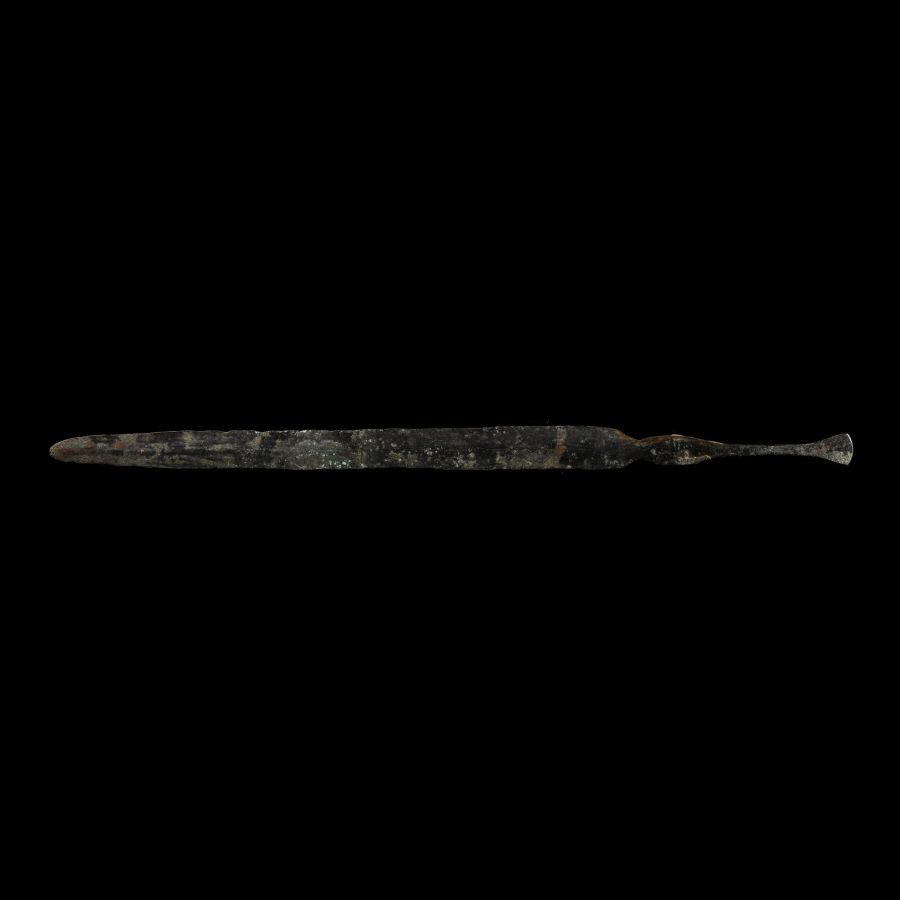
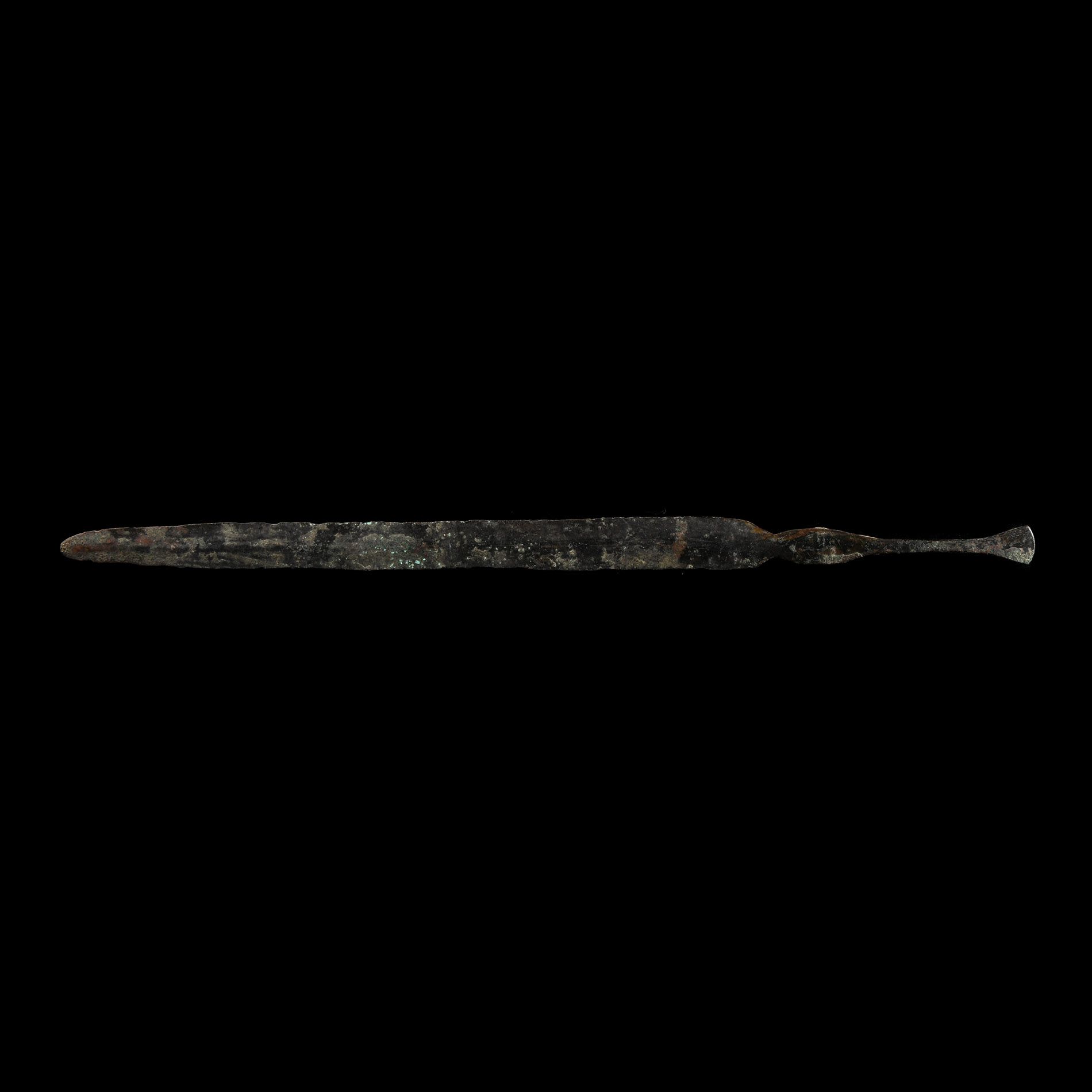
Western Asiatic Bronze Dagger Blade
EARLY 1ST MILLENNIUM B.C.
13 in. (61 grams, 33 cm).
With a narrow tapering blade, slightly enlarged in the guard area and narrowing again towards the 'ear' pommel.
ProvenanceAcquired 1980-2015.
Ex Abelita family collection.
See Christie's, Axel Guttmann collection of Ancient Arms and Armour, Part 2, London, South Kensington, Wednesday 28 April 2004, for a similar dagger (lot 21, p.22).
FootnotesThe techniques used by Luristan craftsmen to create bronze weapons were highly sophisticated. They used a wide variety of surface finishes: repoussé work, chasing and engraving. The fact that the mountains of Luristan were particularly rich in copper and tin, both required for making bronze, was a significant advantage to the metalworking industry. The weapons produced developed into a plethora of different forms in the 2nd millennium B.C. to at least 800 B.C. These objects include axes and adzes, pick axes, daggers and dirks, spears, swords, helmets and shields. Weapons were usually cast, but armour parts were also made by the hammering process.
CONDITIONTimeLine Auctions follows a vetting process to ensure the authenticity and legality of all items, reinforcing our commitment to integrity and responsible trading. Each antiquity, antique, and coin lot undergoes thorough examination by a vetting committee of at least ten external specialists, professional trade association members, scientists, and archaeologists: Our Vetting Process
AUCTIONS:
TimeLine is a leading auction house specialising in antiquities, ancient art, collectables, natural history, coins, medals, and books. Our auctions offer museums, collectors, historians, and enthusiasts the opportunity to acquire unique and historically significant pieces.
-
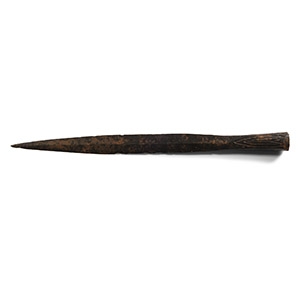
Viking Age Socketted Iron Spearhead
9th-10th century A.D.Sold for (Inc. bp): £195
Type E with leaf-shaped blade with curved edges, socket tending towards a square internal cross-section and decorated with chiselled longitudinal grooves. 126 grams, 28.5 cm
Ex private collection of Mr M.B., Mainz, Germany, since the 1980s. Acquired from the above, 2004.
The spearheads of type E, of which this type is, belongs to the first group of Viking spearheads, i.e. the Frankish spearheads, which appeared between 750 and 950 A.D. These account for one third of the spears found in Viking sites; most of them are pattern forged with herringbone design. -
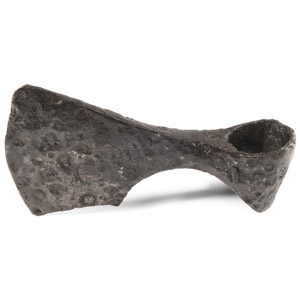
Viking Age Finno-Ugrian Socketted Axehead
10th-13th century A.D.Sold for (Inc. bp): £104
Hand-forged with triangular-section narrow blade widening to a broad bevelled edge with square chin and spur to the rear, socket with flanges to the rear. 548 grams, 17 cm
From the private collection of a London gentleman, from his grandfather's collection formed before the early 1970s.
During the mid 13th century, the axes were favourite weapons among Baltic people. For instance the Curonian army included lightly armed soldiers who fought with spears, shields, fighting knives and axes. A heavily armed soldier could also carry a sword, a helmet, a shield and a wide-bladed axe. -
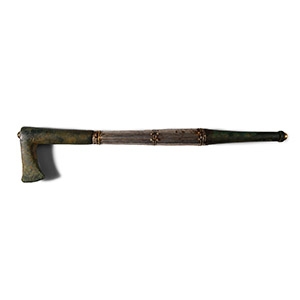
Elamite Ceremonial Axe with Silver Sleeve
3rd-2nd millennium B.C.Estimate: £12,000 - 17,000 (‡+bp*)
Opening Bid: £6,000
With later sheet-silver sleeve to the shaft, attached with ball-headed rivets; gilt dome finial to each end, the lower one in a gusseted collar. 750 grams, 45.5 cm
Acquired in 1996. Ex Samad Khameneh collection. Private Swiss collection. This lot has been checked against the Interpol Database of stolen works of art and is accompanied by search certificate no.11647-199005.
The axe belongs typologically to Type 4 of Maxwell-Hyslop’s classification, with a long and thin shaft narrowing towards the base. When technical developments resulted in heavier axe-blades, it was necessary to prolong the socket into a shaft tube and to cut away the underside of the blade where it joined the shaft. The edge of the blade was curved and this shifted the point of impact of the cutting edge.
