
Loading, please wait...

LOT 0678
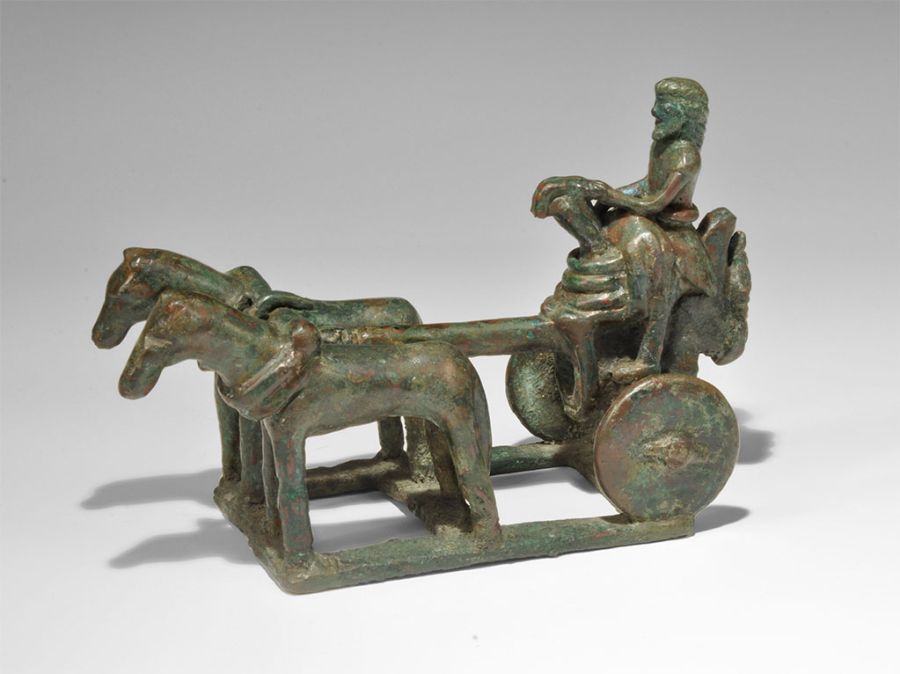
Western Asiatic Bronze Chariot Hunter
MID 3RD MILLENNIUM BC
7 1/4" (692 grams, 18.5cm).
A diorama on a rectangular framework base comprising: two stationary horses with halters attached to a round-section balustered yoke; a two-wheeled hunting chariot with stepped axle-tree and linch-pins to the solid wheels; a kilted hunter standing bare-chested and bearded holding the reins (part absent), with a slaughtered animal across the frame before him, game-bag behind to his left and quiver with arrows to his right; to the rear, a small hunting dog riding on the chariot's beam.
ProvenanceEx Auction FR, Paris, 17 December 2008, Lot 83; formerly in an important North London collection formed before 1980.
LiteratureSee Frankfort, H. The Art and Architecture of the Ancient Orient, Middlesex, 1954.
FootnotesThe horse was first domesticated on the Eurasian steppe, its original habitat, perhaps as early as the 4th millennium BC; it may have been bred as a food source initially, but its use as a traction animal had begun by the beginning of the 2nd millennium BC, replacing the ox for this purpose. Wheeled vehicles had already appeared in the 3rd millennium BC, but the spoked wheel is not evidenced until the late 2nd millennium BC. The earliest known physical remains of chariots are in the chariot burials of the Andronovo Culture, an Indo-Iranian population in the area of modern Russia and Kazakhstan dating to around 2000 BC.
The combination of multiple horses and light-framed two-wheeled vehicles offered the possibility of travel at speed, both for war and for hunting. Chariot warfare originated with the Hittites, with the invention of spoked wheels around 1900 BC. Depictions of hunting in a chariot appear in Egypt after the vehicle's introduction by the Hyksos in the 16th century BC, notably at Abu Simbel where the Battle of Kadesh fought in 1274 BC is represented, showing Ramses II fighting from a chariot with two archers accompanying him.
See similar example made from gold that forms part of the Oxus Treasure now in the British museum.
TimeLine Auctions follows a vetting process to ensure the authenticity and legality of all items, reinforcing our commitment to integrity and responsible trading. Each antiquity, antique, and coin lot undergoes thorough examination by a vetting committee of at least ten external specialists, professional trade association members, scientists, and archaeologists: Our Vetting Process
AUCTIONS:
TimeLine is a leading auction house specialising in antiquities, ancient art, collectables, natural history, coins, medals, and books. Our auctions offer museums, collectors, historians, and enthusiasts the opportunity to acquire unique and historically significant pieces.
.jpg&width=120)
3100-2900 BC
Lot No. 0741
Sold for (Inc. premium): £121
Early 2nd millennium BC
Lot No. 0755 Opening bid: £1,350
Early Dynastic Period, 3rd-2nd millennium BC
Lot No. 0777 Opening bid: £360
