
Loading, please wait...
_900x900.jpg "Western Asiatic Bronze Bowl with Dancing Figures")
_200x200.jpg "Western Asiatic Bronze Bowl with Dancing Figures")
_900x900.jpg "Western Asiatic Bronze Bowl with Dancing Figures")
_200x200.jpg "Western Asiatic Bronze Bowl with Dancing Figures")
.jpg "Western Asiatic Bronze Bowl with Dancing Figures")
.jpg "Western Asiatic Bronze Bowl with Dancing Figures")
LOT 0245
Western Asiatic Bronze Bowl with Dancing Figures
1ST CENTURY B.C.-1ST CENTURY A.D.
6 in. (121 grams, 15.2 cm wide).
Hemispherical in profile with stepped inner rim above a repoussé frieze of horned monsters each wearing a kilt and linking hands with his neighbours; below, a bilinear band enclosing a bull-headed figure sitting with legs crossed on a rectangular mat(?).
ProvenanceGerman private collection, 1990s.
with Bonhams, London, 3 October 2000, no.338.
Private collection, Europe.
This lot has been checked against the Interpol Database of stolen works of art and is accompanied by a search certificate number no.12879-241694.
This lot has been cleared against the Art Loss Register database, and is accompanied by an illustrated lot declaration signed by the Head of the Antiquities Department, Dr Raffaele D'Amato.
TimeLine Auctions follows a vetting process to ensure the authenticity and legality of all items, reinforcing our commitment to integrity and responsible trading. Each antiquity, antique, and coin lot undergoes thorough examination by a vetting committee of at least ten external specialists, professional trade association members, scientists, and archaeologists: Our Vetting Process
AUCTIONS:
TimeLine is a leading auction house specialising in antiquities, ancient art, collectables, natural history, coins, medals, and books. Our auctions offer museums, collectors, historians, and enthusiasts the opportunity to acquire unique and historically significant pieces.
-
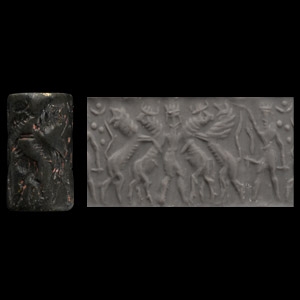
Akkadian Stone Cylinder Seal with Divine Hero
2nd-1st millennium B.C.Estimate: £500 - 700 (+bp*)
Opening Bid: £250
With front-facing standing male figure between a bull and a lion on each side, a standing male holding an axe(?), moon crescent and three dots ;accompanied by a museum-quality impression. 11.6 grams, 27 mm
From the collection of the late S, London, UK, 1970-2000. Examined by Professor Wilfrid George Lambert FBA (1926-2011), historian, archaeologist, and specialist in Assyriology and Near Eastern archaeology, in the 1990s. This lot has been cleared against the Art Loss Register database, and is accompanied by an illustrated lot declaration signed by the Head of the Antiquities Department, Dr Raffaele D'Amato. -
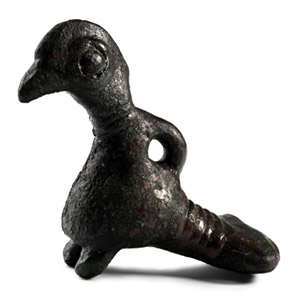
Western Asiatic Bronze Figure of a Bird
Circa 1000-600 B.C.Sold for (Inc. bp): £247
Modelled in the round as a stylised bird with large bulbous eyes and flared tail, suspension loop on the back. 54 grams, 57 mm
Nicolas Koutoulakis (1910-1996), thence by descent. Ex Galerie Khnoum, Geneva, Switzerland. Private collection of Mr K.A. This lot has been cleared against the Art Loss Register database, and is accompanied by an illustrated lot declaration signed by the Head of the Antiquities Department, Dr Raffaele D'Amato. -
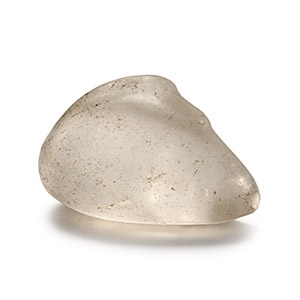
Neo Babylonian Rock Crystal Duck Weight
8th-6th century B.C. or laterSold for (Inc. bp): £221
Carved with the head resting along the spine, flat base. 9.24 grams, 27 mm
UK private collection before 2000. Acquired on the UK art market. Private collection, London, UK. This lot has been cleared against the Art Loss Register database, and is accompanied by an illustrated lot declaration signed by the Head of the Antiquities Department, Dr Raffaele D'Amato.
