
Loading, please wait...
_900x900.jpg "Western Asiatic Bronze Arrowheads, Javelin Heads and Daggers")
_200x200.jpg "Western Asiatic Bronze Arrowheads, Javelin Heads and Daggers")
.jpg "Western Asiatic Bronze Arrowheads, Javelin Heads and Daggers")
LOT 1037
Western Asiatic Bronze Arrowheads, Javelin Heads and Daggers
3RD MILLENNIUM-7TH CENTURY B.C.
5 1/2 - 8 1/2 in. (329 grams total, 14-21.5 cm).
Comprising ten slender tanged arrowheads, javelin heads and daggers, some lozenge-section and some with raised midribs. [10]
ProvenanceAcquired 1980-2015.
Ex Abelita family collection.
For similar examples of arrowheads see Gorelik, M., Weapons of Ancient East, IV millennium BC-IV century BC, Saint Petersburg (2003), pl.XLIII, nos.257 (Luristan); 261-262 (from Karkemish); for the daggers Christie's, The Axel Guttmann Collection of Ancient Arms and Armour, part 1, London, 2002, items 31; for the Javelinheads, s.Gernez, G., L’armament en métal au Proche et Moyen-Orient: des origines a 1750 av. J.C., Paris, 2007, fig.2.93, subtypes L3 B.a-b; fig.2.94 variant L3.C.a., for the type.
FootnotesMost of these blades are bipartite, but the definition of the bipartite type is not absolute as it brings together weapons of very different and unrelated designs. In fact, some weapons do not have a sufficiently characteristic shape to be interpreted as a spear, dagger, or long arrowhead. The javelin heads classified by Gernez as type Type L 3 are characterized by the simplicity of their design. They have a sharp and/or pointed active part, a flat, elliptical or rhomboidal cross-section and an elongated tang with a rectangular, square or circular section, ending in a pointed, widened, curved or folded blade.
CONDITIONTimeLine Auctions follows a vetting process to ensure the authenticity and legality of all items, reinforcing our commitment to integrity and responsible trading. Each antiquity, antique, and coin lot undergoes thorough examination by a vetting committee of at least ten external specialists, professional trade association members, scientists, and archaeologists: Our Vetting Process
AUCTIONS:
TimeLine is a leading auction house specialising in antiquities, ancient art, collectables, natural history, coins, medals, and books. Our auctions offer museums, collectors, historians, and enthusiasts the opportunity to acquire unique and historically significant pieces.
LOT 1037
Western Asiatic Bronze Arrowheads, Javelin Heads and Daggers
Estimate £180 - 240€210 - 280 (for guidance only)$240 - 320 (for guidance only)
-
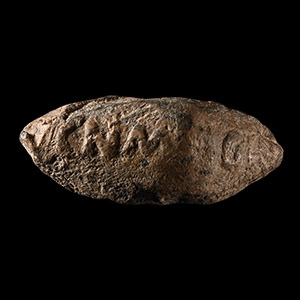
Roman 'Pompey the Great' Lead Slingshot
1st century B.C.Sold for (Inc. bp): £286
Biconical lead slingshot (glans) with inscription in Latin letters 'CN' (Cneius) 'MAG' (Magnus) on one side, and 'IMP' for 'IMPERATOR' (victorious general) to the other side, i.e Gnaeus Pompeius Magnus Imperator (Pompey the Great the victorious general). 47 grams, 39 mm
Ex M.Cummings, UK, 1990s.
The shot (Völling type 1C) is marked with the abbreviated name of Gnaeus Pompey; it was used in quantity at the Battle of Monda (or Munda) against Julius Caesar, 17th March 45 BC. The projectiles were made of different materials: lead (glandes) or in pottery or stone (lapides missiles). Sometimes they were signed with the name of the general, like our specimen. -
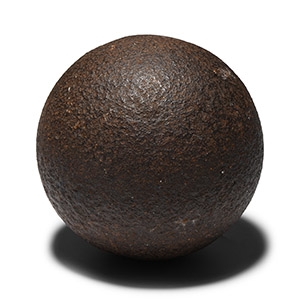
English Civil War Iron Cannon Ball
1642-1651 A.D.Sold for (Inc. bp): £182
Possibly made for a naval long gun, a 'long nine'. 4.3 kg, 98 mm wide
Found in a churchyard in Derbyshire, UK, before 1950. Acquired from the son of the clergyman that found it, in 2004. Property of a Nottinghamshire gentleman. -
.jpg)
North Western Bronze Short Sword
2nd-1st millennium B.C.Sold for (Inc. bp): £1,885
Of fine quality, showing an open cast crescentic pommel with raised midrib and two parallel shallow lines across the top; pommel open on both sides to reveal the tip of the blade, tang rising from the grip; the solid cylindrical grip decorated with fourteen circumferential ribs, angular guard and triangular blade with strong midrib. 1.05 kg, 58 cm
Ex P.A., Hertfordshire, UK, specialist collection of Greek art, 1980-1990s.
The dirk has its hilt cast onto the blade. Moorey published a very similar piece with fourteen encircling ribs on the grip and attributed similar pieces to the North-West, also based upon examples of similar dirks from the Iranian and Russian Talesh region. He dated these pieces to the late 2nd millennium B.C. Similar examples were excavated at Marlik. Stutzinger attributed these types with a wider dating (13th-9th century A.D.)
