
Loading, please wait...
LOT 1077
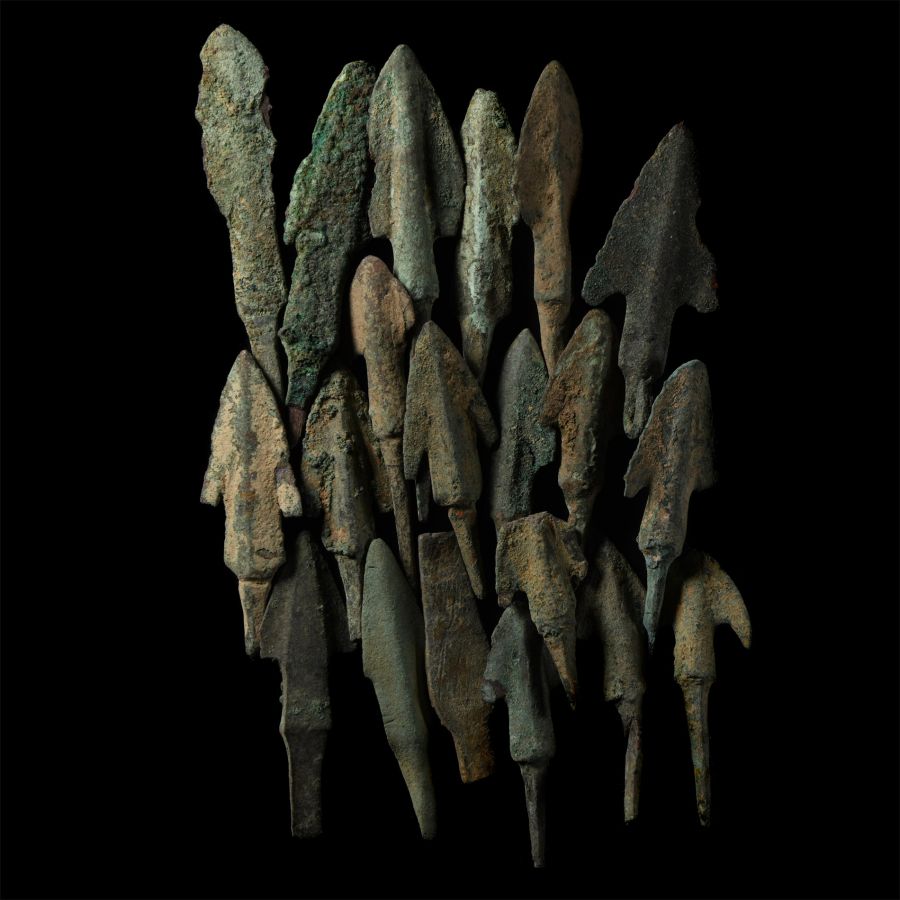
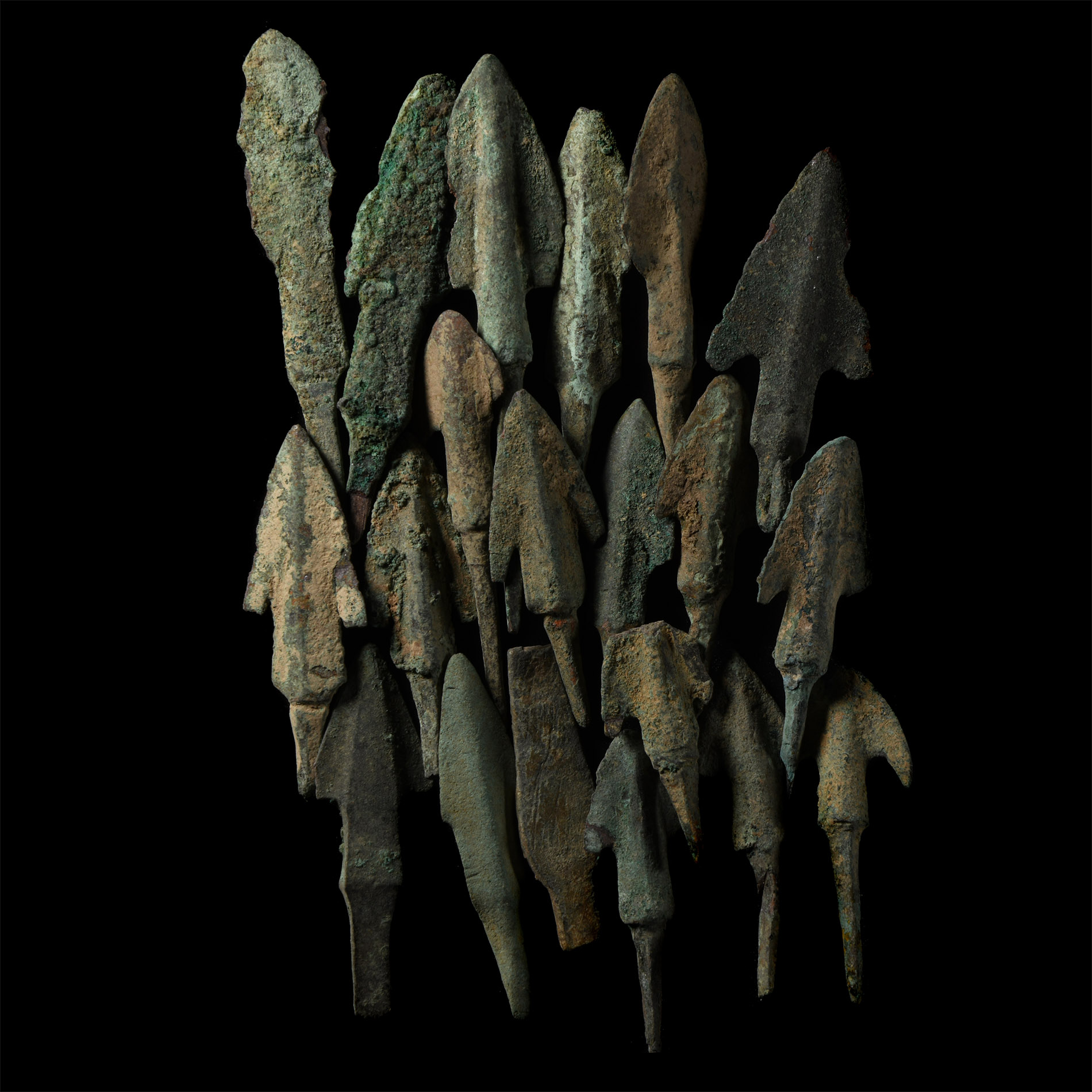
Western Asiatic Bronze Arrowhead Group
10TH-9TH CENTURY B.C.
1 1/8 - 2 5/8 in. (103 grams total, 29-68 mm).
Comprising mainly tanged arrowheads, the most of them having large elongated triangular blades and raised midrib, sharp central groove, cylindrical or squared stem for the shaft, barbed shoulders and convex sides; others with lanceolate head and rounded shoulders with long tang and foliate-section. [20]
ProvenanceAcquired 1980-2015.
Ex Abelita family collection.
See Khorasani, M.M., Arms and Armour from Iran. The Bronze Age to the End of the Qajar Period, Tübingen, 2006, figures 463, 467, and 471, for the types.
FootnotesThe most of these arrowheads, having a lozenge-section midrib with thin blades filed sharp at the edges, are typical of the early Iron Age in Luristan. These arrowheads seem to belong to the type V, subcategory types A, C and D according to the classification of Khorasani and Negahban. In the four categories of triangular bronze arrowheads from Luristan, Marlik, and Northern Iran individuated by Negahban, subtypes C and D of type V are larger arrow or javelin heads, C with barbed shoulders and D with round shoulders. Subtype A is substantially similar to C, but smaller. Similar arrowheads are also visible in the Western Iberian and Balkan cultures in the Early Iron Age.
CONDITIONTimeLine Auctions follows a vetting process to ensure the authenticity and legality of all items, reinforcing our commitment to integrity and responsible trading. Each antiquity, antique, and coin lot undergoes thorough examination by a vetting committee of at least ten external specialists, professional trade association members, scientists, and archaeologists: Our Vetting Process
AUCTIONS:
TimeLine is a leading auction house specialising in antiquities, ancient art, collectables, natural history, coins, medals, and books. Our auctions offer museums, collectors, historians, and enthusiasts the opportunity to acquire unique and historically significant pieces.
-
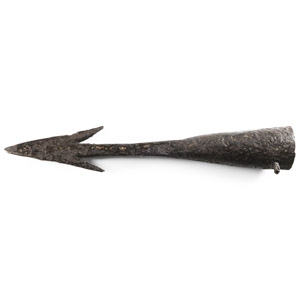
Late Roman Iron Socketted Javelin
4th-6th century A.D.Sold for (Inc. bp): £208
Fitted with a triangular blade with two barbs, expanding tubular socket. 213 grams, 23.5 cm
From the private collection of a London gentleman, from his grandfather's collection formed before the early 1970s.
Since the third century, Roman soldiers increasingly started to use long shafted socketed weapons with barbed heads. These weapons were called bebrae by Vegetius, according to whom they were able to cut heads with a single stroke. They first appeared in Northern Europe, as shown by numerous finds of barbed heads in graves and peat-bogs, especially Danish, and were introduced to the Roman army by Germanic mercenaries. -
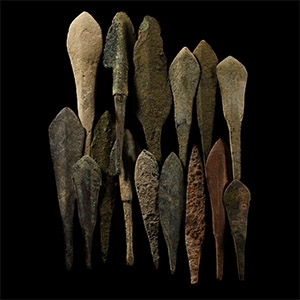
Western Asiatic Bronze Arrowhead Group
2nd-1st millennium B.C.Estimate: £100 - 140 (+bp*)
Opening Bid: £50
Comprising fifteen tanged examples, including one slender arrowhead in iron. 112 grams total, 44-75 mm
Acquired 1980-2015. Ex Abelita family collection. -
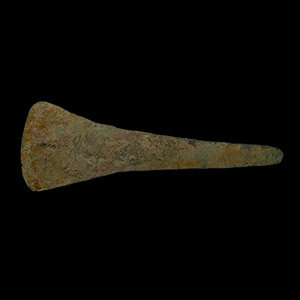
Luristan Copper Flat Axehead
13th-7th century B.C.Estimate: £100 - 140 (+bp*)
Opening Bid: £50
Formed with a rounded butt and flared cutting edge; flat in cross-section. 112 grams, 20.8 cm
UK private collection formed before 2000. Ex North London, UK, gallery.
