
Loading, please wait...
LOT 1085
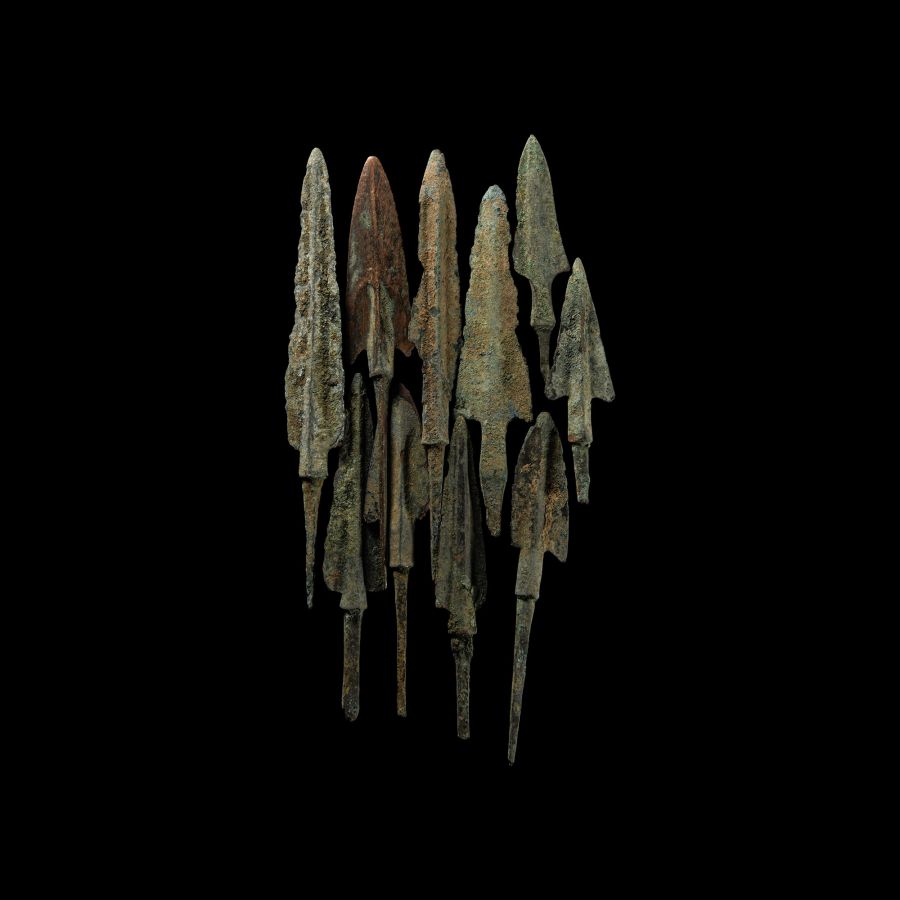
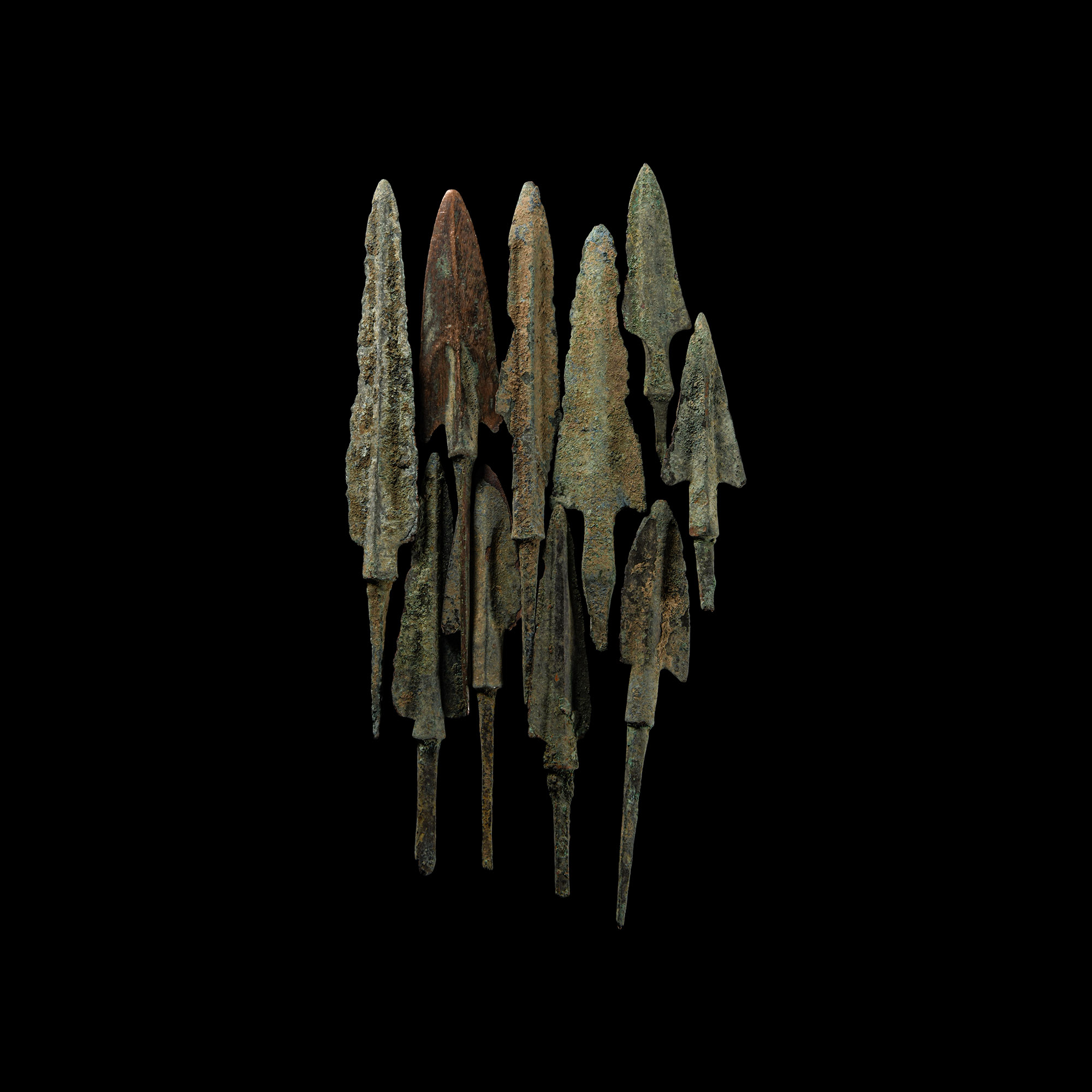
Western Asiatic Bronze Arrowhead Group
14TH-10TH CENTURY B.C.
3 1/8 - 5 7/8 in. (203 grams total, 8.1-15 cm).
Comprising ten triangular arrowheads with tangs. [10]
ProvenanceAcquired 1980-2015.
Ex Abelita family collection.
See Khorasani, M.M., Arms and Armour from Iran. The Bronze Age to the End of the Qajar Period, Tübingen, 2006, figures 467 and 470, for some of these types.
FootnotesSome of these arrowheads seem to belong to the type V, subcategory types A and C according to the classification of Khorasani and Negahban. In the four categories of triangular bronze arrowheads from Luristan, Marlik and Northern Iran described by Negahban, subtypes A and C of type V are larger arrow heads with barbed shoulders and triangular heads. These types of arrowheads were commonly used in Anatolia and Mesopotamia from the 2nd millennium B.C., but apparently their employment began earlier in this area, where types like these occur alongside the non-barbed, predominantly ribbed and tanged types.
CONDITIONTimeLine Auctions follows a vetting process to ensure the authenticity and legality of all items, reinforcing our commitment to integrity and responsible trading. Each antiquity, antique, and coin lot undergoes thorough examination by a vetting committee of at least ten external specialists, professional trade association members, scientists, and archaeologists: Our Vetting Process
AUCTIONS:
TimeLine is a leading auction house specialising in antiquities, ancient art, collectables, natural history, coins, medals, and books. Our auctions offer museums, collectors, historians, and enthusiasts the opportunity to acquire unique and historically significant pieces.
-
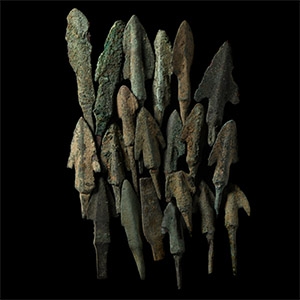
Western Asiatic Bronze Arrowhead Group
10th-9th century B.C.Sold for (Inc. bp): £117
Comprising mainly tanged arrowheads, the most of them having large elongated triangular blades and raised midrib, sharp central groove, cylindrical or squared stem for the shaft, barbed shoulders and convex sides; others with lanceolate head and rounded shoulders with long tang and foliate-section. 103 grams total, 29-68 mm
Acquired 1980-2015. Ex Abelita family collection.
The most of these arrowheads, having a lozenge-section midrib with thin blades filed sharp at the edges, are typical of the early Iron Age in Luristan. These arrowheads seem to belong to the type V, subcategory types A, C and D according to the classification of Khorasani and Negahban. In the four categories of triangular bronze arrowheads from Luristan, Marlik, and Northern Iran individuated by Negahban, subtypes C and D of type V are larger arrow or javelin heads, C with barbed shoulders and D with round shoulders. Subtype A is substantially similar to C, but smaller. Similar arrowheads are also visible in the Western Iberian and Balkan cultures in the Early Iron Age. -
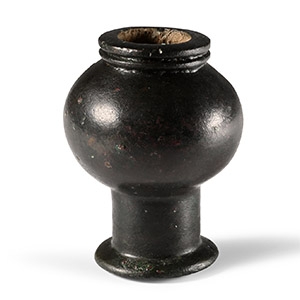
Luristan Sar-e Gorz Luristan Bronze Macehead
14th-13th century B.C.Estimate: £200 - 300 (+bp*)
Opening Bid: £111
With plain globular body, extended to a small raised ring encircling the top of the mace-head, circular short shaft expanding to a circular flat base. 279 grams, 70 mm high
Acquired 1980-2015. Ex Abelita family collection.
Caucasian stone and bronze maces were distinguished by modestly finished, clean processed and predominantly close-to-ball shapes (with a variety of surface finishing, ranging from the smooth, ribbed, lobular forms to the rounded with protrusions and spikes), and the Western Iranian maces, especially the Luristan ones, notable for the variety of different forms. Similar mace-heads, probably realised in Luristan, decorated the head of the sceptres of Assyrian kings like Tukulti-Ninurta I (1243-1207 B.C.). -
.jpg)
Siamese 'Wild Tigers Corps' Type 62 Pattern 1907 Bayonet and Scabbard
Dated 1919 A.D.Sold for (Inc. bp): £65
Stamped 2642 in Thai numerals at top of blade with 'tiger mask' mark for Siam, together with original British marks, fitted with wood grip scales and spring release button; the scabbard with original throat and chape, modified in Thailand to replace the original leather main section. 726 grams, 58.5 cm
Property of a Luton, UK gentleman, by inheritance.
The Type 62 is a re-badged British Pattern 1907 bayonet. Siam purchased 10,000 SMLE rifles and Pattern 1907 bayonets from Britain in 1919 to equip the 'Wild Tiger Corps', royal bodyguard of Vajiravudh, King Rama VI (reigned 1910–1925). The tiger figural on the ricasso is representative of the Wild Tiger Corps. Year 2462 on the Buddhist Calendar corresponds to 1919. SMLE rifles and Pattern 1907 bayonets were taken from British stocks, refurbished by Birmingham Small Arms (BSA), and remarked with Siamese markings. The bayonets were shipped with standard steel-mounted leather scabbards. However, the leather rapidly deteriorated in the tropical climate, so the Siamese made a replacement steel scabbard body to which the original steel mounts were brazed.
