
Loading, please wait...
LOT 1985
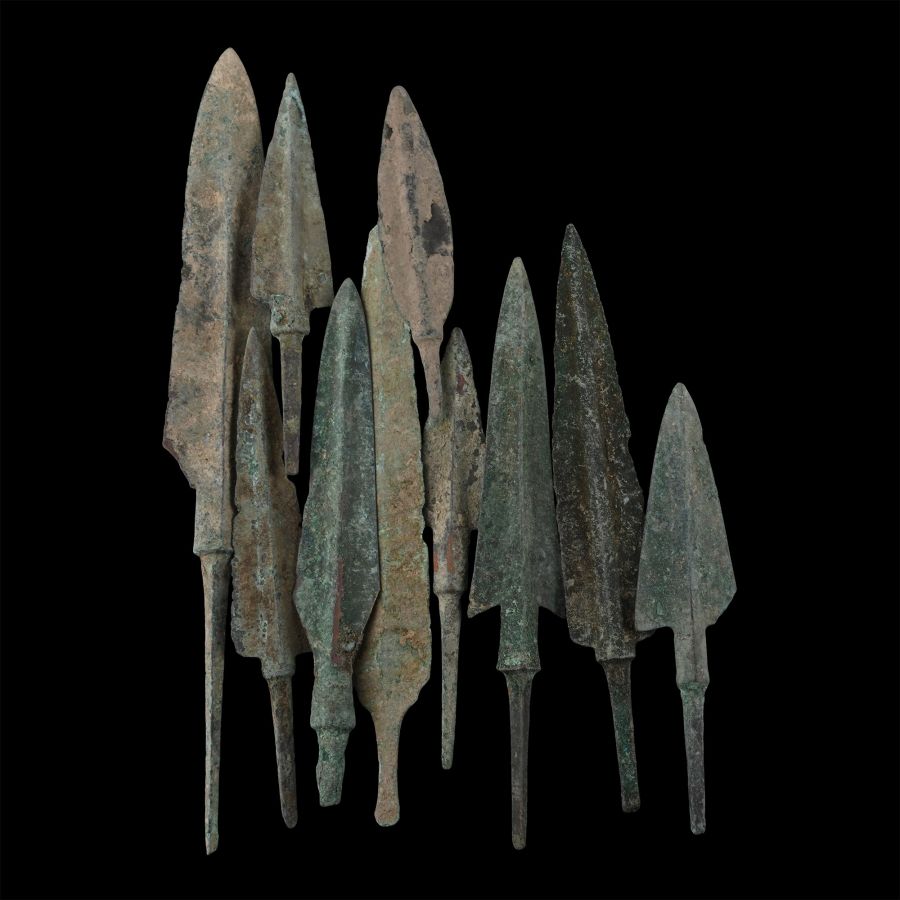
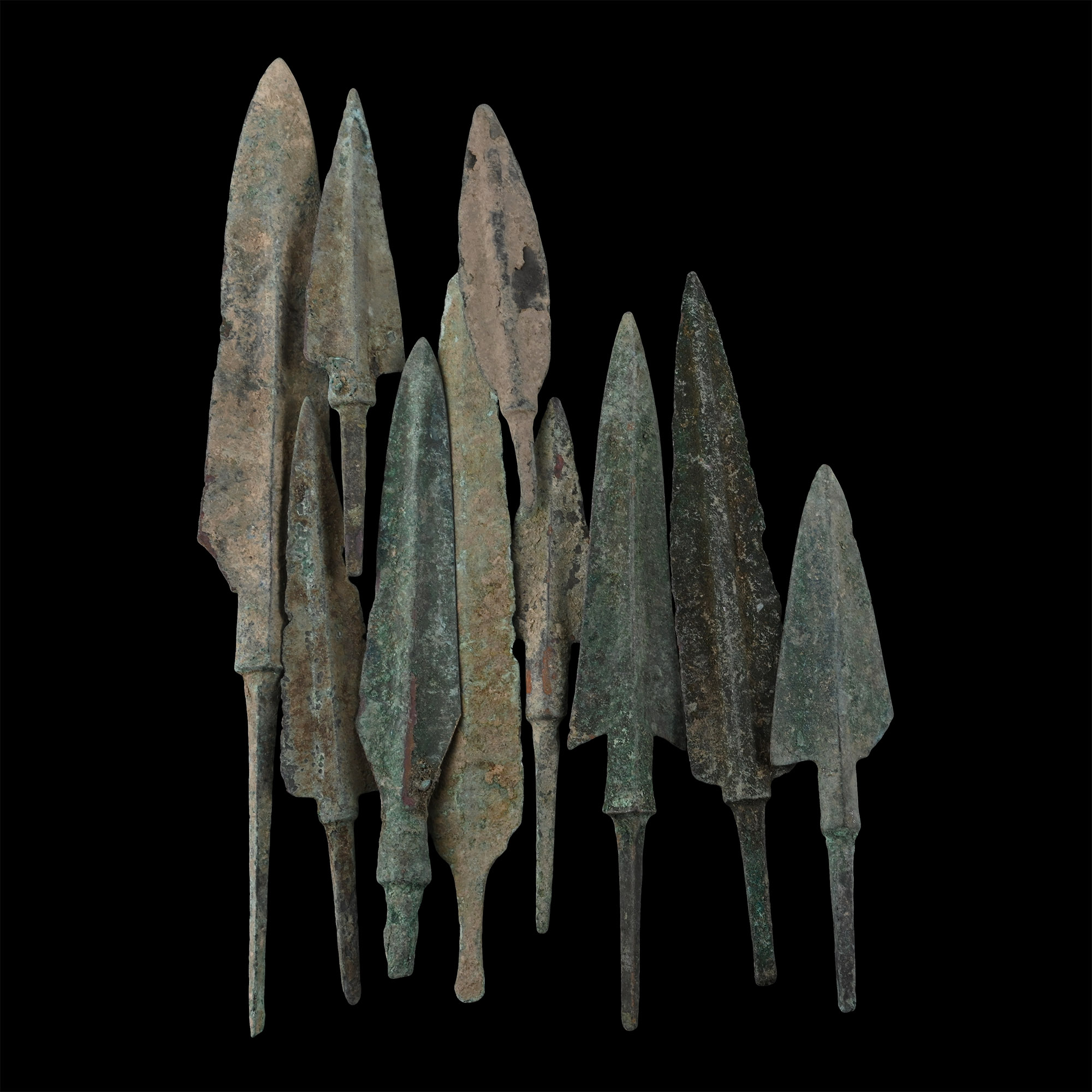
Western Asiatic Bronze Arrowhead Collection
2ND-1ST MILLENNIUM B.C.
3 1/8 - 7 3/8 in. (238 grams total, 8.1-18.7 cm).
Comprising leaf-shaped and triangular tanged arrowheads, most with a raised midrib. [10]
ProvenanceLondon, UK, collection, 1990s.
LiteratureCf. Muscarella, O.W., Bronze and Iron Ancient Near Eastern Artifacts in the Metropolitan Museum of Art, New York, 1988, pp.289ff, for similar arrowheads; Mahboubian, H., Art of the Ancient Iran, London, 1997, no.390, for some similar arrowheads.
FootnotesAll these bronze typologies of arrowheads were cast in moulds. Similar specimens have been found in Northwest and West Iran, Azerbaijan, Luristan and Amlash. Most of these blades are bipartite, but the definition of the bipartite type is not absolute, as it brings together weapons of very different and unrelated designs. In fact, some weapons do not have a sufficiently characteristic shape to be interpreted as a javelin or long arrowhead.
CONDITIONTimeLine Auctions follows a vetting process to ensure the authenticity and legality of all items, reinforcing our commitment to integrity and responsible trading. Each antiquity, antique, and coin lot undergoes thorough examination by a vetting committee of at least ten external specialists, professional trade association members, scientists, and archaeologists: Our Vetting Process
AUCTIONS:
TimeLine is a leading auction house specialising in antiquities, ancient art, collectables, natural history, coins, medals, and books. Our auctions offer museums, collectors, historians, and enthusiasts the opportunity to acquire unique and historically significant pieces.
LOT 1985
Western Asiatic Bronze Arrowhead Collection
Estimate £100 - 140€120 - 160 (for guidance only)$140 - 190 (for guidance only)
Opening Bid
£50 (EUR 58; USD 68) +BP*
-
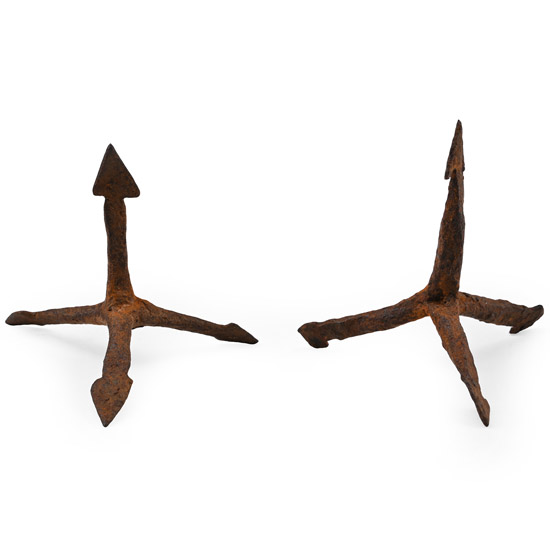
Medieval Iron Anti-Cavalry Caltrop Pair
11th-14th century A.D.Estimate: £100 - 140 (+bp*)
Opening Bid: £50
Each with four arms tipped with triangular spikes. 30 grams total, 60-62 mm
Acquired on the German art market before 2000. Property of a Surrey, UK, collector.
Caltrops were scattered on battlefields in an effort to stop or slow advancing enemy cavalry or foot soldiers; regardless of how a caltrop lands, one spike is always facing upwards. Caesar used them widely at Alesia (Caes., BG 7.73; 82): 'Stakes a foot long, with iron hooks attached to them, were entirely sunk in the ground before these, and were planted in every place at small intervals; these they called spurs'. -
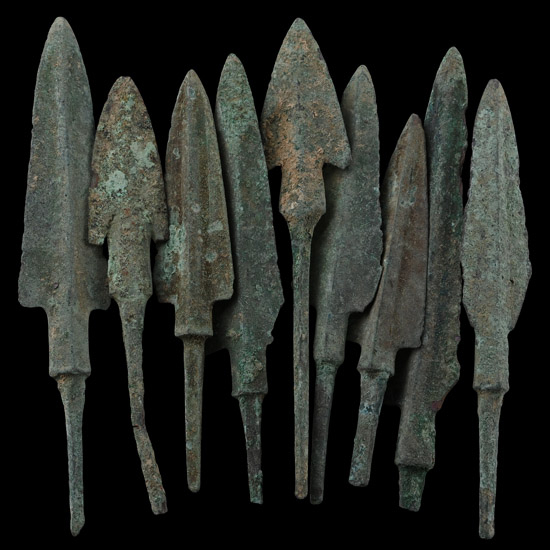
Western Asiatic Bronze Arrowhead Collection
2nd-1st millennium B.C.Estimate: £100 - 140 (+bp*)
Opening Bid: £50
Comprising tanged arrowheads, seven with large elongated triangular blades and raised midrib, sharp central groove, two with barbed shoulders and cylindrical stem with handle for the shaft. 205 grams total, 9.1-12.3 cm
London, UK, collection, 1990s.
These arrowheads seem to belong to the type V, subcategories C and D, according to the classification of Khorasani and Negahban. In the four categories of triangular bronze arrowheads from Luristan, Marlik, and Northern Iran, individuated by Negahban, subtypes C and D of type V are larger arrow or javelin heads, C with barbed shoulders and D with round shoulders. Most of them were cast in moulds. -
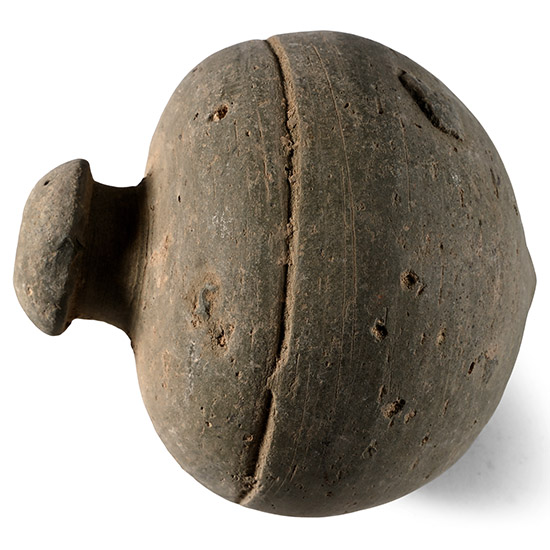
Byzantine 'Greek Fire' Ceramic Fire Bomb or Hand Grenade
9th-11th century A.D.Estimate: £70 - 90 (+bp*)
Bids: 1 | Current Bid: £5
Bulbous body with rounded base and domed filler hole, an impressed circumferential band on the shoulder; intended to be filled with explosive liquid and a wick, and used as a hand grenade. 370 grams, 93 mm
Ex important collection of weaponry, London, UK, 1980-1990s. Accompanied by an academic paper by military specialist Dr Raffaele D'Amato, dated 15 July 2019 and titled 'Eastern Roman Empire - Greek Fire Bomb or Hand Grenade (μεσαίον kακάβιον) 9th-11th century AD'.
Apart from the use of siphons or manual flame-throwers called cheirosiphona, special corps of Roman soldiers employed terracotta grenades, in the form of small jars, abundantly evidenced in archaeological excavations. They were called μεσαία kακαβιά or κυτροκακάβια, where the former had a bulbous shape and the latter a more cylindrical form.
