
Loading, please wait...
LOT 2026
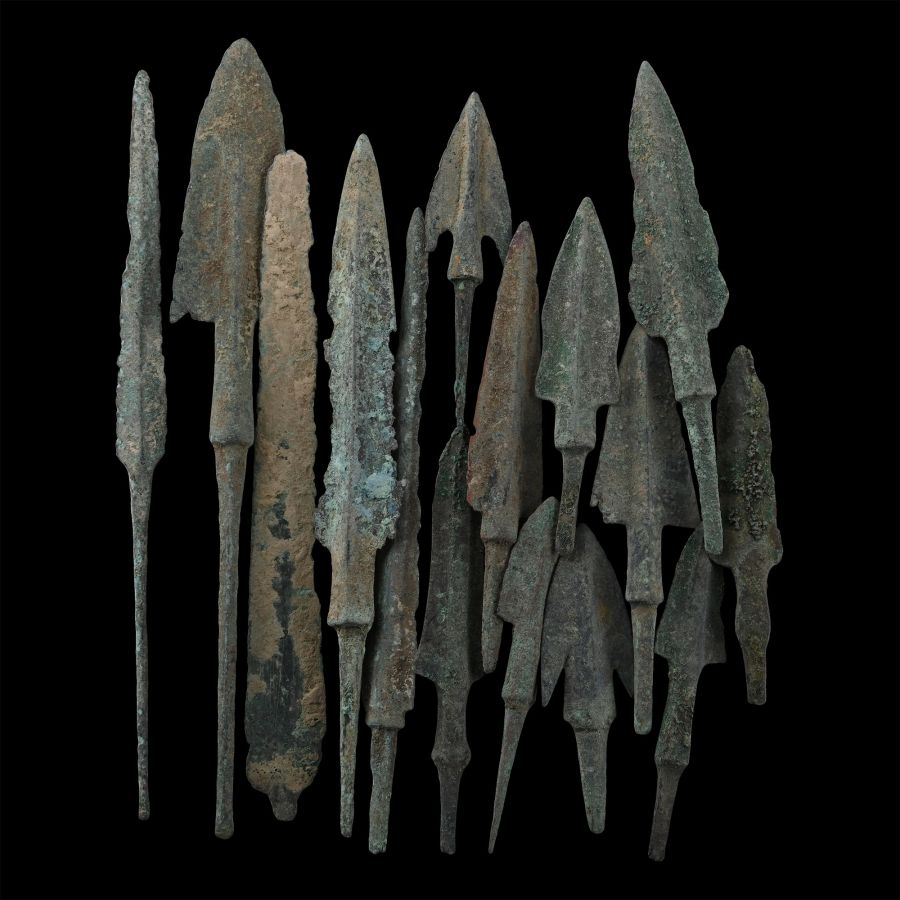
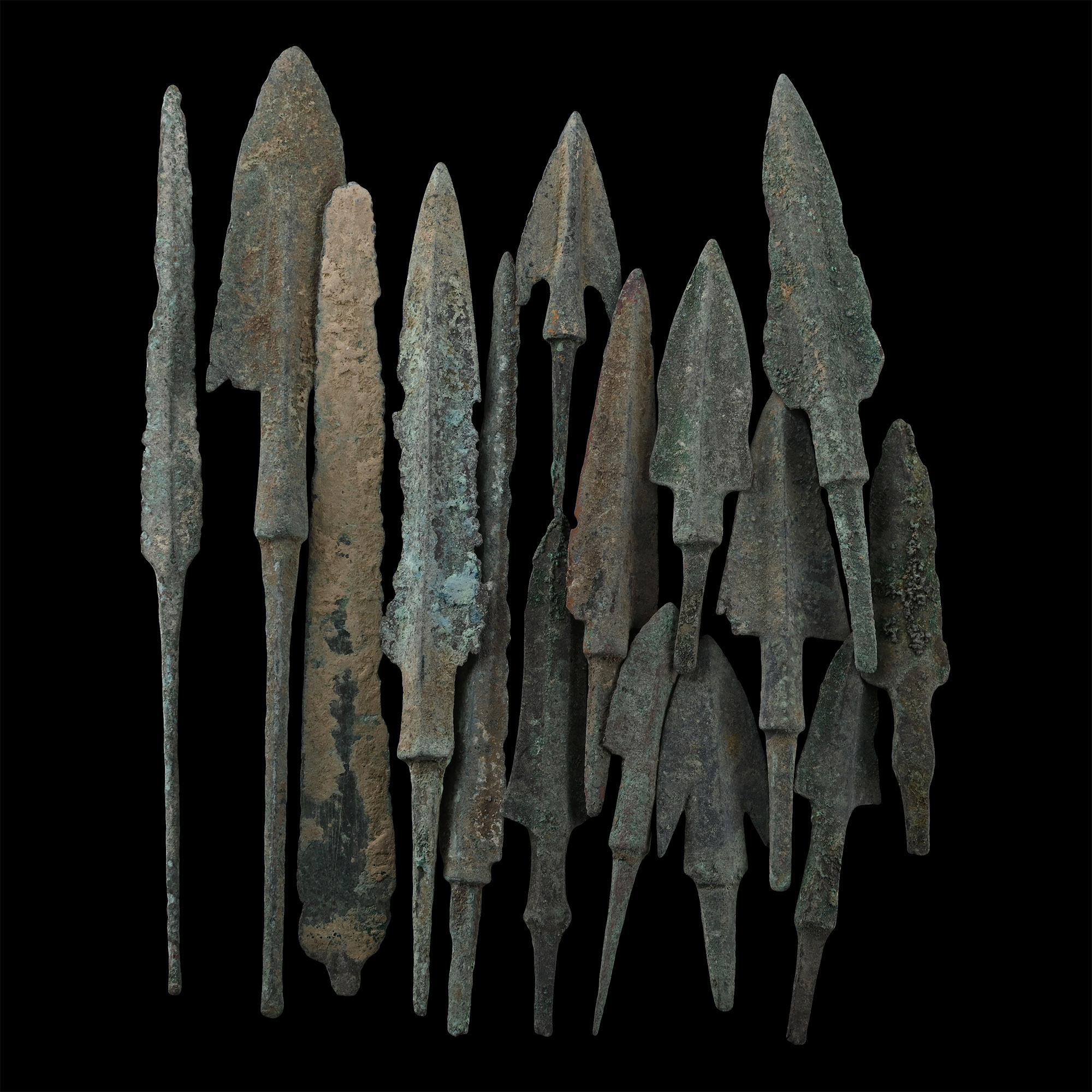
Western Asiatic Bronze Arrowhead Collection
1000-700 B.C.
2 3/4 - 6 1/2 in. (240 grams total, 7.1-16.5 cm).
Comprising fifteen tanged arrowheads, four with elongated triangular blades and raised midrib, two of squared type with flat tang, three with barbed shoulders and short cylindrical stem with handle for the shaft; two with squared shoulders and rectangular stem with handle for the shaft, one with leafed elongated blade, one with wide triangular head and long handle for the shaft, and other two long and spiked with raised midrib. [15]
ProvenanceLondon, UK, collection, 1990s.
LiteratureFor some of the similar types cf. Mahboubian, H., Art of the Ancient Iran, London, 1997, no.390; Khorasani, M.M., Arms and Armour from Iran. The Bronze Age to the End of the Qajar Period, Tübingen, 2006, figs. 458-461, 463-467, for some of these types.
FootnotesSome of the arrowheads belong to type V of the Khorasani classification: subtype D (triangular arrowheads with rounded or angular midrib) and subtype C, arrowheads with elongated, triangular shape with barbed shoulders and convex sides, and a raised midrib with a sharp central line.
CONDITIONTimeLine Auctions follows a vetting process to ensure the authenticity and legality of all items, reinforcing our commitment to integrity and responsible trading. Each antiquity, antique, and coin lot undergoes thorough examination by a vetting committee of at least ten external specialists, professional trade association members, scientists, and archaeologists: Our Vetting Process
AUCTIONS:
TimeLine is a leading auction house specialising in antiquities, ancient art, collectables, natural history, coins, medals, and books. Our auctions offer museums, collectors, historians, and enthusiasts the opportunity to acquire unique and historically significant pieces.
LOT 2026
Western Asiatic Bronze Arrowhead Collection
Estimate £100 - 140€120 - 160 (for guidance only)$140 - 190 (for guidance only)
Opening Bid
£50 (EUR 58; USD 68) +BP*
-
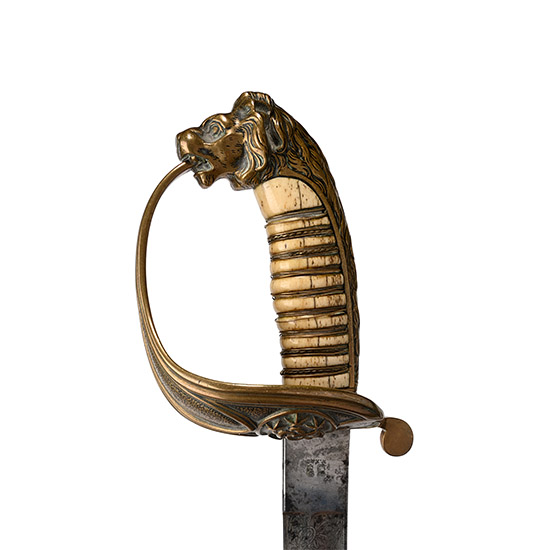
Turkish Naval Officer's Dress Sword with Scabbard
Circa 1900 A.D.Estimate: £300 - 400 (+bp*)
Bids: 1 | Current Bid: £1
Single-edged blade, almost straight with thick back and narrow tip, shallow fuller to each face; brass lion-head sleeve to the bone grip with wire binding; solid swept lion-head knuckle-guard with lug and hinged rear plate pierced to accept a sword-knot, low-relief escutcheon with anchor and three stars; ricasso with stamped 'W.K. &C' beneath a crowned bust and helmet; back stamped '[Wey]ersberg Kirschbaum & Cie. Solingen'; wooden-framed scabbard with black leather covering, brass chape, plaque and frog with two suspension rings, fixed with screws; edge of blade nicked and scored at tip, scabbard split along centreline; old collector's label 'Turkish (Ottoman) Naval Sword c.1900'. 1.32 kg, 96.3 cm
From the private collection of Peter Clayton, FCILIP, Dip, Arch, FSA, FRNS, Hemel Hempstead, Hertfordshire, UK; formed since the late 1950s.
The blade-maker Weyersberg Kirschbaum & Cie. was formed in 1883 from the merger of two earlier factories. -
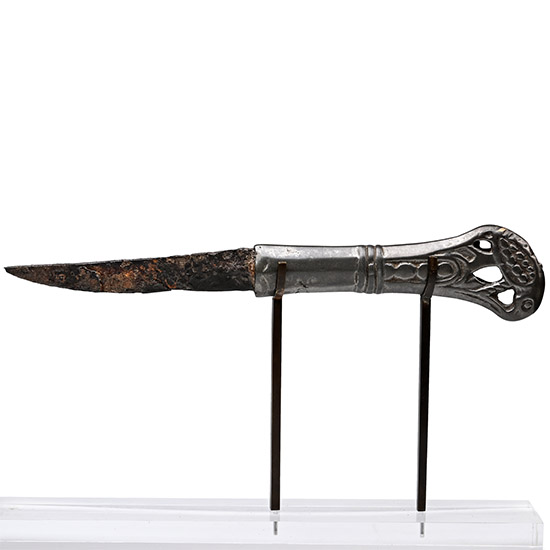
Western Siberian Iron Knife with Handle in the Shape of a Raptor
Circa 10th century A.D.Estimate: £1,800 - 2,400 (‡+bp*)
Opening Bid: £900
Single-edged iron blade attached to the hexagonal baluster in high-tin bronze; triple band forming a collar at the transition to the figural butt formed as a pecking raptor with long claws sitting on a stylised tree; annular punched eyes and pellets on the wings and the interior of the tree; mounted on a custom-made stand. 155 grams total, knife: 17 cm, 17.9 cm wide including stand
Ex W.L., USA, early 1990s. with Artemis Gallery, 26 September 2016, USA. This lot has been checked against the Interpol Database of stolen works of art and is accompanied by search certificate no.13528-263112.
Objects created in the West Siberian animal style served as ornamentation, offered protection against evil forces, and brought good fortune, while simultaneously signalling the high status of their owners. The West Siberian animal style represents a vivid artistic chapter in the history of the peoples of Western Siberia. Today, it is recognised, alongside the well-known ‘Scytho-Siberian’ and ‘Permian’ animal styles, as a distinct cultural phenomenon. -
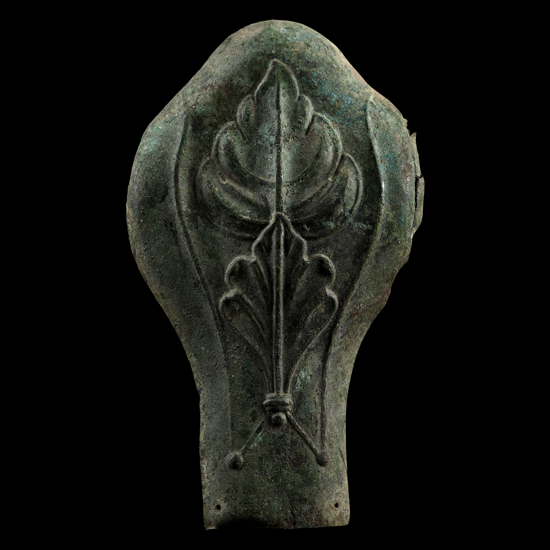
Greek Armour Plate with Palmette
Hellenistic, 2nd-1st century B.C.Estimate: £400 - 600 (+bp*)
Bids: 2 | Current Bid: £11
Piriform in plan with convex surface, high-relief repoussé acanthus-leaf palmette; mounting holes at the narrow end, edge chipped. 39.6 grams, 15.3 cm
From the late collection of a Cornish couple, formed from the early 1990s.
