
Loading, please wait...
LOT 1416
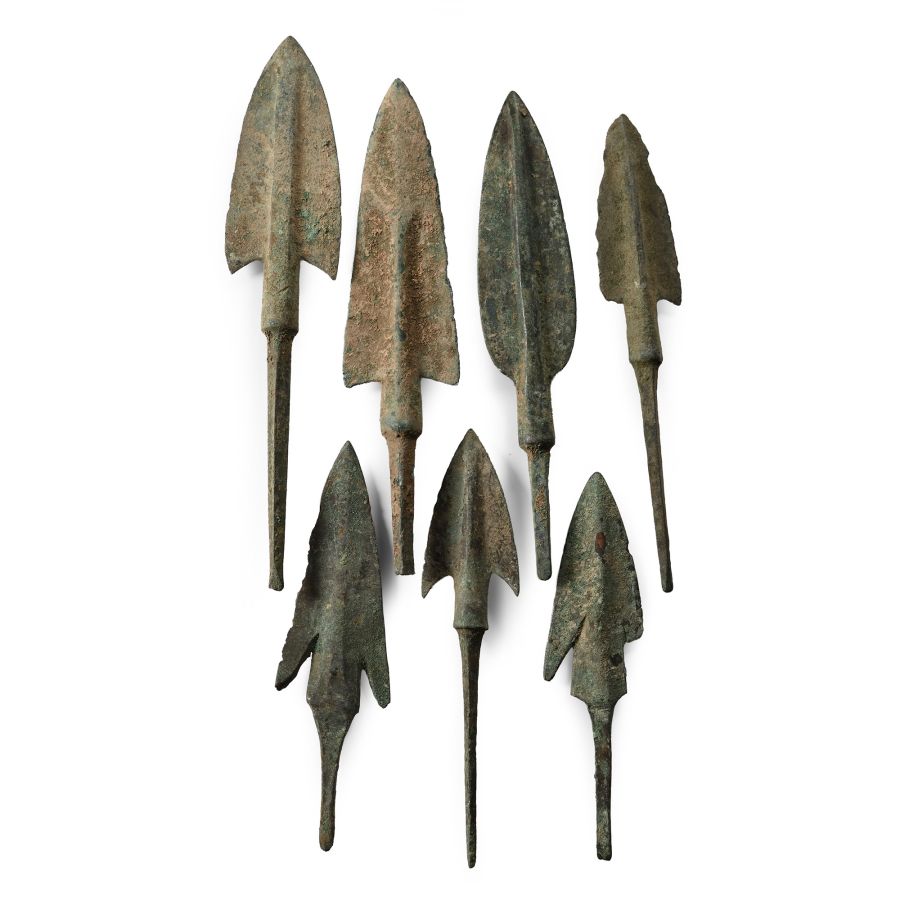
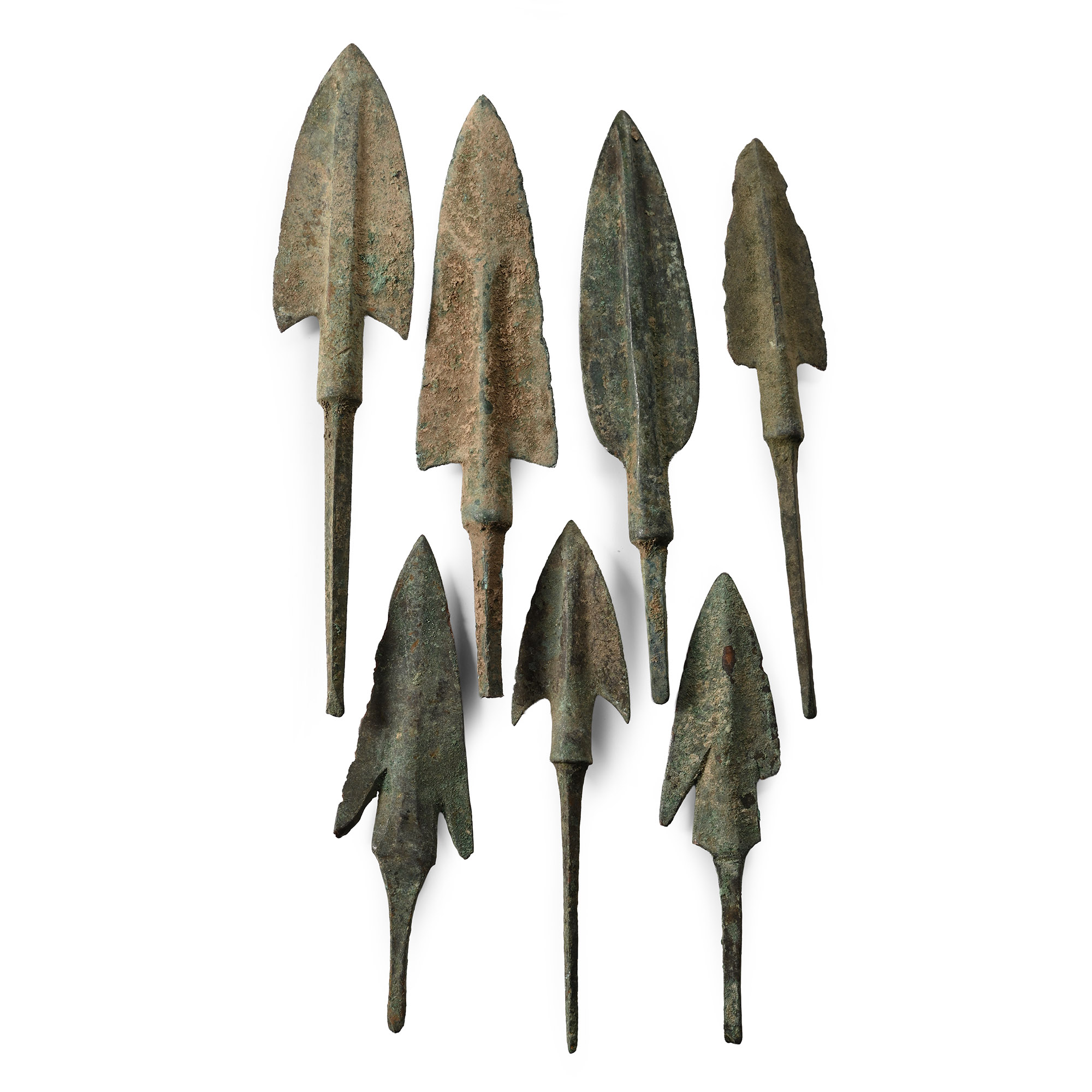
Western Asiatic Bronze Arrowhead Collection
2ND-1ST MILLENNIUM B.C.
3 1/4 - 5 in. (140 grams total, 8.3-12.5 cm).
Comprising: five large elongated triangular arrowheads with raised midrib, sharp central groove, cylindrical stem, barbed shoulders and convex sides; two large tanged arrowheads, one of triangular type with mid-rib, the other with rounded shoulders. [7]
ProvenanceAcquired in the 1990s.
Ex Abelita family collection.
This lot is accompanied by an illustrated lot declaration signed by the Head of the Antiquities Department, Dr Raffaele D'Amato.
Cf. Khorasani, M.M., Arms and Armour from Iran. The Bronze Age to the End of the Qajar Period, Tübingen, 2006, figs.376 and 467, for the barbed type.
FootnotesOne of the categories of arrowheads coming from Marlik shows a large triangular blade with barbed shoulders, and has been ascribed by Negahban to the subtype C of the type V of Luristan or North Persian arrowheads.
CONDITIONTimeLine Auctions follows a vetting process to ensure the authenticity and legality of all items, reinforcing our commitment to integrity and responsible trading. Each antiquity, antique, and coin lot undergoes thorough examination by a vetting committee of at least ten external specialists, professional trade association members, scientists, and archaeologists: Our Vetting Process
AUCTIONS:
TimeLine is a leading auction house specialising in antiquities, ancient art, collectables, natural history, coins, medals, and books. Our auctions offer museums, collectors, historians, and enthusiasts the opportunity to acquire unique and historically significant pieces.
-
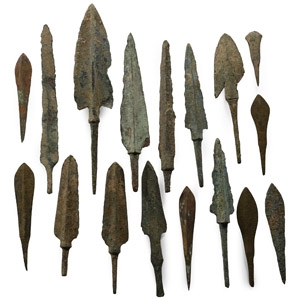
Luristan Bronze Arrowhead Collection
2nd-1st millennium B.C.Sold for (Inc. bp): £91
Comprising fifteen tanged arrowheads, mostly triangular with raised midrib. 239 grams total, 4.1-14 mm
From the London art market, 1990s. This lot is accompanied by an illustrated lot declaration signed by the Head of the Antiquities Department, Dr Raffaele D'Amato. -
.jpg)
Luristan Bronze Sword
Late 2nd millennium B.C.Sold for (Inc. bp): £520
Later hilt with mushroom-shaped pommel, openwork grip with 'chain'-shaped pattern, crescentic guard, long sloping blade with rectangular-section mid-ridge. 1.05 kg, 55.2 cm
Acquired 1980-2015. Ex Abelita family collection. This lot is accompanied by an illustrated lot declaration signed by the Head of the Antiquities Department, Dr Raffaele D’Amato. This lot is accompanied by an illustrated lot declaration signed by the Head of the Antiquities Department, Dr Raffaele D'Amato.
These bronze swords were characterised by a solid-cast hilt with penannular guard, a grip equipped with raised shaped figures and a conical, hollow-cast mushroom pommel. The blade had a very pronounced shaped central midrib. In the complete specimens the hilt was usually cast with the blade. -
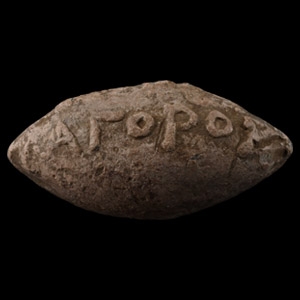
Greek Sling Shot with Inscription
4th-1st century B.C.Sold for (Inc. bp): £312
Lentoid in form with raised legend 'AΓOPOY'. 35.8 grams, 30 mm
Private collection, Austria. Private collection, Europe. This lot is accompanied by an illustrated lot declaration signed by the Head of the Antiquities Department, Dr Raffaele D'Amato.
