
Loading, please wait...
_900x900.jpg "Western Asiatic Bronze Arrowhead and Javelin Collection")
_200x200.jpg "Western Asiatic Bronze Arrowhead and Javelin Collection")
.jpg "Western Asiatic Bronze Arrowhead and Javelin Collection")
LOT 1033
Western Asiatic Bronze Arrowhead and Javelin Collection
11TH-10 CENTURY B.C.
5 1/8 - 7 in. (164 grams total, 13.1-17.8 cm).
Comprising four tanged arrowheads, two with elongated triangular blades and raised midrib, sharp central groove, cylindrical stem with handle for the shaft; one with barbed shoulders and convex sides; one with narrow and flattened blade and short tang; the javelin head with slightly rounded shoulders, lanceolate shape and flattened blade. [5]
ProvenanceFrom London art market, acquired in 1990s.
Ex C.J. Martin, London, UK.
Accompanied by a copy of the Spanish export licence.
See Khorasani, M.M., Arms and Armour from Iran. The Bronze Age to the End of the Qajar Period, Tübingen, 2006, figures 463, 468, for some of these types.
FootnotesThese types of arrowheads were commonly used in Anatolia and Mesopotamia from the 2nd millennium B.C., but it appears that their employment began earlier in this area, where types like these occur alongside the non-barbed, predominantly ribbed and tanged types.
CONDITIONTimeLine Auctions follows a vetting process to ensure the authenticity and legality of all items, reinforcing our commitment to integrity and responsible trading. Each antiquity, antique, and coin lot undergoes thorough examination by a vetting committee of at least ten external specialists, professional trade association members, scientists, and archaeologists: Our Vetting Process
AUCTIONS:
TimeLine is a leading auction house specialising in antiquities, ancient art, collectables, natural history, coins, medals, and books. Our auctions offer museums, collectors, historians, and enthusiasts the opportunity to acquire unique and historically significant pieces.
LOT 1033
Western Asiatic Bronze Arrowhead and Javelin Collection
Sold for (Inc. bp): £130
-
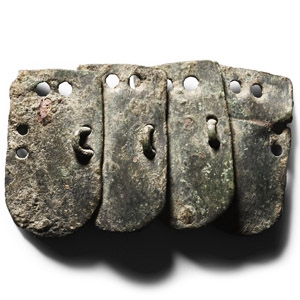
Roman Bronze Armour Segments
2nd-4th century A.D.Sold for (Inc. bp): £468
Comprising four interlocking tongue-shaped segments from a lorica squamata; each with double piercing on the top and the two side edges. 4.4 grams, 45 mm
Ex North American private collection. Acquired privately on the European art market in the 1990s. Property of a Buckinghamshire, UK, gentleman. -
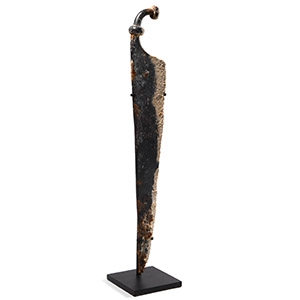
Iron Age Celtic La Tene Dagger
1st century B.C.-1st century A.D.Sold for (Inc. bp): £975
Featuring a gently curved single-edged iron blade and one-sided fuller, curved handle with knot pommel; mounted on a custom-made display stand. 525 grams total, 35 cm high including stand
Dutch art market. Private collection of K.S., Cologne, Germany, acquired 1996.
One of the military insignia of a Celtic warrior was the war-knife, usually between 33 and 35 cm long. For example, in the collection of Celtic military equipment from Galish-Lovachka, the archaeologists have found a short sword with an X-shaped handle (l = 41 cm), two middle La Tène swords (72.5 and 75 cm long), 12 large curved knives, 27 spearheads, two javelin heads, 14 arrowheads, and nine iron chain belts for hanging a sword. The war-knife was also used for hunting, as a spare weapon, or to cut the throat of an enemy in a surprise attack. -
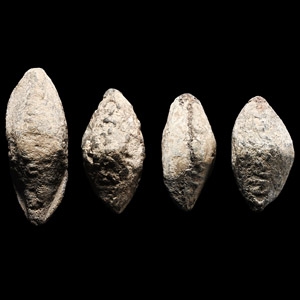
Roman Inscribed Lead Slingshot Group
17 March 45 B.C.Sold for (Inc. bp): £286
Comprising four scaphoid lead slingshots (glandes), each with traces of low-relief inscription(s) referring to 'CN P[OMPEIUS]'. 216 grams total, 37-50 mm
Ex M.Cummings, UK, 1990s.
These shots (mainly of type IIb of the Völling classification) are marked with the abbreviated name of Cn.Pompeius; they were used in quantity at the Battle of Monda (or Munda) against the Caesarian troops, by the followers of Pompey, on 17th March 45 B.C. Similar missiles were used in the civil war between Pompey and Caesar, and in all Caesar's wars. The projectiles of the slingers could be in lead (glandes) or in pottery or stone (lapides). Sometimes they were signed with the name of the general, or used to report some injuries, for example the sling missile found in Alesia with the name of Labienus.
