
Loading, please wait...
LOT 1087
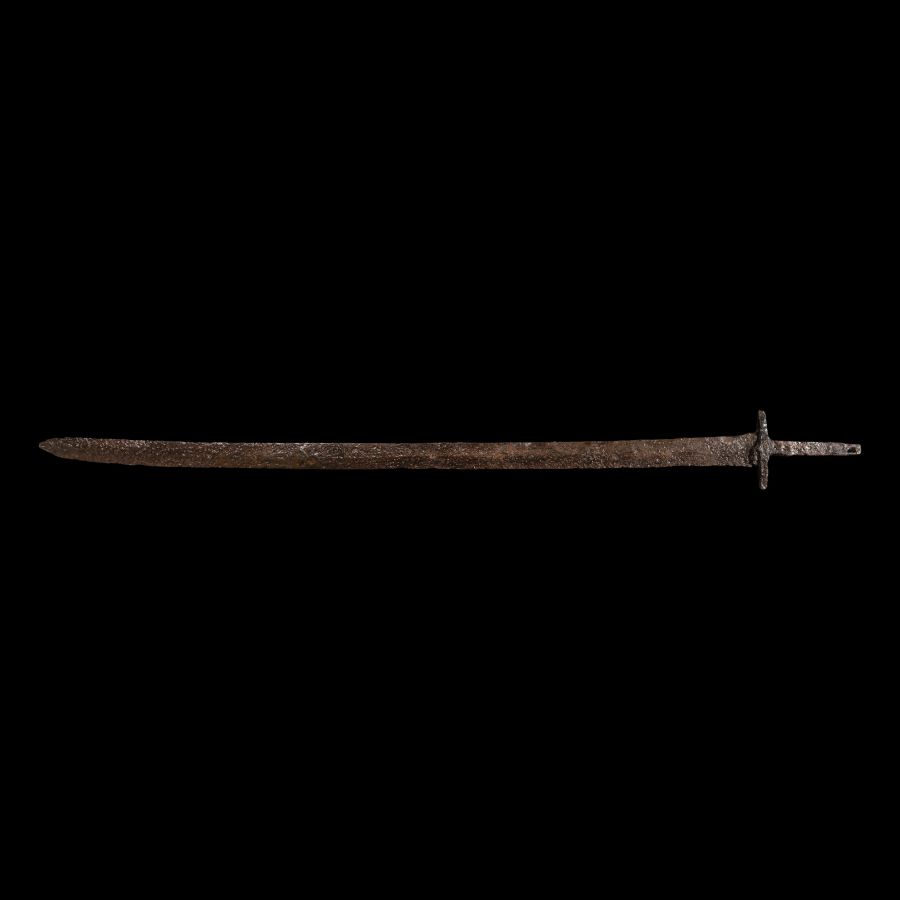
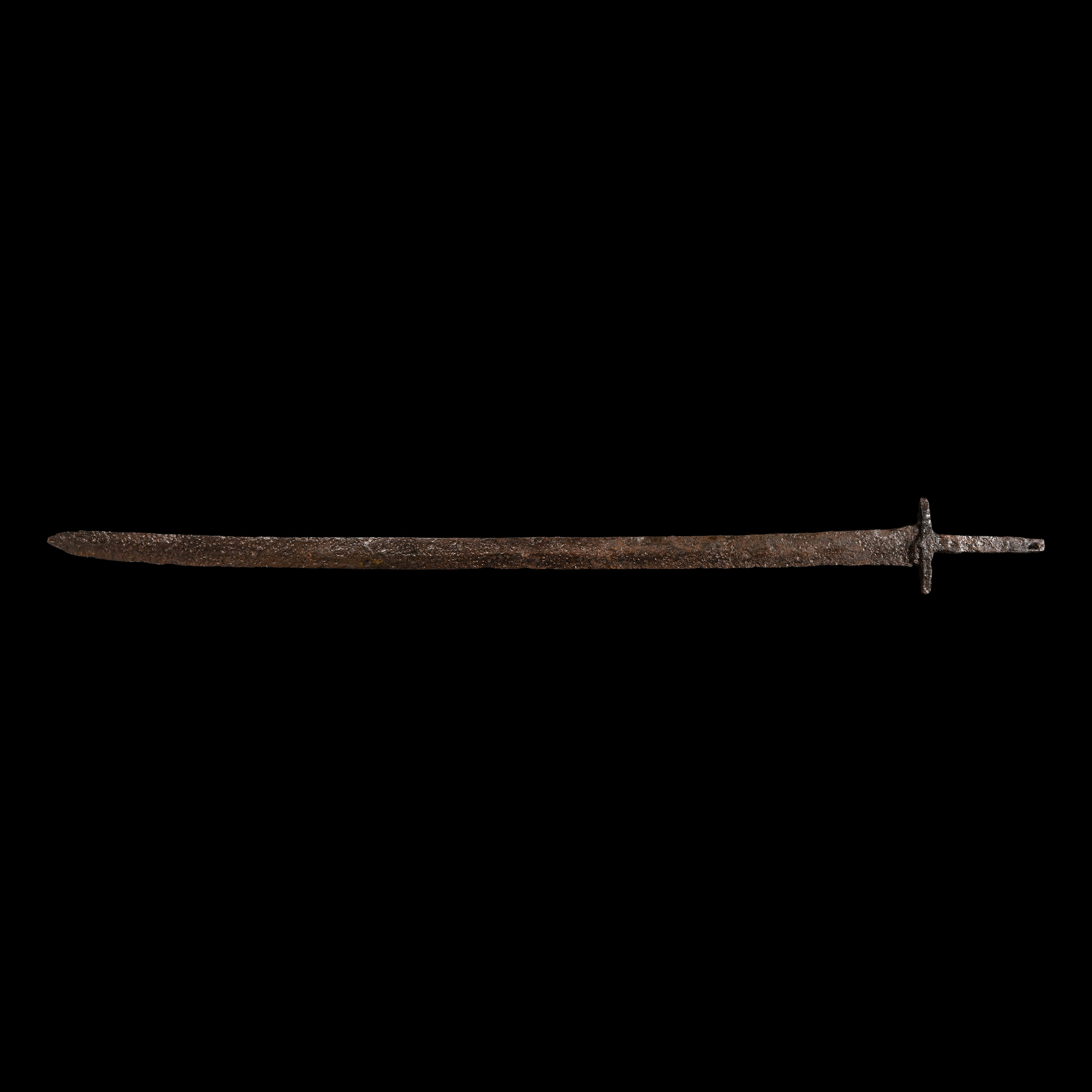
Volga-Ural Nomad Sabre
9TH-11TH CENTURY A.D.
35 in. (725 grams, 89 cm).
An iron single-edged sabre with slightly curving blade showing battle nicks, evidence of a possible iron extension together with a tongue to the side of the blade, beneath the straight guard. [No Reserve]
ProvenanceAcquired 1971-1972.
From the collection of the vendor's father.
Property of a London, UK, collector.
Accompanied by an academic report by military specialist Dr Raffaele D'Amato.
Cf. similar specimens in Харламов, П.В., ‘Weapons complex of the Nomadic tribes of the Volga-Ural Region in the 9th -11th Centuries (in Russian)’ in Archaeology of the Eurasian Steppes, Vol. I, Kazan, 2017, pp.364-379, esp.figs.6, 14; Lebedinsky, I., De l’epée scythe au sabre mongol, Paris, 2008, pp.172ff.; for discussion on the sabres see Pletneva, S.A., Antiquities of black hoods (in Russian) SAI. Issue, E1-19, Moscow, 1973; Evglevsky, A.V., Potemkina, T.M., ‘Eastern European late nomadic sabers’ in Evglevsky, A.V., European Steppes in the Middle Ages, Vol.1, Donetsk, 2002, pp.291-336.
FootnotesVarious sabres of similar typology were found in a complex of medieval nomad weapons in archaeological excavations in the steppe and forest-steppe zone of the Volga-Ural region; chronologically, they were dated to the 9th-11th centuries.
CONDITIONTimeLine Auctions follows a vetting process to ensure the authenticity and legality of all items, reinforcing our commitment to integrity and responsible trading. Each antiquity, antique, and coin lot undergoes thorough examination by a vetting committee of at least ten external specialists, professional trade association members, scientists, and archaeologists: Our Vetting Process
AUCTIONS:
TimeLine is a leading auction house specialising in antiquities, ancient art, collectables, natural history, coins, medals, and books. Our auctions offer museums, collectors, historians, and enthusiasts the opportunity to acquire unique and historically significant pieces.
-
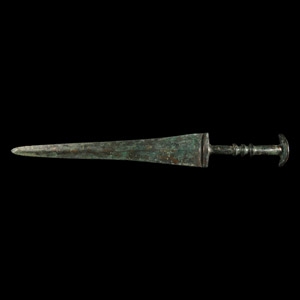
Luristan Dagger with Decorated Hilt
9th-8th century B.C.Sold for (Inc. bp): £780
A bronze dagger with a tapering triangular blade, the handle with three raised concentric bands, crescent-shaped pommel. 322 grams, 37 cm
Ex S. Motamed collection. with Bellman's Auctions, 20th-26th June 2015, lot 2482. Property of a London gentleman.
Several similar iron daggers were discovered during excavations at War Kabud. Differently from the bronze specimens, where the handle is ribbed, the iron specimens have bronze nails for fastening of the wooden grip on either side. -
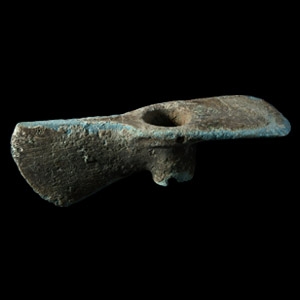
Luristan Socketted Axe-Adze
13th-7th century B.C.Sold for (Inc. bp): £121
A substantial copper-alloy adze-axe head composed of a cylindrical socket, one blade at a right angle to the socket with tapering sides and D-section cutting edge; one blade upright with convex cutting edge. 559 grams, 16.5 cm
Fine condition.
Acquired in the 1980s. London, UK, private collection. Property of an Essex gentleman. -
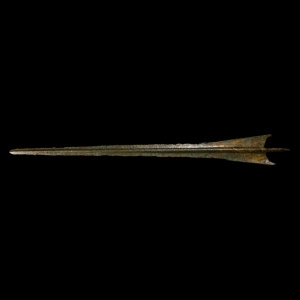
Western Asiatic Dagger Blade with Winged Guards
Late 2nd-mid 1st millennium B.C.Sold for (Inc. bp): £410
A bronze dagger with prominently curved or winged guard, extending out from the ricasso and partly framing the tang, once covered by an organic hilt; the thick midrib extending slightly above the ricasso. 484 grams, 60 cm
Acquired 1980-2015. Ex Abelita family collection.
Many examples of these blades have been excavated in the South Caspian area at Ghalekuti, and in the area of Talish. They have been found primarily in Iron Age graves, although the curves of the guards are reminiscent of the barbed arrow and javelin heads associated with Bronze Age Marlik. This is why some scholars (Dyson) dated them to the second millennium BC and others (Muscarella) to the recent Iron Age. It is possible that this style represents continuity from the Bronze to the Iron Age.
