
Loading, please wait...
LOT 1052
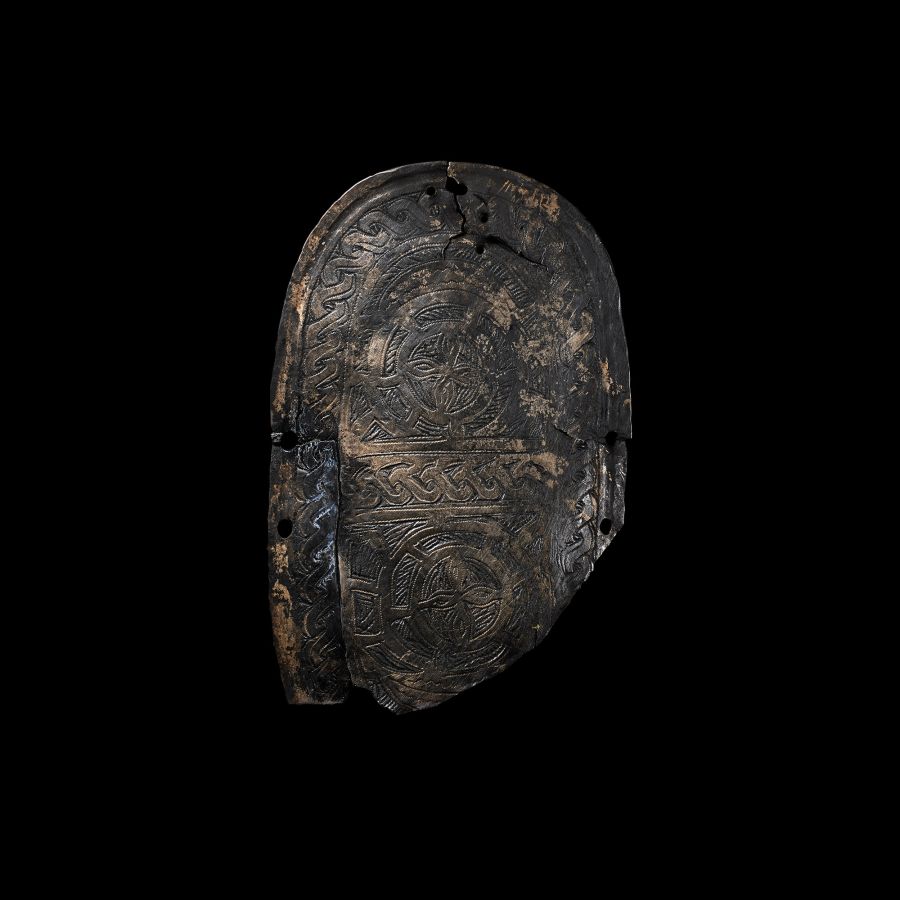
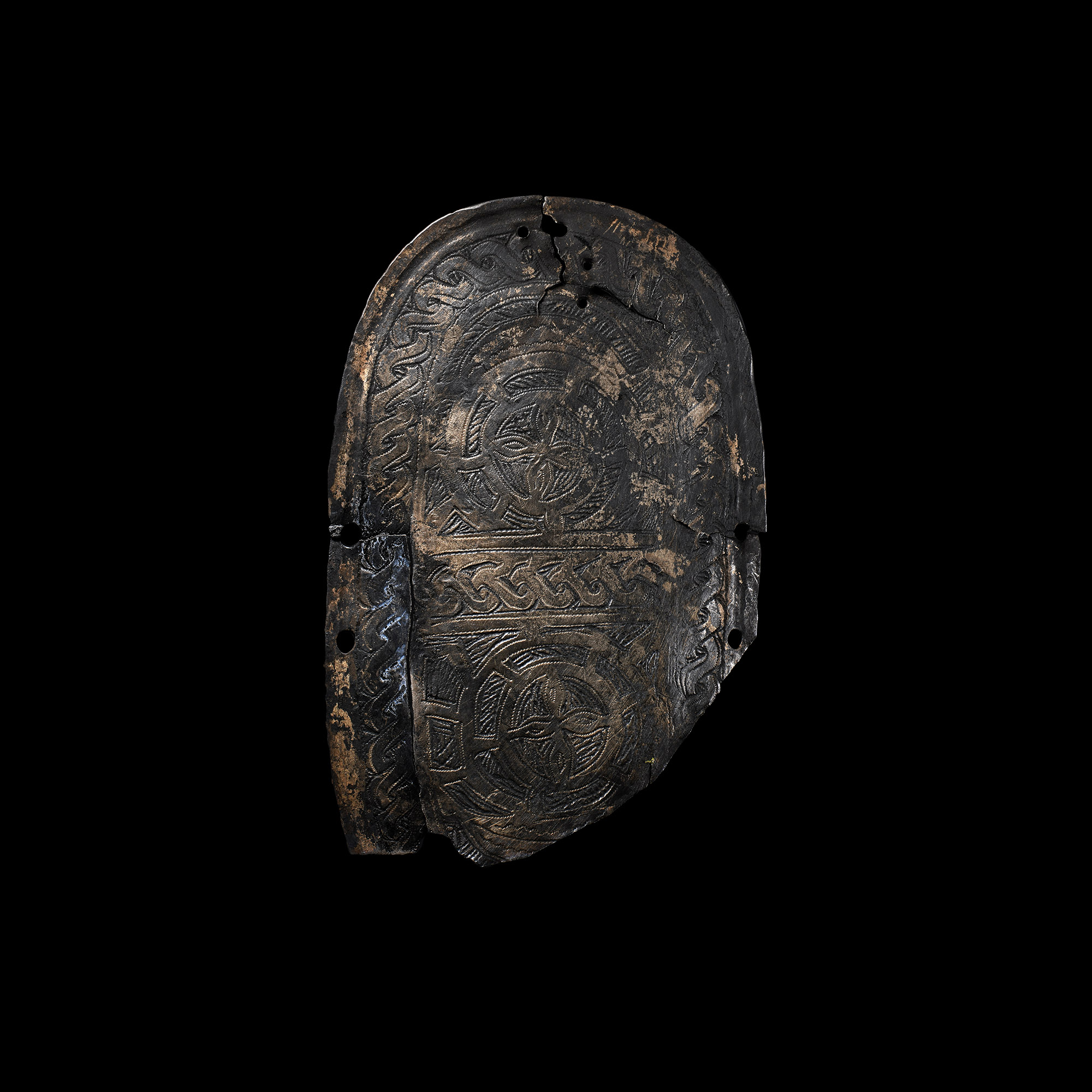
Volga-Bulgar Archer's Arm Guard
CIRCA 10TH-14TH CENTURY A.D.
3 1/2 in. (20.2 grams, 90 mm).
An oval silver plate decorated with an intertwined design formed of flowers inside a double circle framed by a wavy design; pierced to the sides for fastening. [No Reserve]
ProvenanceAcquired in the 1990s.
From a North Yorkshire private collection, UK.
Cf. Fedorova, N.V., ‘Volga Bulgaria Silver of the 10th-14th centuries (on materials of the Trans-Urals collections)’ in Compareti, Raffetta, Scarcia, (ed.), Eran ud Aneran, Studies presented to B. Marshak on the Occasion of His 70th Birthday, Venezia, 2006, figs.10-11.
FootnotesDecorated bow string protection plates were developed by Steppe people and widespread among the Volga-Bulgarian warriors, often decorated with niello. These protective plates were fastened with straps on the wrist to protect the lower arm from the blows of the bow tendons. In addition to the bone plaques used by the Khazars, precious silver specimens from the territory of the Volga Bulgars have been preserved, including finds from Zauralia and Western Siberia. A protective plaque decorated with mythological scenes also comes from Bilär (11th-12th century A.D.) Similar plaques with simpler decorations have been found in the region of Prikamye (10th-14th century A.D.).
CONDITIONTimeLine Auctions follows a vetting process to ensure the authenticity and legality of all items, reinforcing our commitment to integrity and responsible trading. Each antiquity, antique, and coin lot undergoes thorough examination by a vetting committee of at least ten external specialists, professional trade association members, scientists, and archaeologists: Our Vetting Process
AUCTIONS:
TimeLine is a leading auction house specialising in antiquities, ancient art, collectables, natural history, coins, medals, and books. Our auctions offer museums, collectors, historians, and enthusiasts the opportunity to acquire unique and historically significant pieces.
-
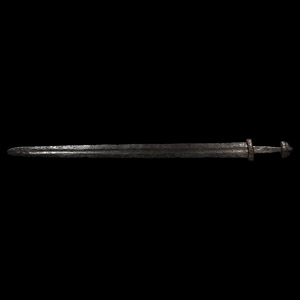
Viking Age Sword with Three-Lobed Pommel
Early 11th century A.D.Sold for (Inc. bp): £4,940
A double-edged cutting sword of Oakeshott Type XII with inlaid hilt and tapering blade with shallow fullers; the lower guard gently curving and decorated with copper inlaid dots, upper guard and three-lobed pommel with similar decoration, traces of silver inlay to the hilt. 720 grams, 90 cm long
Acquired 1971-1972. From the collection of the vendor's father. Property of a London, UK, collector. Accompanied by an academic report by Dr Raffaele D’Amato. This lot has been checked against the Interpol Database of stolen works of art and is accompanied by searcher certificate no.11575-198856.
The sword belongs to the Type XII of the Oakeshott classification (Oakeshott, 1998, pp.37ff.), the characteristics of which are a broad, flat, evenly tapering blade, generally with a good sharp point and tending to widen perceptibly below the hilt. After the publication of the Finnish specimen, Peirce, due to the inlaid inscriptions of this latter, noted a close parallel, both in style and content, with a sword in the Schweizerischen Landesmuseum in Zurich. In the expanded context including the example from Finland, Peirce was able to re-date them to the 11th century. -
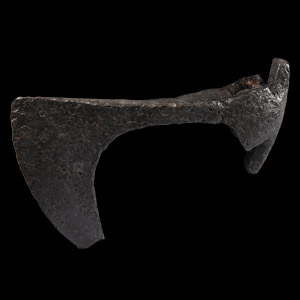
Viking Period Bearded Type Axehead
Circa 9th-11th century A.D.Sold for (Inc. bp): £546
An iron axehead with broad curved blade and spur to the chin, narrow neck, deep socket with lateral spurs and extended plate to the reverse. 777 grams, 20 cm
Acquired 1971-1972. From the collection of the vendor's father. Property of a London, UK, collector.
Iron axeheads of this typology show a sub-trapezoidal asymmetrical blade, sometimes perforated through the centre. They are characterised by two projecting spurs to the back of the shaft-hole. -
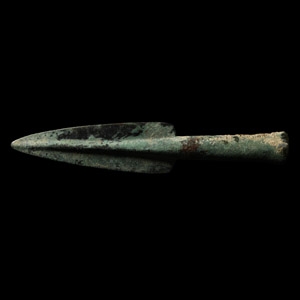
Western Asiatic Socketted Spearhead
9th-7th century B.C.Estimate: £100 - 140 (+bp*)
Opening Bid: £50
A bronze spearhead with short conical socket, triangular-shaped blade with prominent central rib. 81 grams, 15 cm long
Fine condition.
Earlier 20th century Cologne collection, Germany. London Mayfair gallery, UK. Dr D.G. collection, 1990s-2019. Accompanied by an old typed catalogue slip with provenance.
