
Loading, please wait...
_900x900.jpg "Villanovan Impasto Biconical Urn")
_200x200.jpg "Villanovan Impasto Biconical Urn")
.jpg "Villanovan Impasto Biconical Urn")
LOT 0112
Villanovan Impasto Biconical Urn
CIRCA 8TH CENTURY B.C.
9 7/8 in. (2 kg, 25 cm high).
Black burnished ceramic urn with conical lower body, two flared loop handles, bell-shaped upper body and flat everted rim; band of incised chevrons to the equator, horizontal linear bands and ropework key patterns; one handle restored.
ProvenanceEx private Orange Country collection.
with Ancient Resources Auctions, Auction 34, 14 September 2014, lot 246.
Accompanied by a detailed collector's catalogue pages including description and photograph.
See Morandi, L., Early Iron Age Finds from the Villanovan cemetery of Colle Baroncio: remarks on early Vetulonia and its connections, in Mediterranean Archaeology, 2013.
FootnotesSuch urns were often deposited with the cremated remains inside, one handle broken off (perhaps part of the funerary rites) and in some case a bronze crested helmet placed over the top of the urn.
CONDITIONTimeLine Auctions follows a vetting process to ensure the authenticity and legality of all items, reinforcing our commitment to integrity and responsible trading. Each antiquity, antique, and coin lot undergoes thorough examination by a vetting committee of at least ten external specialists, professional trade association members, scientists, and archaeologists: Our Vetting Process
AUCTIONS:
TimeLine is a leading auction house specialising in antiquities, ancient art, collectables, natural history, coins, medals, and books. Our auctions offer museums, collectors, historians, and enthusiasts the opportunity to acquire unique and historically significant pieces.
-
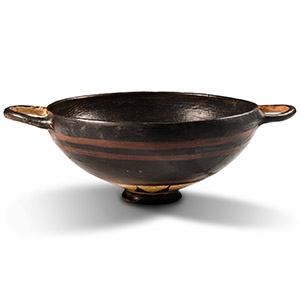
Proto-Corinthian Painted Pottery Cup
7th century B.C.Sold for (Inc. bp): £650
Broadly conical in form, with rounded shoulder, inverted rim, two slender D-shaped handles and gently splayed foot; polychrome painted concentric bands to the inner and outer faces and geometric sunburst pattern around the foot; restored. 74 grams, 16 cm wide
Acquired in the 1960s-1970s. Ex European private collection. -
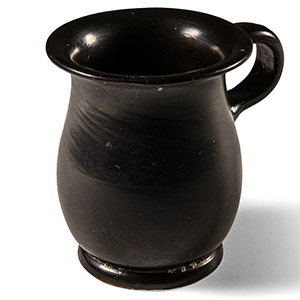
Greek High-Glazed Black Ware Mug
4th-3rd century B.C.Sold for (Inc. bp): £1,820
With flared base, bulbous body. tapering shoulder and flared mouth with everted rim, loop handle. 69 grams, 71 mm
Private collection, Sussex, UK; acquired 1975-1990. -
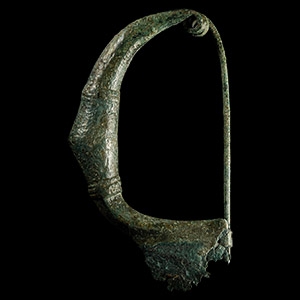
Greek Bronze Bow Fibula
8th-7th century B.C.Sold for (Inc. bp): £111
Arched bow with a central bulb and ribbed collar, integral pin and large catch-plate. 93 grams, 99 mm
From the family collection of a Surrey gentleman since before 1960.
The function of the catch-plate fibulae was utilitarian and decorative, they were used for woollen clothing (Herodotus V, 87) and they have been found in houses, tombs and as votive offerings in sanctuaries. Our fibula is an early type, very often found in the graves of the Greek colonies of Southern Italy and widespread in the Magna Graecia. This typology was introduced there by the Greeks. Like all female fibulae, it functioned as a clothing fastener, usually worn as a pair on each shoulder.
