
Loading, please wait...
LOT 0235
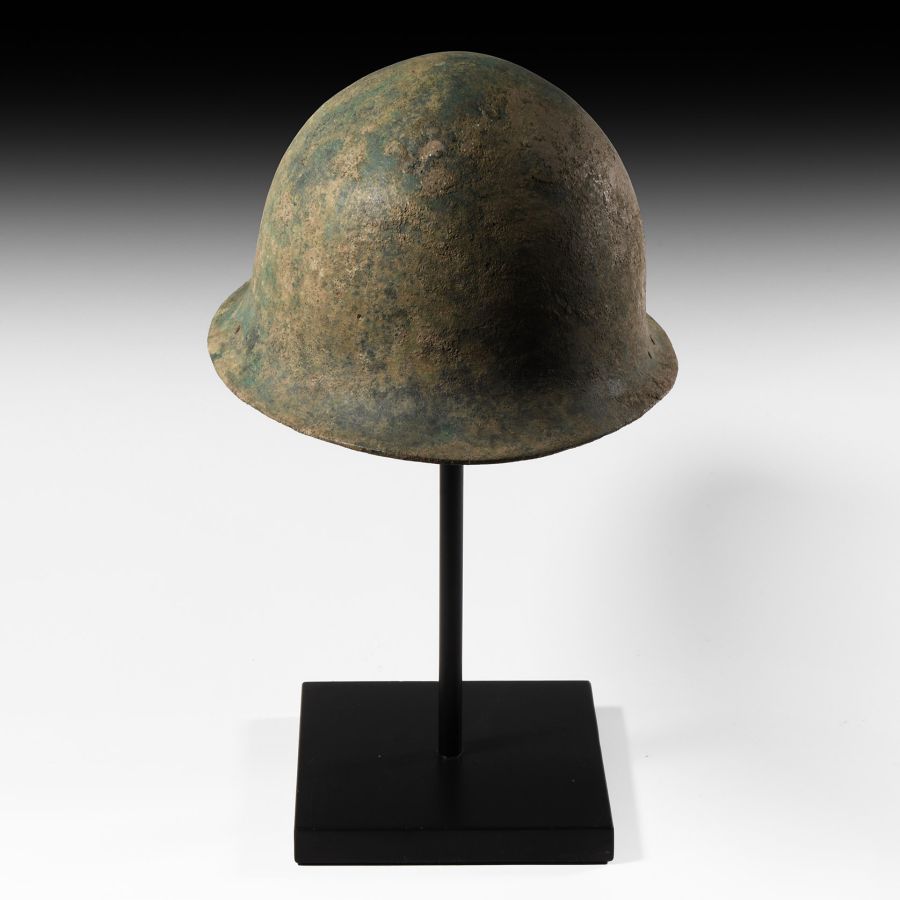
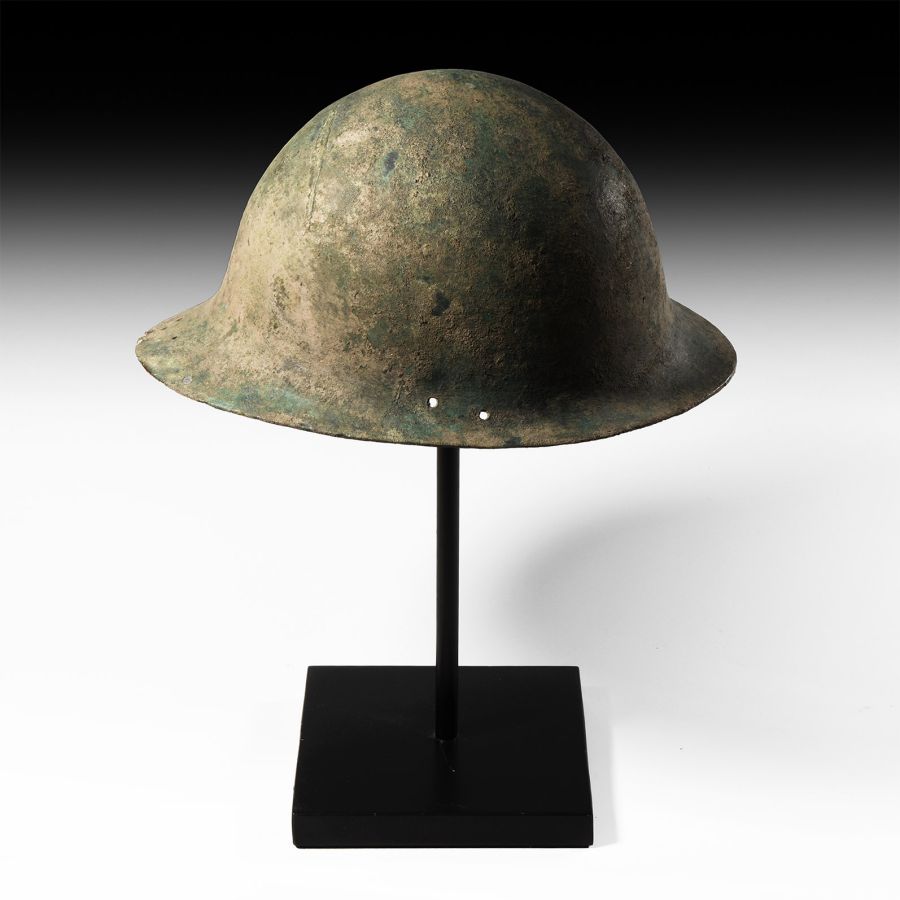
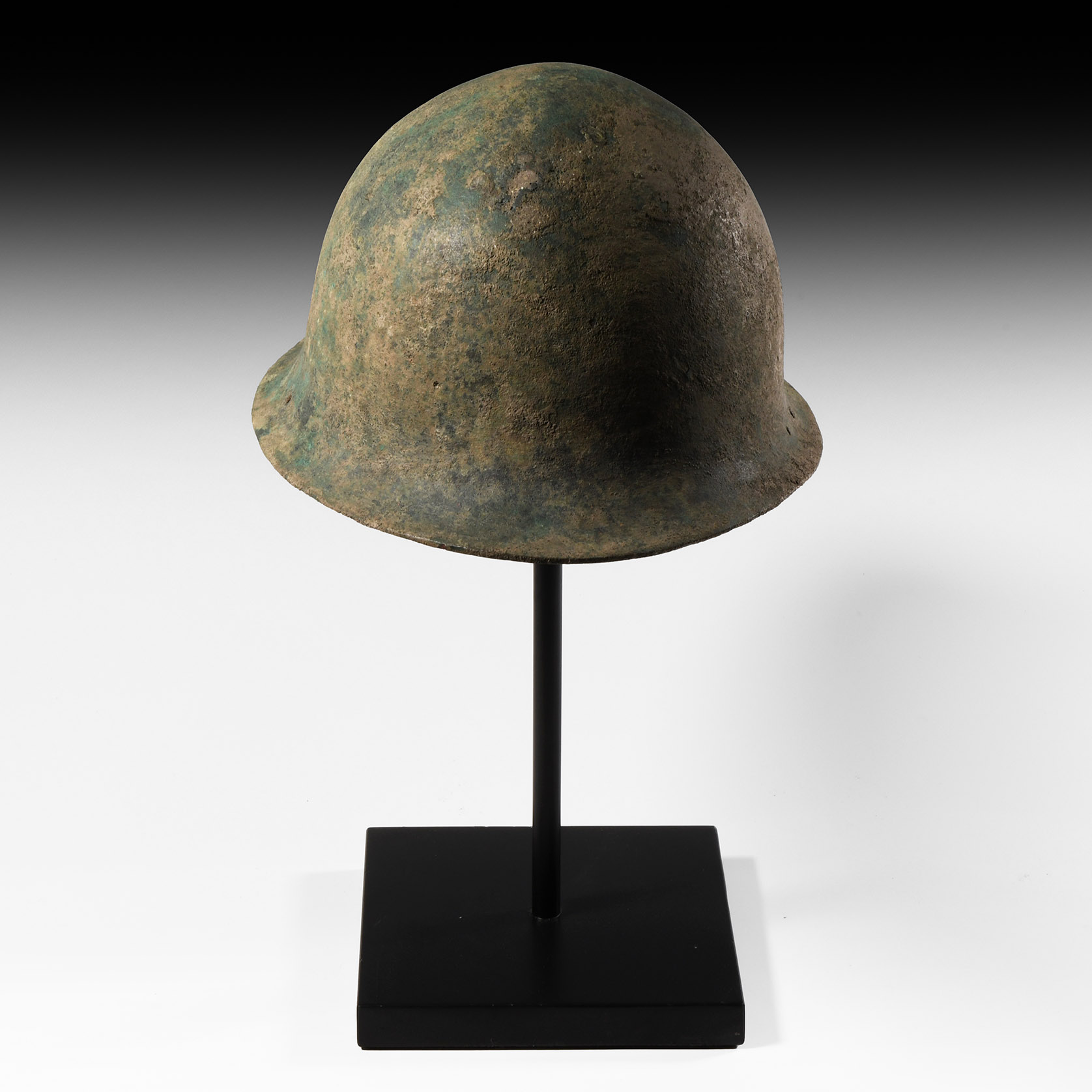
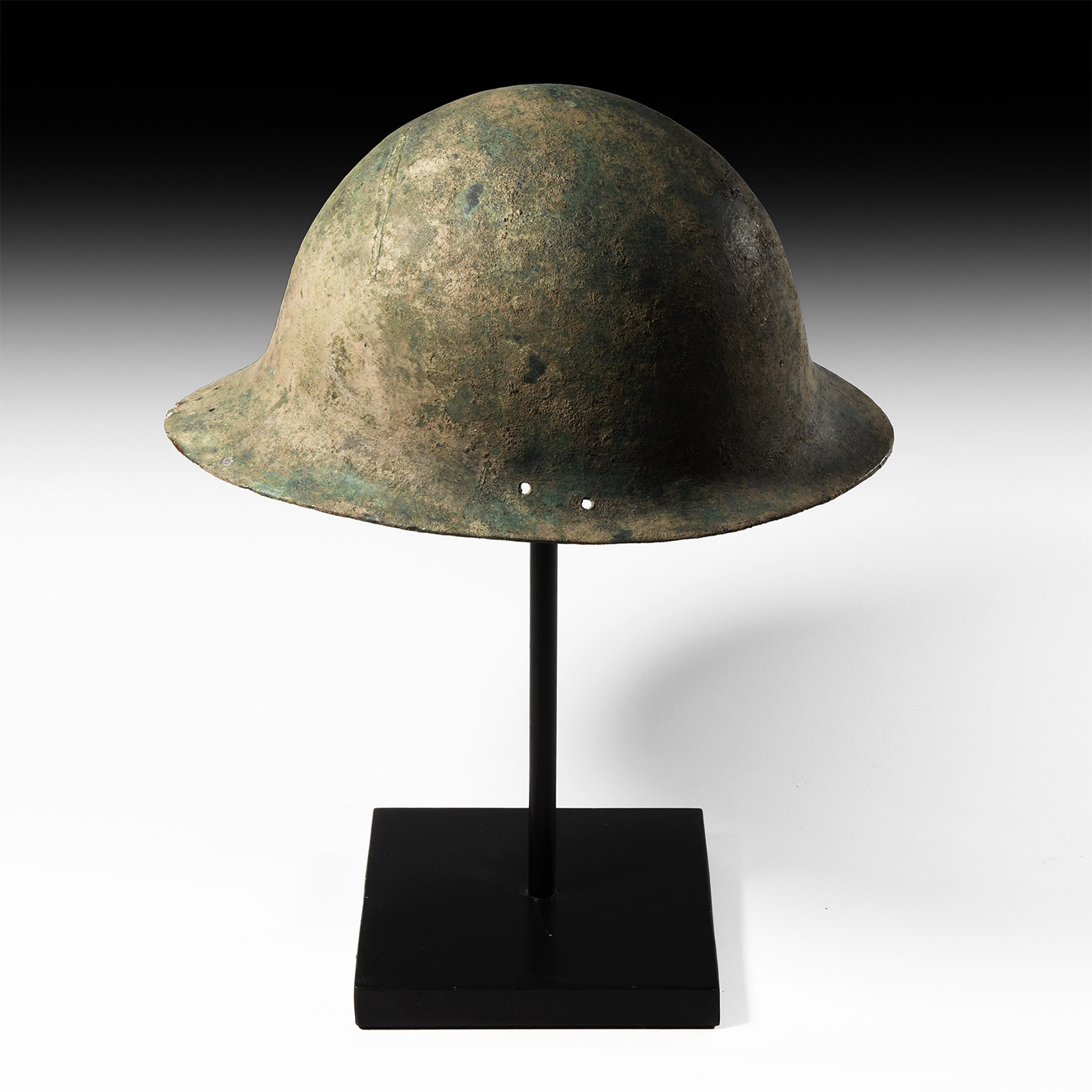
Villanovan Bronze Helmet
8TH CENTURY B.C.
12 in. (1.7 kg, 30.5 cm wide).
A bronze 'pot' helmet with rounded bowl and flared rim; three sets of paired piercings for attachment of leather cheek-flaps; cracked; accompanied by a custom-made display stand.
ProvenanceAcquired early 1990s.
Ex private American collection; thence by descent.
Private Swiss collection since 1998.
Accompanied by an academic report by Dr Raffaele D'Amato.
This lot has been checked against the Interpol Database of stolen works of art and is accompanied by searcher certificate no.11573-199009.
Cf. Coussin, P., Les Armes Romaines, Paris, 1926; Connolly, P., Greece and Rome at War, London, 1981; Fossati, I., Etruscan Armies, Milano, 1987, p.50, fig.4; Egg, M., 'Italische Helme mit krempe' in Antike Helme, RGZM Monographien 14, Mainz, 1988, pp.222ff., figs.1, 2, 34 and items 58-59, for type; Sekunda, N., and Northwood, S., Early Roman Armies, Oxford, 1995; Connolly, P., Greece and Rome at War, London, 2006; D'Amato, R., Salimbeti, A., The Etruscans, Oxford, 2018, pp.21ff. and pl.B3; D’Amato, R., Negin, A., Decorated Roman Armour, London, 2017, pp.8ff. and fig.2.
FootnotesThe ‘pot’ or ‘bell’ helmet, found as early as in an 8th century coffer grave (ad arca) from the Esquiline (Rome) and other graves (Coussin, 1926, p.88, fig.23; Sekunda, Northwood,1995, p.6, grave 94) was made from a single piece of bronze, while later Italic variants were fashioned from jointed plates (Connolly, 1981, p.102, figs.2-2a; Egg, 1988, p.223, variant Vetulonia). The skull was somewhat spherical and with a flared rim: this in some Etruscan and Italic specimens, was rivetted for strength (Egg, 1988, fig.18, p.240, from Picenum, and Murlo and Trestina variants, p.232, fig.10 and p.234, fig.12; Connolly, 2006, p.102, figs.2-2a, from Sesto Calende). The smooth surface of these types of helmets was intended to deflect blows. The ‘calotte’ helmets (Egg, 1988, pl.57) from Rome, as the helmet here, appear to be variants of a similar helmet from Montegiorgio Piceno and from Montelparo (ex Zschille collection). Some of them, like the helmet found in the necropolis of Tolentinum, were decorated with rich engravings. These practical helmets were probably furnished with a leather chinstrap, even though a similar Galea, found in the Tomba del Duce at Vetulonia, (Fossati, 1987, p.50; Egg, 1988, pp.223-224, fig.3, p.231, fig.12) dated to the first half of the 7th century B.C., still had the remains of what was probably a bronze cheek-piece.
CONDITIONTimeLine Auctions follows a vetting process to ensure the authenticity and legality of all items, reinforcing our commitment to integrity and responsible trading. Each antiquity, antique, and coin lot undergoes thorough examination by a vetting committee of at least ten external specialists, professional trade association members, scientists, and archaeologists: Our Vetting Process
AUCTIONS:
TimeLine is a leading auction house specialising in antiquities, ancient art, collectables, natural history, coins, medals, and books. Our auctions offer museums, collectors, historians, and enthusiasts the opportunity to acquire unique and historically significant pieces.
LOT 0235
Villanovan Bronze Helmet
Estimate £20,000 - 30,000€23,200 - 34,800 (for guidance only)$27,000 - 40,500 (for guidance only)
-
Luristan Sword with Blood Channels
Late 2nd-early 1st millennium B.C.Estimate: £1,000 - 1,400 (+bp*)
Opening Bid: £500
A tanged bronze sword of triangular shape with multiple fullers tapering to a pointed tip, the tang forming an extension of the thick ridged midrib. 295 grams, 42 cm
Exceptional quality.
with John Hewitt. Ex Maurice Braham, acquired from the above. Lord Alistair McAlpine collection.
The blade belongs to a sword probably made in a Luristan workshop, once fitted with a conical pommel and a crescentic guard. The metalworking techniques used in making bronze weapons in Luristan were very complex. Surfaces were often finished in repoussé work, and some of the weapons were chased, others engraved. -
Medieval Socketted Catapult Dart
14th-16th century A.D.Sold for (Inc. bp): £169
An iron catapult dart formed with a tapering cylindrical socket, square-section neck and barbed triangular head with full-length medial rib to both faces. 94 grams, 29 cm
Acquired before 2000. From the collection of a European gentleman living in the UK. -
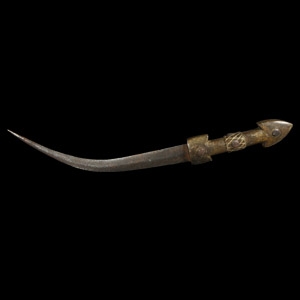
Khandjar Type Dagger
19th century A.D.Estimate: £180 - 240 (+bp*)
Opening Bid: £100
A very large iron dagger, curved with a thick double edge blade, handle composed of wood and iron, ornately decorated with lozenges, fastened by eight iron flat-headed rivets. 118 grams, 32 cm long
Fine condition.
Private family collection formed in London, mid 1980s to early 1990s.
Among the various Arab dagger groups, the one from North Africa is characterised by rather fine blades made in the Turkish-Persian style. Usually the handles (in wood, ivory and metal) feature a large rounded pommel in the guise of peacock feathers. This type is common in Morocco, Tunisia and all the way to Egypt, and is a type of Khandjar usually called Koummiya or Goummiya (a term later adopted in Spanish as Goumia, to indicate all the short Arab daggers).
