
Loading, please wait...
_900x900.jpg "Viking Silver-Gilt Beast-Head Finial")
_200x200.jpg "Viking Silver-Gilt Beast-Head Finial")
.jpg "Viking Silver-Gilt Beast-Head Finial")
LOT 0383
Viking Silver-Gilt Beast-Head Finial
9TH-11TH CENTURY A.D.
1 5/8 in. (12.6 grams, 42 mm).
Drinking horn terminal formed as a tubular socket with flange rim, narrow canine head with raised ovoid eyes, open mouth with swept struts, muzzle with flange. [No Reserve]
ProvenanceFrom the John Hewitt collection (1919-1994).
Ex Sam Fogg, London, UK, dealer in the art of the Middle Ages.
Property of a Canadian collector living in Ontario; acquired 2018.
Supplied with a printed copy of Fornvännen article by Peter Pentz.
Cf. similar find from Oppelstrup, Denmark in Pentz, P., The same but Different. A note on a recently found zoomorphic drinking horn terminal, in Fornvännen, 2020/2, p.83.
CONDITIONTimeLine Auctions follows a vetting process to ensure the authenticity and legality of all items, reinforcing our commitment to integrity and responsible trading. Each antiquity, antique, and coin lot undergoes thorough examination by a vetting committee of at least ten external specialists, professional trade association members, scientists, and archaeologists: Our Vetting Process
AUCTIONS:
TimeLine is a leading auction house specialising in antiquities, ancient art, collectables, natural history, coins, medals, and books. Our auctions offer museums, collectors, historians, and enthusiasts the opportunity to acquire unique and historically significant pieces.
-
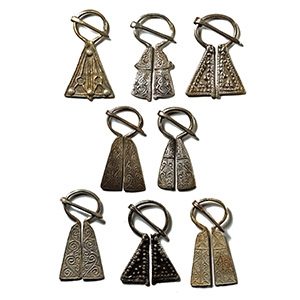
Viking Inspired Silver Penannular Omega Brooch Collection
12th-14th century A.D.Sold for (Inc. bp): £546
A group of flat-section Mordvinian type brooches, decorated to the trapezoidal plates with raised pellets, reserved scroll tendrils, hatching and other ornament. 91 grams total, 52-57 mm
Acquired on the European art market since the early 2000s. From the private Northern Ireland collection of R.M.
This type of brooch belongs to the typologies of the omega brooches. It was probably used by Ugro-Finnic people to fasten the shirt at the neck or to attach other lighter garments. These brooches evolved to become very elaborate, with dangling springs from the edges, and were often worn in pairs, particularly on female garments. In this late Viking period their coins demonstrated Russian and Eastern Roman influences in their art and jewellery. -
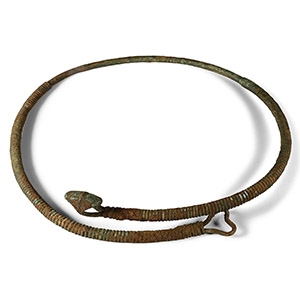
Large Viking Age Bronze Coiled Wire Neck Torc
9th-12th century A.D.Sold for (Inc. bp): £195
Comprising a single coiled rod with ribbed detailing, overlapping arms and loop terminals, one with securing button. 264 grams, 23.2 cm
Acquired on the European art market since the early 2000s. From the private Northern Ireland collection of R.M. -
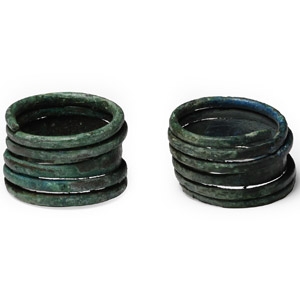
Viking Age Bronze Coiled Ring Pair
9th-11th century A.D.Sold for (Inc. bp): £72
Each a scaphoid plaque with extensions coiled to form a finger ring. 15.7 grams total, 22 mm each
Acquired on the European art market since the early 2000s. From the private Northern Ireland collection of R.M.
