
Loading, please wait...
LOT 1041
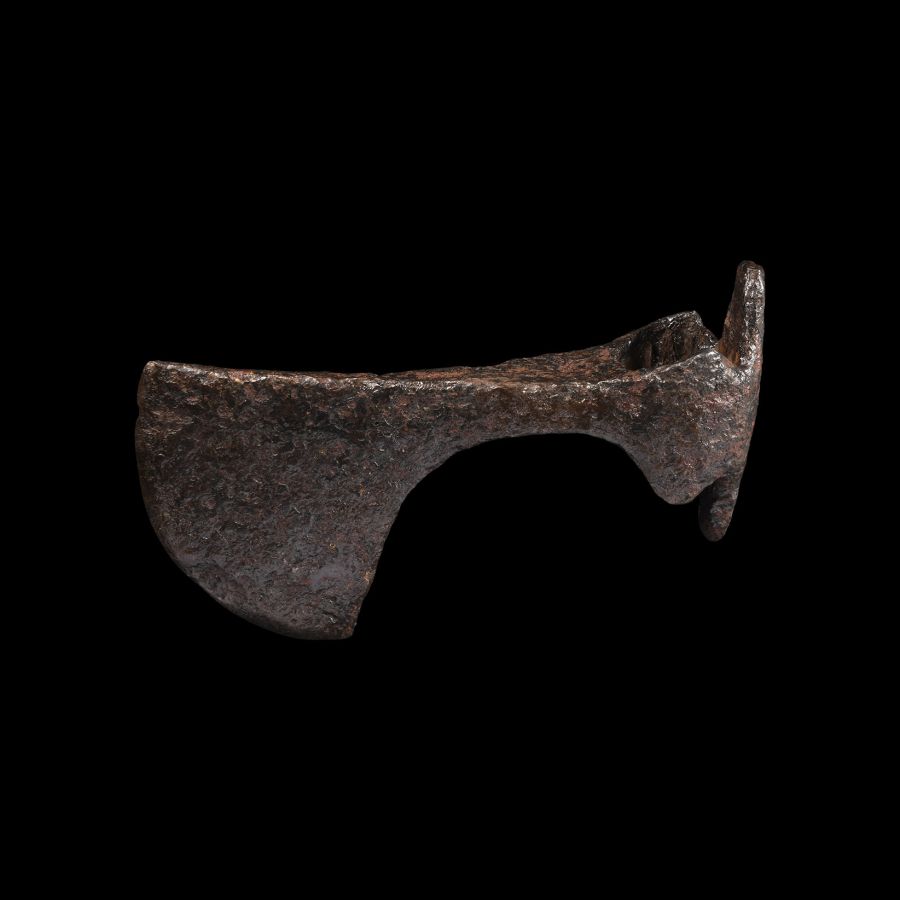
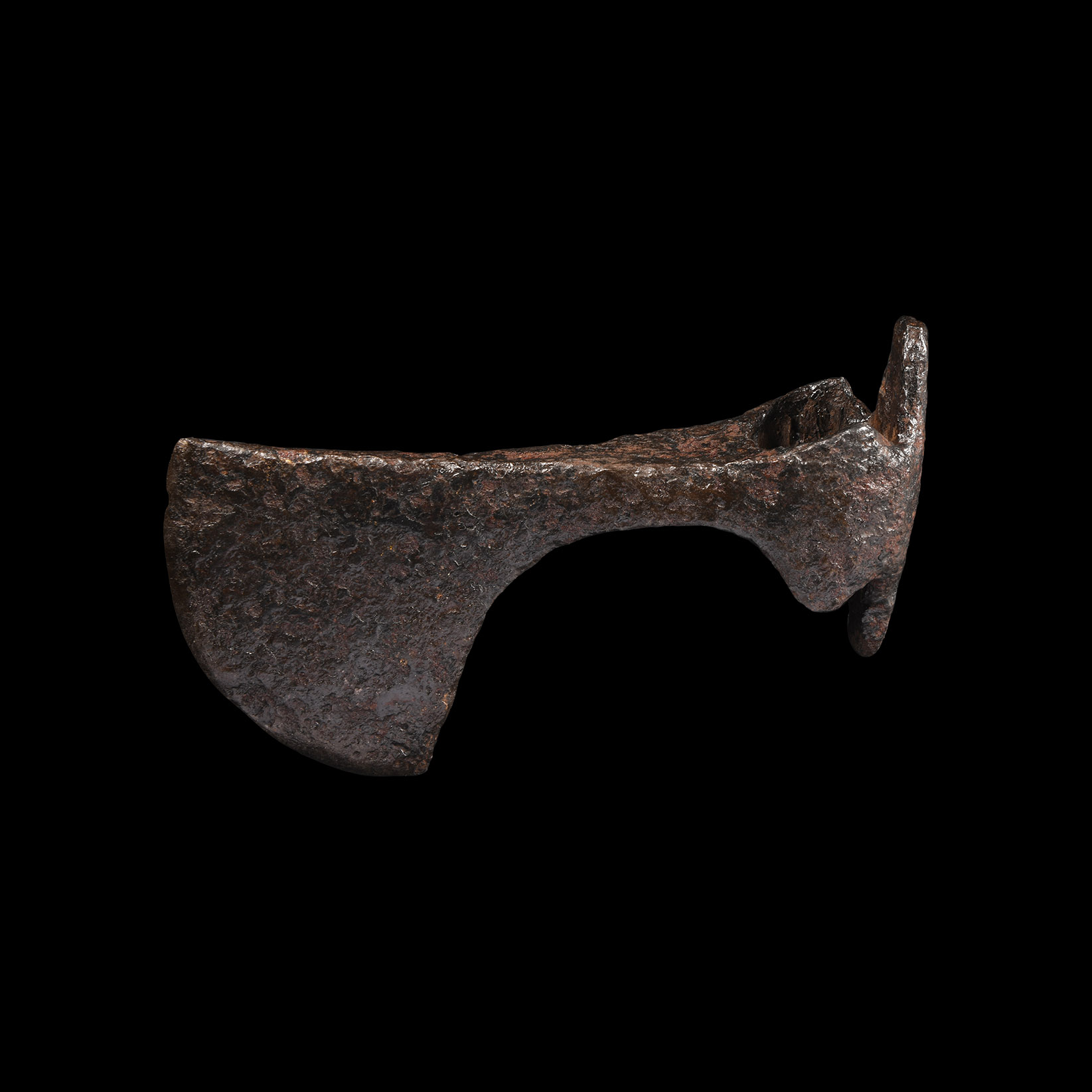
Viking Rus Period Bearded Type Axehead
CIRCA 11TH CENTURY A.D.
7 1/2 in. (746 grams, 19 cm).
An iron axehead with sturdy neck and slightly curved triangular blade; socket with lateral flanges and long rectangular extension to the rear. [No Reserve]
ProvenanceAcquired 1971-1972.
From the collection of the vendor's father.
Property of a London, UK, collector.
Cf. Kirpichnikov, A.N., Drevnerusskoe Oruzie (Ancient Russian Weapons), II, Moscow-Leningrad, 1966, in Arkheologia SSSR, vol. E1-36, especially axe no.2, from (pl.XVIII) from Zauzhelie; Sedov, B.B., Finno-Ugri i Balti v Epokhi Srednevekovija, Moscow, 1987, plate V, item 23.
FootnotesThe axe seems to be a variation of type III of the Kirpichnikov classification of the Eastern Rus Axes typology - battle axes with downwards blade, two pairs of side wings and an elongated cut-out butt. Paulsen called the related type "Varangian group" of North Baltic axes.
CONDITIONTimeLine Auctions follows a vetting process to ensure the authenticity and legality of all items, reinforcing our commitment to integrity and responsible trading. Each antiquity, antique, and coin lot undergoes thorough examination by a vetting committee of at least ten external specialists, professional trade association members, scientists, and archaeologists: Our Vetting Process
AUCTIONS:
TimeLine is a leading auction house specialising in antiquities, ancient art, collectables, natural history, coins, medals, and books. Our auctions offer museums, collectors, historians, and enthusiasts the opportunity to acquire unique and historically significant pieces.
-
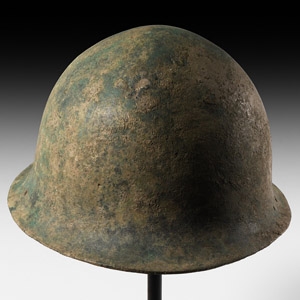
Villanovan Bronze Helmet
8th century B.C.Estimate: £20,000 - 30,000 (‡+bp*)
Opening Bid: £7,500
A bronze 'pot' helmet with rounded bowl and flared rim; three sets of paired piercings for attachment of leather cheek-flaps; cracked; accompanied by a custom-made display stand. 1.7 kg, 30.5 cm wide
Bowl pierced and cracked.
Acquired early 1990s. Ex private American collection; thence by descent. Private Swiss collection since 1998. Accompanied by an academic report by Dr Raffaele D'Amato. This lot has been checked against the Interpol Database of stolen works of art and is accompanied by searcher certificate no.11573-199009.
The ‘pot’ or ‘bell’ helmet, found as early as in an 8th century coffer grave (ad arca) from the Esquiline (Rome) and other graves (Coussin, 1926, p.88, fig.23; Sekunda, Northwood,1995, p.6, grave 94) was made from a single piece of bronze, while later Italic variants were fashioned from jointed plates (Connolly, 1981, p.102, figs.2-2a; Egg, 1988, p.223, variant Vetulonia). The skull was somewhat spherical and with a flared rim: this in some Etruscan and Italic specimens, was rivetted for strength (Egg, 1988, fig.18, p.240, from Picenum, and Murlo and Trestina variants, p.232, fig.10 and p.234, fig.12; Connolly, 2006, p.102, figs.2-2a, from Sesto Calende). The smooth surface of these types of helmets was intended to deflect blows. The ‘calotte’ helmets (Egg, 1988, pl.57) from Rome, as the helmet here, appear to be variants of a similar helmet from Montegiorgio Piceno and from Montelparo (ex Zschille collection). Some of them, like the helmet found in the necropolis of Tolentinum, were decorated with rich engravings. These practical helmets were probably furnished with a leather chinstrap, even though a similar Galea, found in the Tomba del Duce at Vetulonia, (Fossati, 1987, p.50; Egg, 1988, pp.223-224, fig.3, p.231, fig.12) dated to the first half of the 7th century B.C., still had the remains of what was probably a bronze cheek-piece. -
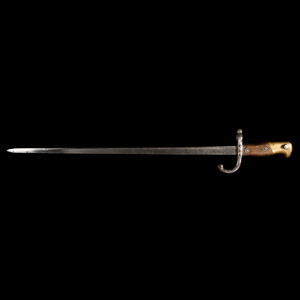
French Gras Model 1874 Rifle Bayonet
Dated 1878 A.D.Sold for (Inc. bp): £49
A Gras bayonet with T-shaped tapering 'epee' blade fitted with steel perforated quillon, rivetted wood grip scales and brass pommel slotted to fit the rifle barrel key; various punchmarks and numbered '54506' to quillon, the back of the blade inscribed 'Mme d'Arennes de Chatrs Avril 1878' in script. 573 grams,64.5 cm
Acquired on the UK antiques market between 1974-1985. Albert Ward collection, Essex, UK. -
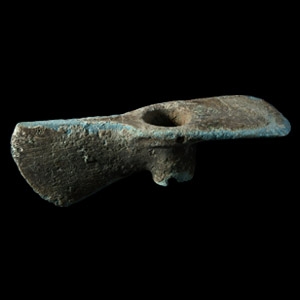
Luristan Socketted Axe-Adze
13th-7th century B.C.Sold for (Inc. bp): £121
A substantial copper-alloy adze-axe head composed of a cylindrical socket, one blade at a right angle to the socket with tapering sides and D-section cutting edge; one blade upright with convex cutting edge. 559 grams, 16.5 cm
Fine condition.
Acquired in the 1980s. London, UK, private collection. Property of an Essex gentleman.
