
Loading, please wait...
LOT 1073
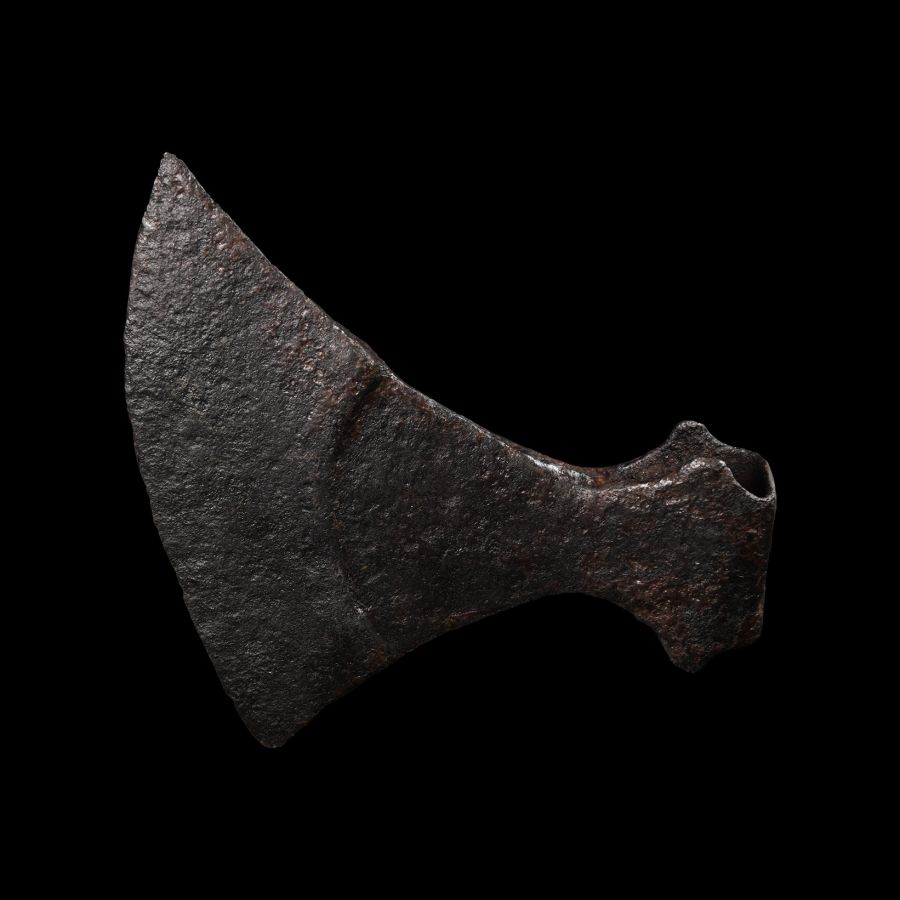
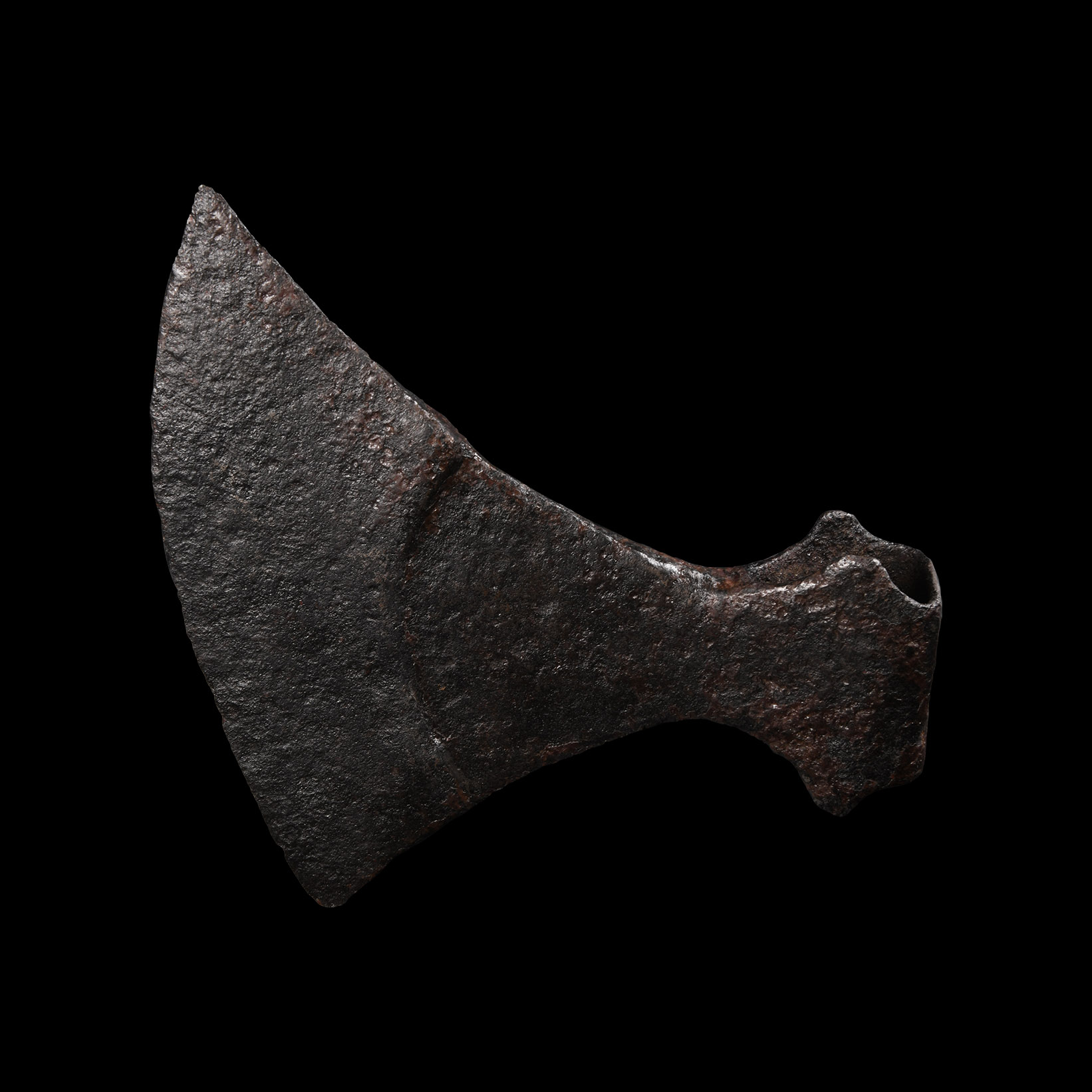
Viking Period Danish Type Broad Axehead
CIRCA 10TH-11TH CENTURY A.D.
6 1/8 in. (387 grams, 15.7 cm).
An iron broad axehead of asymmetrical profile with reinforced curved cutting edge, triangular-section socket with flanking spurs to upper and lower edges. [No Reserve]
ProvenanceAcquired 1971-1972.
From the collection of the vendor's father.
Property of a London, UK, collector.
Cf. Arbman, H., Birka I: Die Gräber, Uppsala, 1940, pl.14(5); Hjardar K. and Vike, V., Vikings at war, Oxford-Philadelphia, 2016, p.162, for a similar specimen from Troms, dated 1000-1050 A.D.
FootnotesThe broad axe of type M is a weapon specifically designed as battle-axe with the edge, being Þunssleginn, i.e. thinly forged. These broad axes were the prerogative of the housecarls of the Anglo-Danish King Canute, of the guardsmen fighting with Harold at Stamford Bridge and Hastings in 1066 A.D. and of the famous Varangian Guard of the Roman emperors of Constantinople.
CONDITIONTimeLine Auctions follows a vetting process to ensure the authenticity and legality of all items, reinforcing our commitment to integrity and responsible trading. Each antiquity, antique, and coin lot undergoes thorough examination by a vetting committee of at least ten external specialists, professional trade association members, scientists, and archaeologists: Our Vetting Process
AUCTIONS:
TimeLine is a leading auction house specialising in antiquities, ancient art, collectables, natural history, coins, medals, and books. Our auctions offer museums, collectors, historians, and enthusiasts the opportunity to acquire unique and historically significant pieces.
-
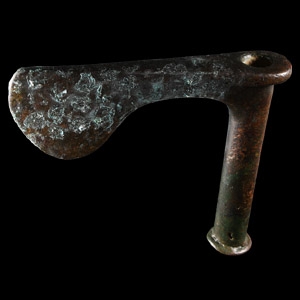
Western Asiatic 'Crescentic' Axehead
1st millennium B.C.Estimate: £200 - 300 (+bp*)
Opening Bid: £100
A bronze axehead with slender tubular socket, horizontal upper cheek and curved lower one, scooped profile to blade with convex cutting edge. 330 grams, 12.5 cm
Acquired 1980-2015. Ex Abelita family collection. -
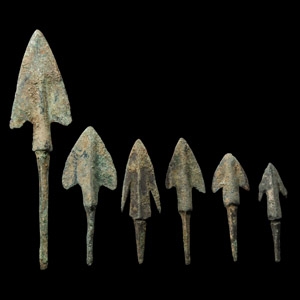
Luristan Arrowhead Group
2nd millennium B.C.Sold for (Inc. bp): £260
A group of six bronze arrowheads with deltoid form, a sharp barbed blade and prominent midrib extending to a long tang. 52 grams total, 4.3-10.9 cm
Acquired 1980-2015. Ex Abelita family collection.
A number of arrowheads of this type have been excavated from the Northern Iranian Plateau, in Luristan and in the South-Caspian region. Many parallels have a burial provenance, but a large hoard of them was found in a non-funerary context. This type of arrowhead has been in use from the 2nd millennium B.C. Godard claimed that barbed types of heads came from tombs from Luristan, like the ones found in Tang-i-Hamamlan. -
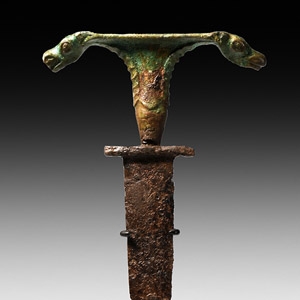
Heniochi Dagger with Beast Heads
4th-2nd century B.C.Sold for (Inc. bp): £520
A short iron dagger with triangular blade, short straight guard surmounted by a bronze pommel characterised by twinned beast heads projecting from each side; accompanied by a custom-made display stand. 170 grams, 28 cm (753 grams total, 39 cm high including stand)
Acquired 1971-1972. From the collection of the vendor's father. Property of a London, UK, collector.
The tribe of the Heniochs, according to Artemidorus of Ephesus, existed during the 5th-1st century B.C., on the Black Sea littoral that is part of present-day Abkhazia. Aristotle describes the Heniochi as a group of people "ready enough to kill and eat men." The dagger shows similarities with the pommel of a sword from Akhul Abaa grave 4 with twinned beast heads. These weapons of subtype I, according to the classification of Gamkrelidze-Shatberashvili-Pirtskhalava-Charkviani, were popular not only in Abkhazia, but throughout the territory of west Georgia during the 4th-1st century B.C.
