
Loading, please wait...


LOT 1821
Viking Period Bronze Openwork Cross Pendant
CIRCA 9TH-11TH CENTURY A.D.
1 1/4 in. (4.25 grams, 32 mm).
Comprising a cross patonce with low-relief pellet decoration, surrounded by a circular frame with integral suspension loop. [No Reserve]
ProvenanceUK gallery, early 2000s.
LiteratureCf. similar pendant in Arbman, H., Birka I: Die Gräber, Uppsala, 1940, pl.103 (8).
CONDITIONTimeLine Auctions follows a vetting process to ensure the authenticity and legality of all items, reinforcing our commitment to integrity and responsible trading. Each antiquity, antique, and coin lot undergoes thorough examination by a vetting committee of at least ten external specialists, professional trade association members, scientists, and archaeologists: Our Vetting Process
AUCTIONS:
TimeLine is a leading auction house specialising in antiquities, ancient art, collectables, natural history, coins, medals, and books. Our auctions offer museums, collectors, historians, and enthusiasts the opportunity to acquire unique and historically significant pieces.
-

Viking Age Bronze Pendant with Bell-Shaped Drops
8th-10th century A.D.Sold for (Inc. bp): £221
Comprising a semi-circular plate with faux-rope decoration, three loops below with pendant drops with bell finials, the central one from a different pendant. 29.6 grams, 63 mm
From the private coin collection of a West London, UK, gentleman, formed since the mid 1980s. -

Viking Age Inlaid Iron Horse Bit Cheek Piece Pair with Opposing Beasts
Northern Europe, 11th-12th century A.D.Sold for (Inc. bp): £2,210
Matched pair of bridle fittings formed as two opposing fantastical creatures with their heads turned back and front legs resting on a globe forming a passage for a strap, the bodies decorated with bands of herringbone decoration. 79.2 grams total, 79 mm each
From a European collection, 1990s. This lot has been checked against the Interpol Database of stolen works of art and is accompanied by search certificate number no.13379-257911.
On these types of horse-bits, two heads or a head/tail normally face each other. But an unusual piece from Edsvära in Västergötland, Sweden, depicts two heads turned outwards, like in the current example. The mount from Edsvära, with its attached iron bit, was found in 1906 next to a horse's skeleton. -
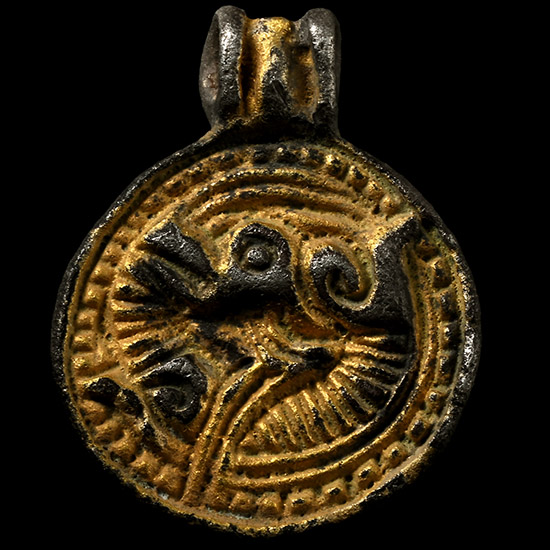
Scandinavian Viking Silver Pendant with Beast
9th-11th century A.D.Sold for (Inc. bp): £520
Discoid type with suspension loops, pellets to the border enclosing a bird-head in profile; Baltic type. 3.53 grams, 24 mm
Private collection formed in Europe in the 1980s. Westminster collection, central London, UK.
