
Loading, please wait...
LOT 0382
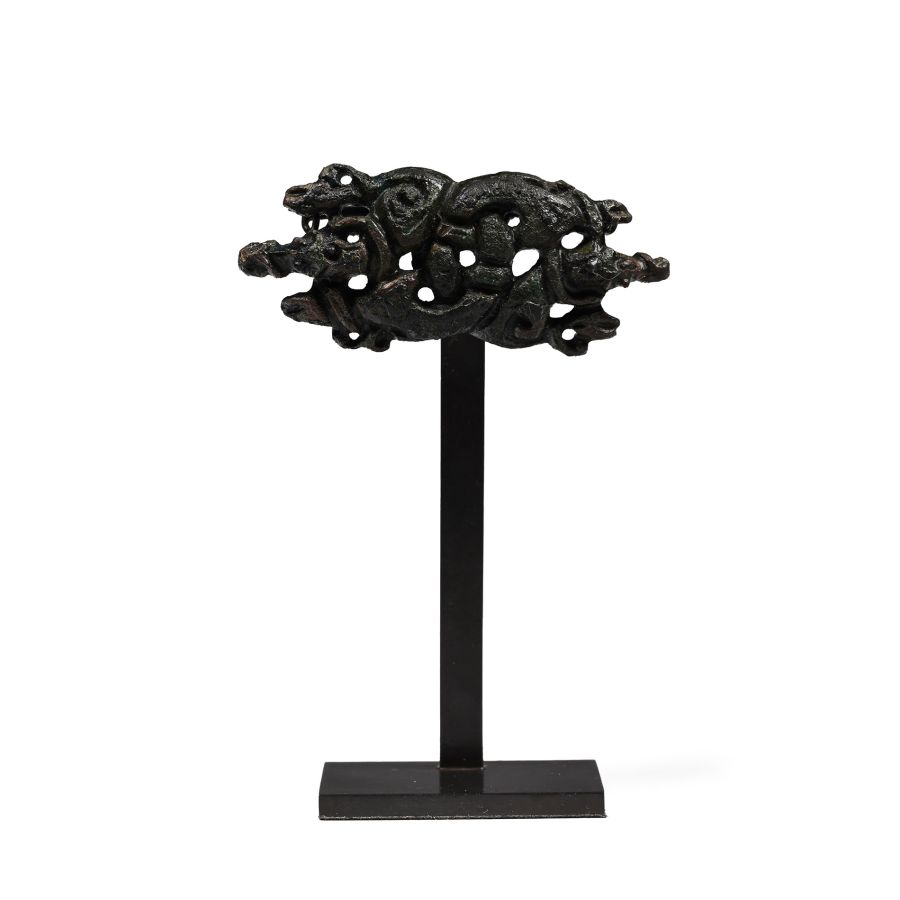
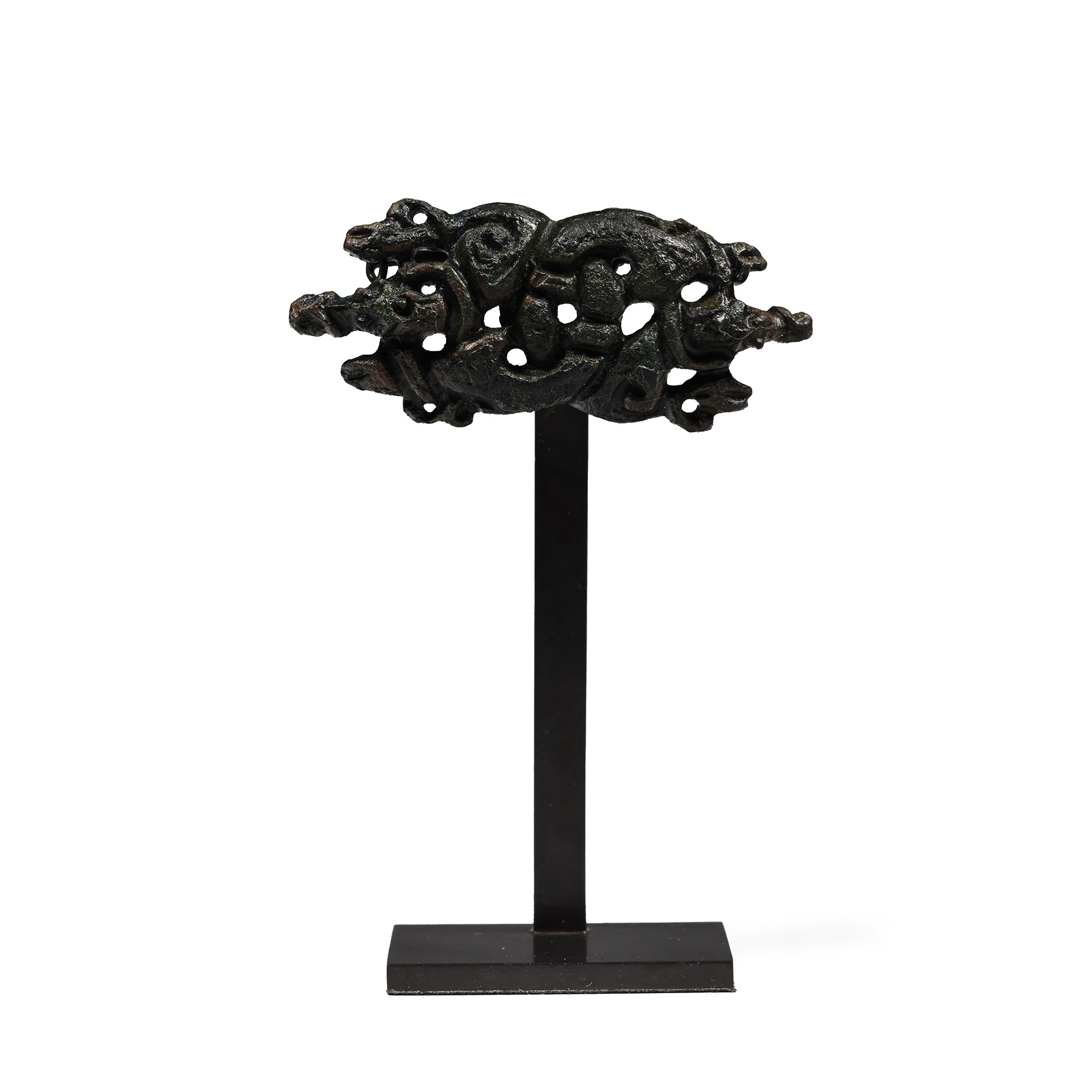
Viking Mount with Entwined Beasts
10TH-11TH CENTURY A.D.
2 1/4 in. (3 3/8 in.) (21.17 grams, 57 mm (60.7 grams total, 85 mm including stand)).
Ellipsoid in plan, formed as interlaced beasts with central knot and interlaced body parts in Jellinge Style; six piercings to accept mounting rivets; hollow to the underside; mounted on a custom-made stand.
ProvenanceAcquired on the London art market, 1997.
Private collection, London.
TimeLine Auctions follows a vetting process to ensure the authenticity and legality of all items, reinforcing our commitment to integrity and responsible trading. Each antiquity, antique, and coin lot undergoes thorough examination by a vetting committee of at least ten external specialists, professional trade association members, scientists, and archaeologists: Our Vetting Process
AUCTIONS:
TimeLine is a leading auction house specialising in antiquities, ancient art, collectables, natural history, coins, medals, and books. Our auctions offer museums, collectors, historians, and enthusiasts the opportunity to acquire unique and historically significant pieces.
-
.jpg)
Scandinavian Viking Bronze Drum Brooch with Interlaced Panels
8th-9th century A.D.Sold for (Inc. bp): £1,560
With four raised arms and central knop to the upper face, all with punched ring-and-dot detailing; the outer sidewall with four panels of knotwork, dividing vertical stems with ring-and-dot motif, each with a D-shaped protrusion; the upper face with dense zoomorphic ornament; pin and separate catchplate to the underside with central hole, five studs retaining it to the upper. 71.6 grams total, 45 mm
Fine condition, pin intact, backplate slightly cracked.
UK gallery, acquired in the 2000s. Property of an English gentleman. This lot has been checked against the Interpol Database of stolen works of art and is accompanied by search certificate no.11406-192532.
The type is known as a 'drum' brooch or 'box' brooch. They were apparently manufactured on the island of Gotland and all known examples probably have their origin there. Over time, the refinement of the earlier types (such as the present example) is superseded by cruder decoration consisting of dimples or simple dots. -
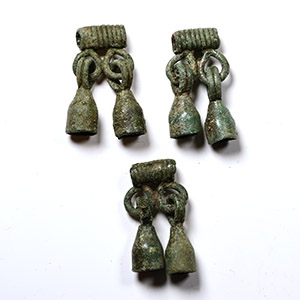
Viking Age Bronze Double Bell Pendant Group
Circa 9th-11th century A.D.Sold for (Inc. bp): £33
Each comprising a tubular bead with ribbing to the outer face, suspension loops each supporting a bottle-shaped dangle. 25 grams total, 40 mm each
UK gallery, early 2000s. -
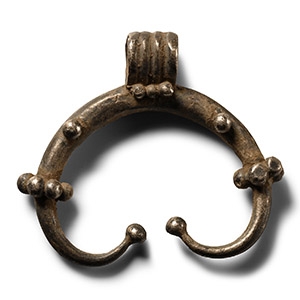
Viking Age Silver Lunar Pendant
Circa 9th-11th century A.D.Sold for (Inc. bp): £195
With ribbed suspension loop, applied granules. 3.82 grams, 32 mm
Private collection, Arundel, West Sussex, UK, 1980s.
