
Loading, please wait...
_900x900.jpg "Viking Iron Danish Type Broad Axehead")
_200x200.jpg "Viking Iron Danish Type Broad Axehead")
.jpg "Viking Iron Danish Type Broad Axehead")
LOT 1128
Viking Iron Danish Type Broad Axehead
9TH-10TH CENTURY A.D.
6 in. (334 grams, 15.5 cm).
Featuring flanges to the socket, a rectangular butt and cheeks with shorter upper and longer lower edges.
ProvenanceFrom the private collection of a London gentleman, from his grandfather's collection formed before the early 1970s.
CONDITIONTimeLine Auctions follows a vetting process to ensure the authenticity and legality of all items, reinforcing our commitment to integrity and responsible trading. Each antiquity, antique, and coin lot undergoes thorough examination by a vetting committee of at least ten external specialists, professional trade association members, scientists, and archaeologists: Our Vetting Process
AUCTIONS:
TimeLine is a leading auction house specialising in antiquities, ancient art, collectables, natural history, coins, medals, and books. Our auctions offer museums, collectors, historians, and enthusiasts the opportunity to acquire unique and historically significant pieces.
-
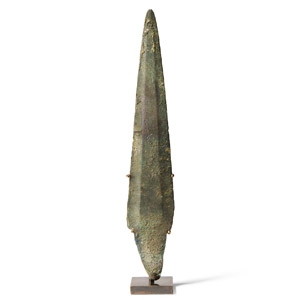
Western Asiatic Bronze Dagger
2nd millennium B.C.Estimate: £200 - 300 (‡+bp*)
Opening Bid: £100
With narrow pointed blade and wide raised flange down centre, straight sides, well marked shoulders with wide tang, one upper hole for rivet. 149 grams total, 21 cm high including stand
From the possessions of a member of a German princely family, gathered in the late 19th century, until the 1930s. with Auction House CUSP, Vienna, Auction Antique Art from Asia and from the Eastern Mediterranean, 16 June 2012, lot 75 [Part].
The type was technically more advanced than previous types of blades in the Near East due to its shape and its slightly convex sides widening out near the point, which combined the advantages of the leaf-shaped and straight-sided forms. -
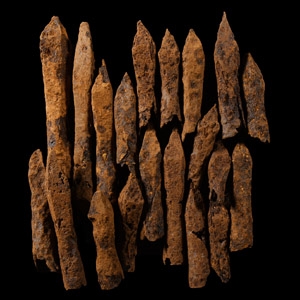
Medieval Iron Crossbow Bolt Group
Circa 12th-15th century A.D.Sold for (Inc. bp): £143
Mainly comprising socketted bolts with tapering and facetted square-section tips. 682 grams total, 4.6-11.7 cm
Acquired 1990s-early 2000s. East Anglian private collection.
In medieval warfare crossbows were of great importance, used especially by infantry. An improvement of their effectiveness by inceasing the weight of projectiles as well the strength of the bow caused a clear evolution of body defences between 13th and 15th centuries A.D. -
.jpg)
Civil War Starr Percussion 1858 Army Revolver
1861-1865 A.D.Estimate: £1,100 - 1,500 (+bp*)
Opening Bid: £611
Double-action with .44 calibre six-shot cylinder, hinged frame and loading arm with 15cm (6") barrel; marked 'STARR ARMS CO NEW YORK' to left frame, 'STARR'S PATENT JAN 15 1858' to right, numbered 705 to cylinder and 8795/W to front frame; plain wood grip with illegible stamped inspector mark each side; action slightly weak. 1.12 kg, 29 cm
Acquired from Bottomley Antiques & Armour, 2014. The Kusmirek Collection, UK. Accompanied by a copy of the Bottomley invoice.
Sold as an exempt item under Section 58 (2) of the Firearms Act, 1968, to be held as a curiosity or ornament. No license required but buyer must be over 18 years of age. Overseas bidders should note that, due to UK regulations governing export of all firearms, overseas buyers will need to make arrangements for shipping this lot out of the UK directly, by air freight, with a specialist company or agent.
