Loading, please wait...
Details
LOT 1455
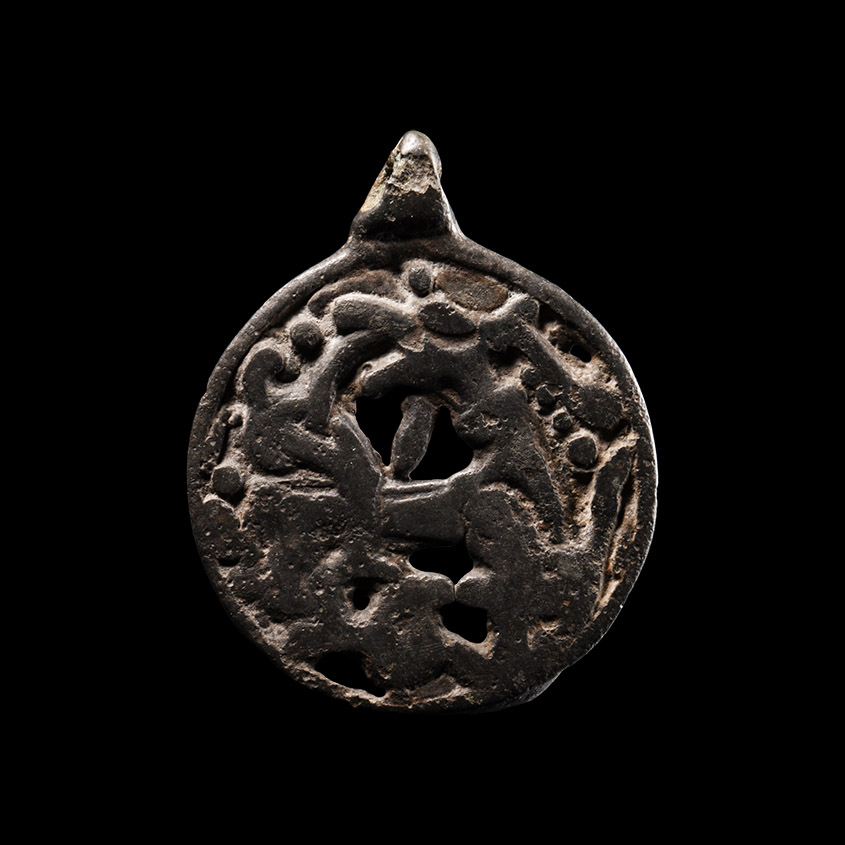
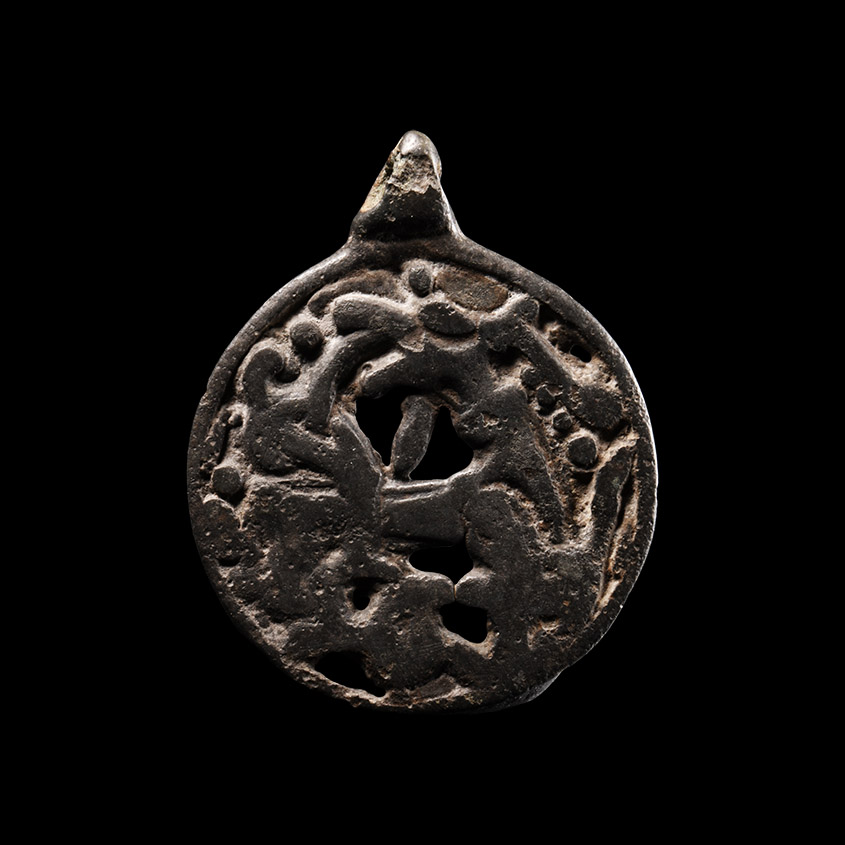
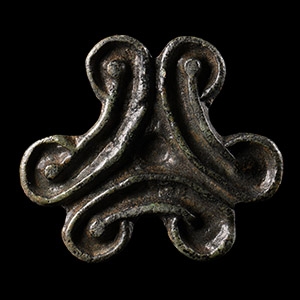
Viking Bronze Jellinge Style Regardant Beast Pendant
9TH-11TH CENTURY A.D.
1 3/4 in. (10.4 grams, 45 mm).
Openwork field with beast and pellets, lappets forming a mesh around the body; integral loop. [No Reserve]
Provenance
From the collection of a North American gentleman, formed in the 1990s.
Literature
Cf. Korshyn, V.E., Yazicheskiye Priveski Drevniye Rysi X-XIV Vekov, Moscow, 2013, type J.2.02.
CONDITIONVETTING:
TimeLine Auctions follows a vetting process to ensure the authenticity and legality of all items, reinforcing our commitment to integrity and responsible trading. Each antiquity, antique, and coin lot undergoes thorough examination by a vetting committee of at least ten external specialists, professional trade association members, scientists, and archaeologists: Our Vetting Process
AUCTIONS:
TimeLine is a leading auction house specialising in antiquities, ancient art, collectables, natural history, coins, medals, and books. Our auctions offer museums, collectors, historians, and enthusiasts the opportunity to acquire unique and historically significant pieces.
RELATED LOTS
-
Viking Bronze Bridle Strap Junction with Beast Heads
10th-11th century A.D.Estimate: £800 - 1,000 (‡+bp*)
Opening Bid: £400
Comprising a rectangular suspension loop with D-section shank and mask below, two flanking arms each with a zoomorphic (bear?) face, one terminating in a wolf's head and the other in a bird's head; small loops below the terminals. 30 grams, 63 mm
Found Bardney, Lincolnshire, UK, in the early 1990s.
This bridle junction is decorated in the Anglo-Scandinavian Ringerike style. On each side of the central hole is an outward facing animal, their beaked heads positioned on the outer edges. The details on the face are carried out in moulded relief as well as engraving. -
Viking Bronze Tortoise Brooch Set
10th-11th century A.D.Sold for (Inc. bp): £1,820
Comprising a pair of domed brooches with low-relief zoomorphic decoration in bands, pin to the reverse on a transverse bar, reinforced catchplate; attached to a loop on the reverse of each brooch, a spacer formed as a lobed plaque with double rosette detailing and loops below, two chains connecting to the matched brooch; from the rosette spacers hang two more chains, one with a needle case with openwork knotwork plaque handle above, the other with a decorated lunate pendant. 334 grams, hangs 53 cm
Fine condition. Rare.
Property of a professional collector; acquired before 1990. Ex London collection since 2016. Accompanied by an academic report by Dr Raffaele D’Amato. This lot has been checked against the Interpol Database of stolen works of art and is accompanied by search certificate number no.11736-201216.
The most characteristic items of Viking women's jewellery are oval brooch pairs, sometimes called 'tortoise brooches' due to their shape, which are found in many female graves of the period. As in this example, the brooches themselves were usually connected by swags of chains, suspended from the pair of brooches and supporting utilitarian objects such as tweezers, an ear spoon, shears or a small knife, as well as amulets. In addition the wearer displayed strands of beads of glass, silver, amber or jet. -
Viking Age Gold Elf Shot Pendant
9th-10th century A.D. or earlierSold for (Inc. bp): £390
Formed as a gold cap set with polished glass gem; suspension loop above. 0.85 grams, 17 mm
Acquired 1980-2015. Ex Abelita family collection.
This amulet was believed to offer protection against 'Elfshot'. The attack of elves was believed responsible for mysterious suffering in men and livestock. 'Elfshot' described sudden shooting pains localised to a particular area of the body, such as in rheumatism, arthritis or muscle stitches or cramps. Elves were thought to shoot darts or arrows where such pains had no obvious external cause. Belief in elfshot persisted into the 20th century in rural areas, and as proof country folk would sometimes find small arrowheads (the remains of Neolithic or Mesolithic flints, or naturally-occurring spear-shaped stones) that were believed to be the magical weapons that caused the afflictions. Belief in elfshot began in the Pagan Germanic period.