
Loading, please wait...
LOT 0239
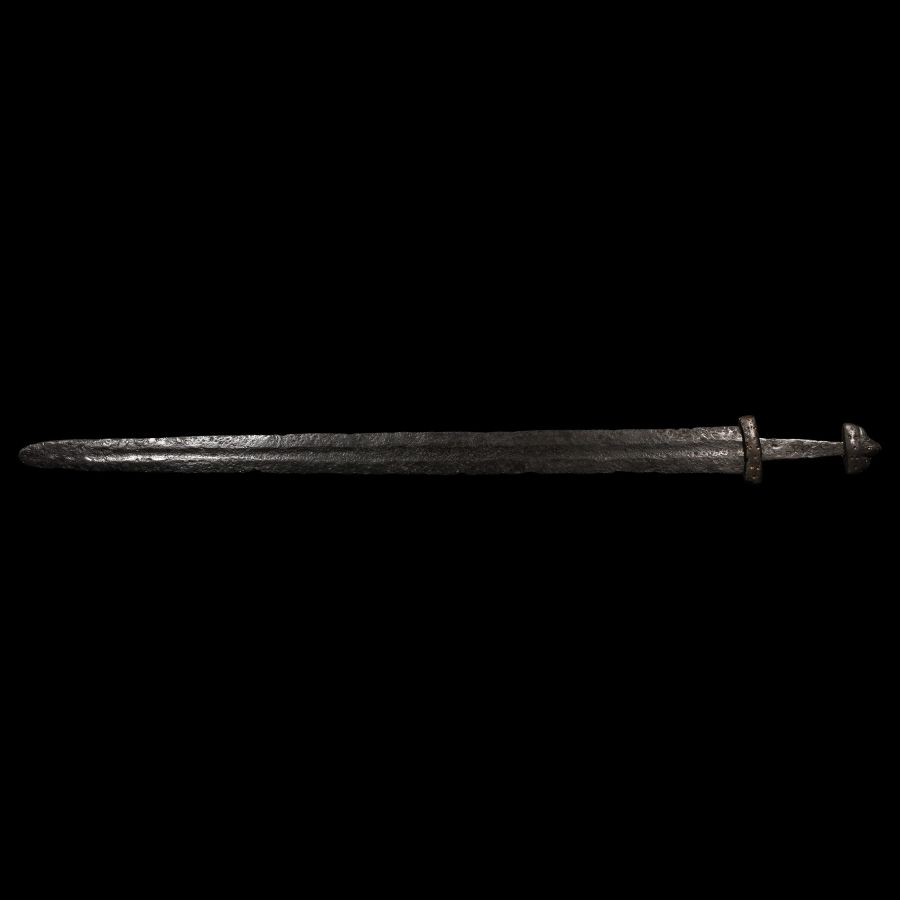
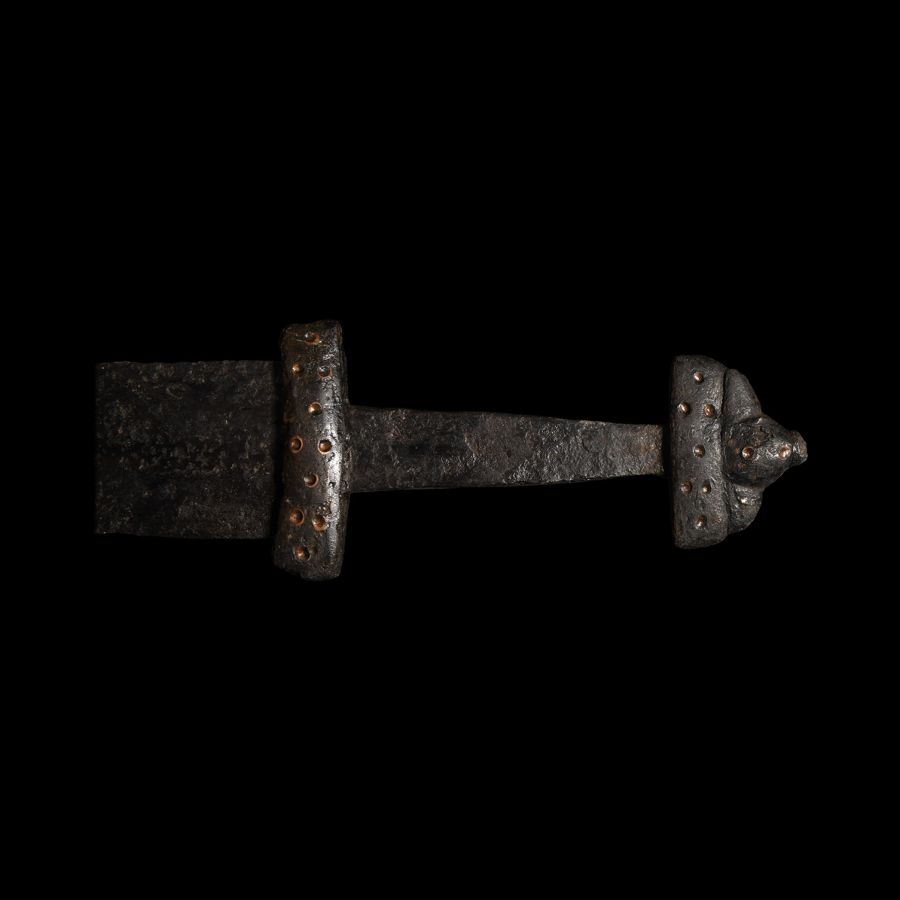
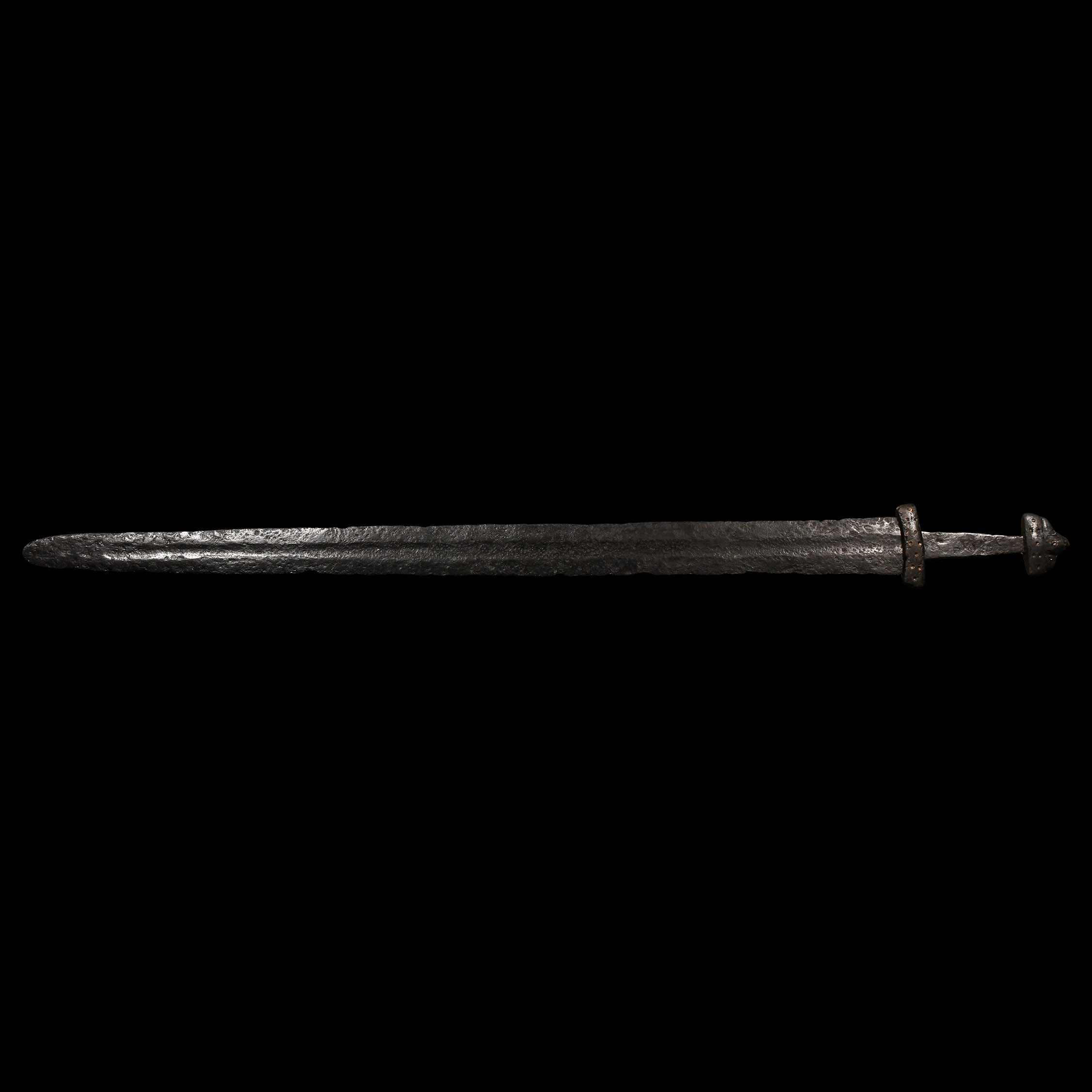
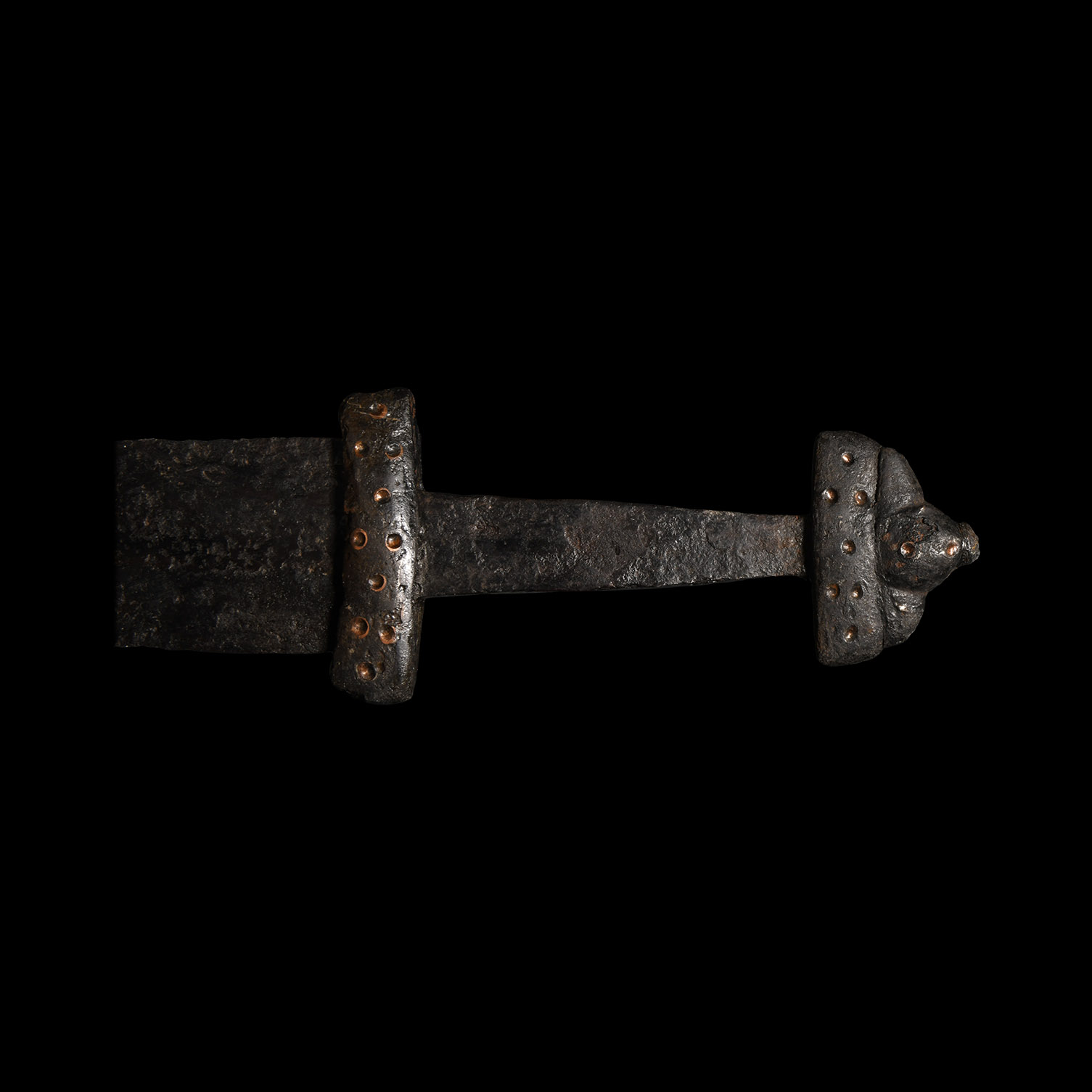
Viking Age Sword with Three-Lobed Pommel
EARLY 11TH CENTURY A.D.
35 1/2 in. (720 grams, 90 cm long).
A double-edged cutting sword of Oakeshott Type XII with inlaid hilt and tapering blade with shallow fullers; the lower guard gently curving and decorated with copper inlaid dots, upper guard and three-lobed pommel with similar decoration, traces of silver inlay to the hilt.
ProvenanceAcquired 1971-1972.
From the collection of the vendor's father.
Property of a London, UK, collector.
Accompanied by an academic report by Dr Raffaele D’Amato.
This lot has been checked against the Interpol Database of stolen works of art and is accompanied by searcher certificate no.11575-198856.
Cf. Petersen, J., De Norske Vikingsverd, Oslo, 1919; Peirce, I., Swords of the Viking Age, Suffolk, 2002; Oakeshott, E., The sword in the age of chivalry, Woodbridge, 1998; this double-edged sword belongs to a group of swords, very similar to Viking Age Scandinavian examples, mostly found in the east of the Baltic; a very similar specimen to our sample is a contemporary sword from Leikkimäki, Kokemäki, Satakunta, Finland (Peirce, 2002, pp.138ff.).
FootnotesThe sword belongs to the Type XII of the Oakeshott classification (Oakeshott, 1998, pp.37ff.), the characteristics of which are a broad, flat, evenly tapering blade, generally with a good sharp point and tending to widen perceptibly below the hilt. After the publication of the Finnish specimen, Peirce, due to the inlaid inscriptions of this latter, noted a close parallel, both in style and content, with a sword in the Schweizerischen Landesmuseum in Zurich. In the expanded context including the example from Finland, Peirce was able to re-date them to the 11th century.
CONDITIONTimeLine Auctions follows a vetting process to ensure the authenticity and legality of all items, reinforcing our commitment to integrity and responsible trading. Each antiquity, antique, and coin lot undergoes thorough examination by a vetting committee of at least ten external specialists, professional trade association members, scientists, and archaeologists: Our Vetting Process
AUCTIONS:
TimeLine is a leading auction house specialising in antiquities, ancient art, collectables, natural history, coins, medals, and books. Our auctions offer museums, collectors, historians, and enthusiasts the opportunity to acquire unique and historically significant pieces.
-
Greek Arrowhead Group
5th-3rd century B.C.Sold for (Inc. bp): £312
A group of 25 bronze socketted arrowheads, including leaf-shaped types and examples with triangular cross-sections. 76.9 grams total, 21-40 mm
Acquired before 2000. From the collection of a European gentleman living in the UK. -
Levantine Helmet with Opposing Ibexes
8th century B.C.Sold for (Inc. bp): £5,200
A Levantine or Assyrian domed bronze helmet of ovoid shape with slightly pointed top and integral cheek-pieces; chased low-relief decoration to both front and back depicting insignia of a pair of opposing ibexes flanking a small palm tree; the edge with regularly disposed holes for fastening of the leather lining; accompanied by a custom-made display stand. 458 grams, 23 cm high (2.36 kg total, 31.5 cm high including stand)
Fine condition, some restoration.
Acquired 1960s-1990s. Late Alison Barker collection, a retired London barrister. Accompanied by an academic report by Dr Raffaele D'Amato. This lot has been checked against the Interpol Database of stolen works of art and is accompanied by search certificate no.11386-190447.
This rare helmet is an unusual example of a conical strap-helmet, linked with similar Greek strap helmets, but until now in the Near East, known only from the Assyrian reliefs. It is shown together with the crested helmets, on the reliefs of Tiglapilaser III and Sennacherib. -
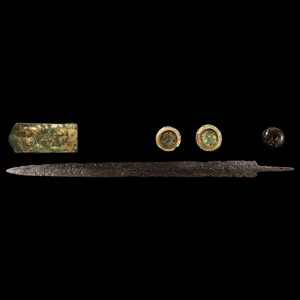
Migration Period Spatha Sword Blade with Fittings
Circa 4th-5th century A.D.Sold for (Inc. bp): £1,950
A military assemblage comprising: a double-edged spatha with a lentoid parallel-sided iron blade and pointed tip, battle nicks to both cutting edges; long tang with a bronze fastening rivet in situ; oblate chalcedony pommel; gilt copper-alloy chape scabbard fitting with fastening holes and a pair of round scabbard or baldric fittings. 937 grams total, 5-81.3 cm
Fine condition
Acquired 1971-1972. From the collection of the vendor's father. Property of a London, UK, collector. Accompanied by an academic report by Dr Raffaele D’Amato. This lot has been checked against the Interpol Database of stolen works of art and is accompanied by a search certificate number no.11587-198852.
Prestigious swords with richly trimmed sheaths, guards and hilts of the Great Migration Period on the Cimmerian Bosphorus are very few, although some specimens have been excavated from Kerch, Phanagoria, Hermonassa and Dzhurga-Oba. They were either custom-made or received as war booty. This sword belongs to a group of spathae of late Roman typology spread among the Germanic and Nomad foederati, and garrison troops of the Northern Black Sea and Bosphorus.
