
Loading, please wait...
LOT 0240
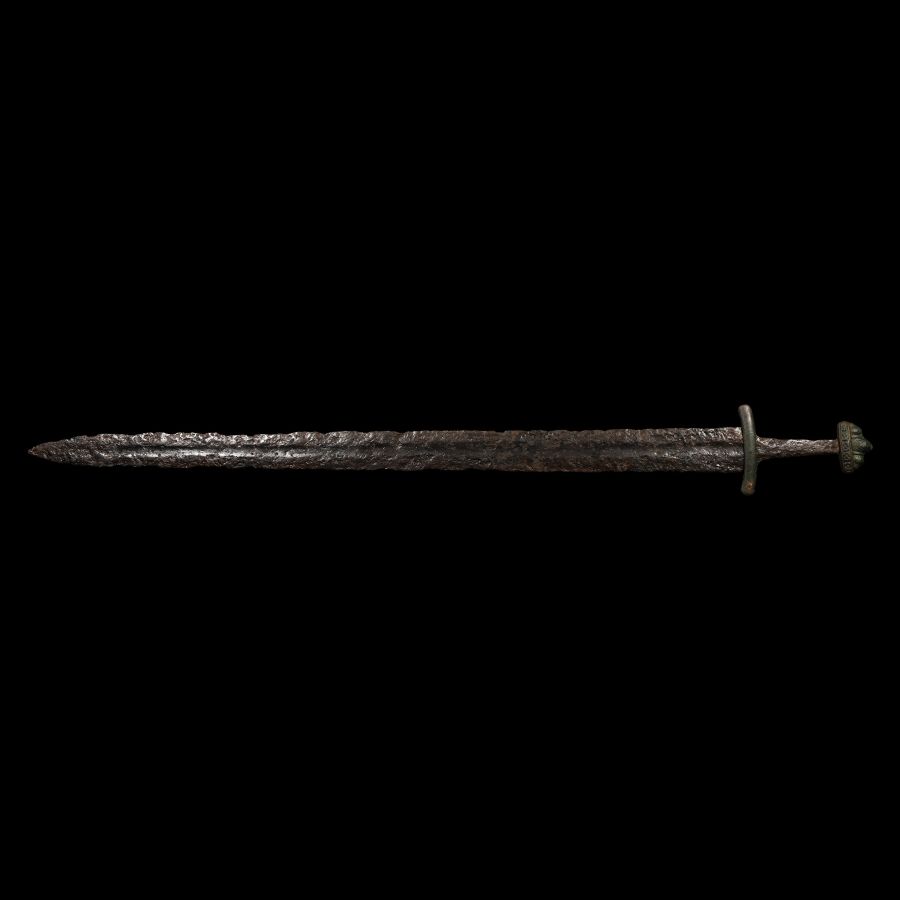
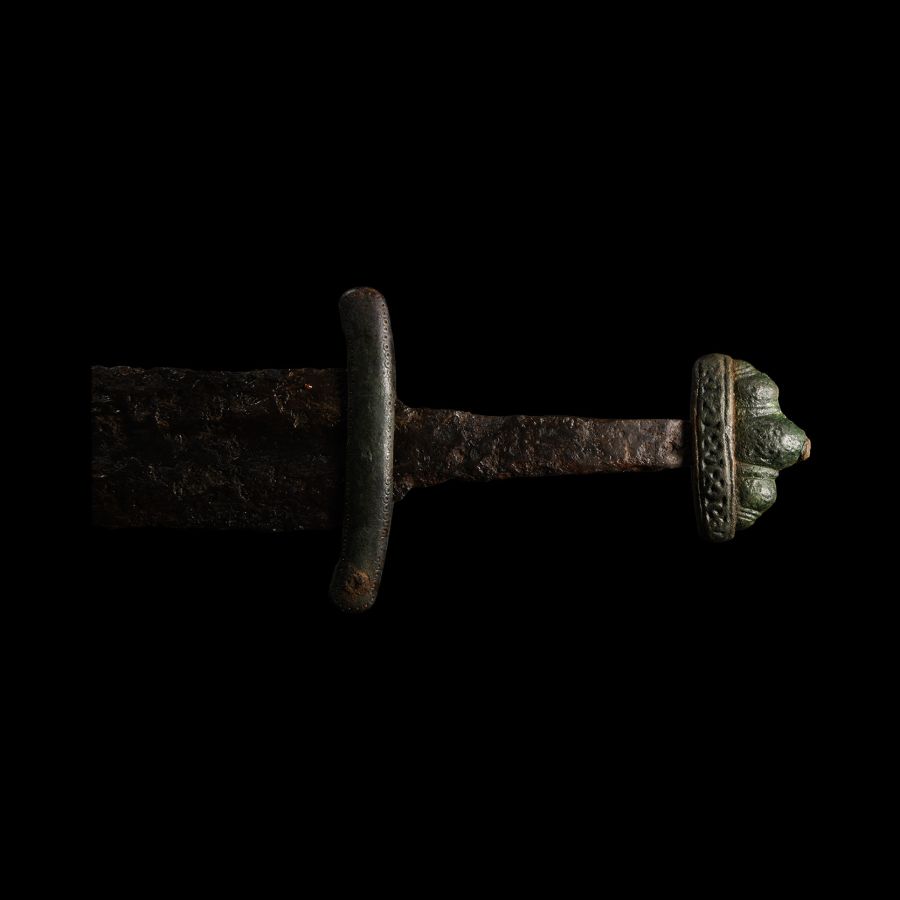
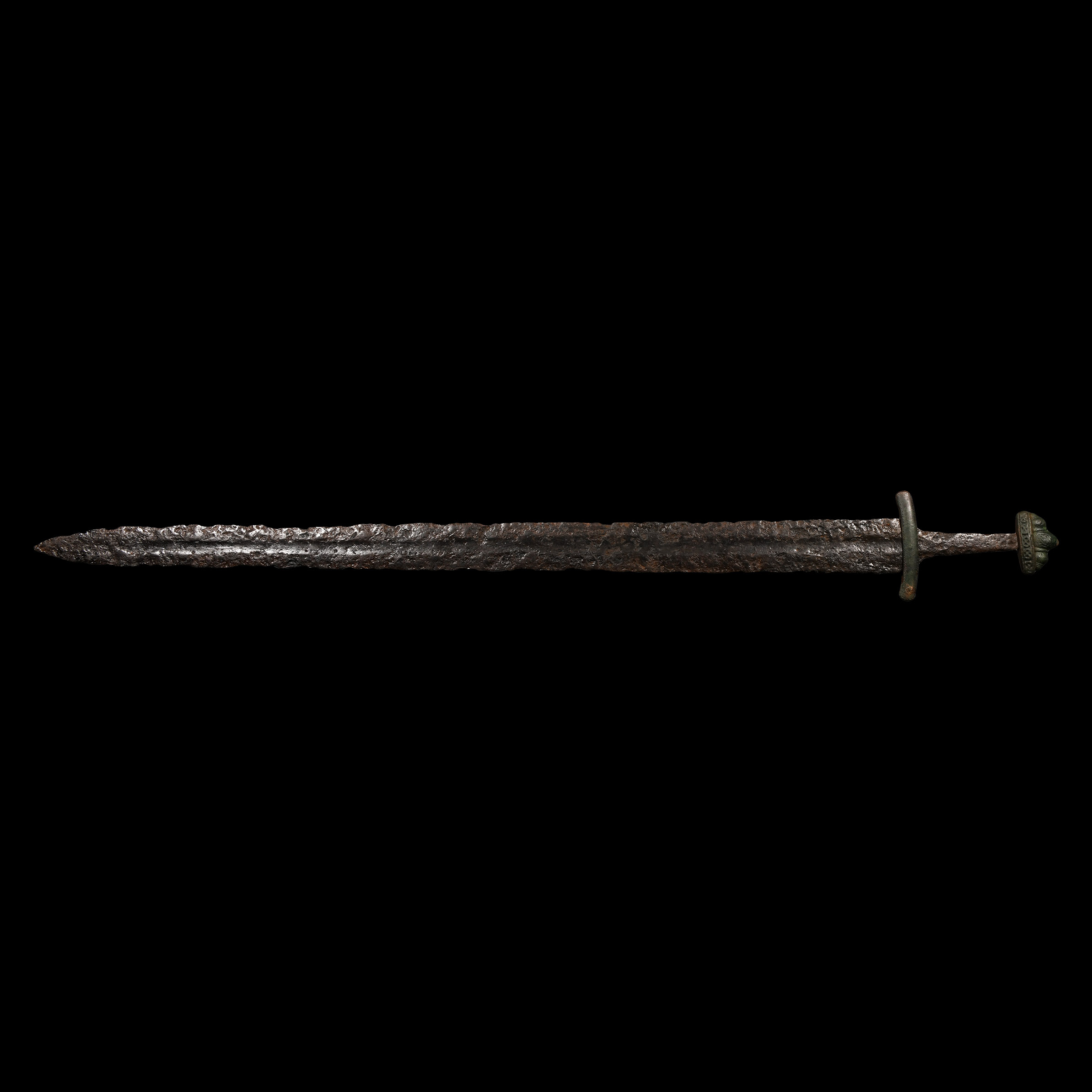
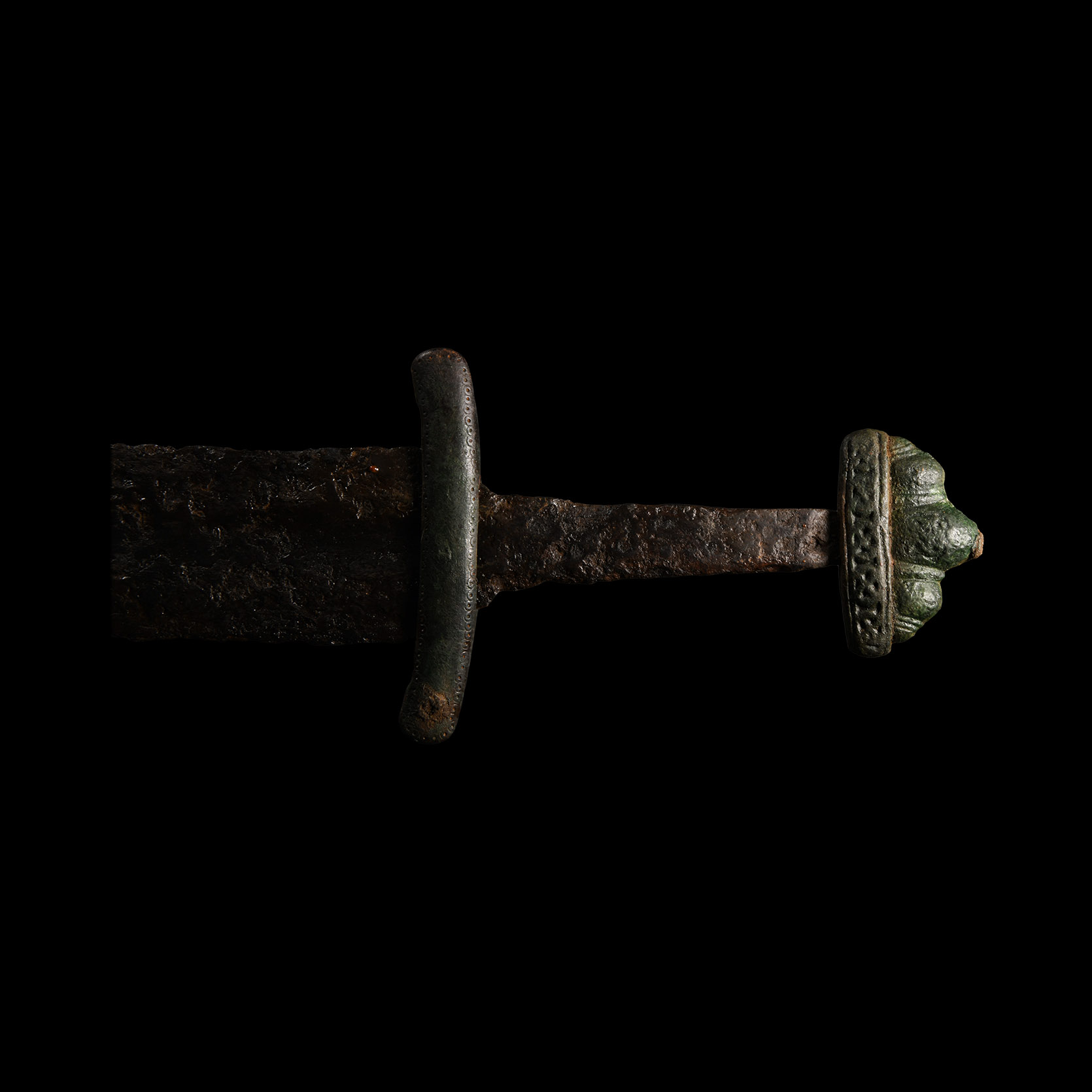
Viking Age Sword with Five-Lobed Pommel
10TH CENTURY A.D.
35 in. (755 grams, 89 cm).
A double-edged sword of Petersen Type L or S variant with straight tapering blade, light traces of pattern-welding and battle-nicks along the blade, tapering fullers and a sturdy long tang; boat-shaped lower guard curving gently towards the blade, decorated with punched ring-and-dot ornament along the edges; the upper guard with Trewhiddle Style ornament, surmounted by an elegant five-lobed pommel decorated with geometric patterns in the same style; cleaned and conserved.
ProvenanceAcquired 1971-1972.
From the collection of the vendor's father.
Property of a London, UK, collector.
Accompanied by an academic report by Dr Raffaele D’Amato.
This lot has been checked against the Interpol Database of stolen works of art and is accompanied by searcher certificate no.11574-198855.
Cf. Petersen, J., De Norske Vikingsverd, Oslo, 1919; Oakeshott, R.E., Records of the Medieval Sword, London, 2000; Peirce, I., Swords of the Viking Age, Suffolk, 2002; the sword finds parallels in various similar Viking age specimens of L variant, two very similar swords, both preserved at the British Museum (inv.1848,10-21.1 and 1856,7-1,1404), have been published by Peirce (2002, pp.77-81); however, the pommel is certainly akin to the type S swords, like an example from London (British Museum, accession number 1887,2-9,1, Peirce, 2002, pp.104-105) or a sword in the National Museum in Copenhagen (C16430, Peirce, 2002, pp.106-107).
CONDITIONTimeLine Auctions follows a vetting process to ensure the authenticity and legality of all items, reinforcing our commitment to integrity and responsible trading. Each antiquity, antique, and coin lot undergoes thorough examination by a vetting committee of at least ten external specialists, professional trade association members, scientists, and archaeologists: Our Vetting Process
AUCTIONS:
TimeLine is a leading auction house specialising in antiquities, ancient art, collectables, natural history, coins, medals, and books. Our auctions offer museums, collectors, historians, and enthusiasts the opportunity to acquire unique and historically significant pieces.
-
Viking Period Danish Type Broad Axehead
Circa 10th-11th century A.D.Sold for (Inc. bp): £2,340
An iron broad axehead of asymmetrical profile with reinforced curved cutting edge, triangular-section socket with flanking spurs to upper and lower edges. 387 grams, 15.7 cm
Acquired 1971-1972. From the collection of the vendor's father. Property of a London, UK, collector.
The broad axe of type M is a weapon specifically designed as battle-axe with the edge, being Þunssleginn, i.e. thinly forged. These broad axes were the prerogative of the housecarls of the Anglo-Danish King Canute, of the guardsmen fighting with Harold at Stamford Bridge and Hastings in 1066 A.D. and of the famous Varangian Guard of the Roman emperors of Constantinople. -
Marlik Decorated Spearhead
14th-10th century B.C.Sold for (Inc. bp): £330
A bronze spearhead with projecting midribs, long folded socket, decorated by concentric horizontal lines at the base and beneath the blade, horizontal triangles and vertical grooves along the shaft; triangular blade with round shoulders, ornamented by vertical lines running parallel to the midrib; pair of holes on the lower part of the shaft for attachment to a wooden haft. 562 grams, 55 cm
Fine condition.
Ex important Japanese collection, 1970s-2010.
The spearhead, cast in one piece, belongs to the type VIII, subtype B (triangular blade) of the Khorasani classification. Similar spearheads were excavated by Dr Negahban in the Marlik necropolis (tomb 1, trench III D) and are preserved in the National Museum of Iran, Teheran. -
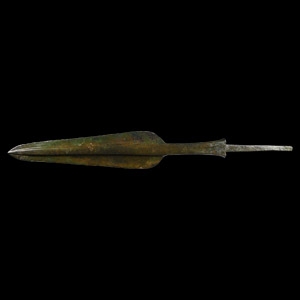
Amlash Type Spearhead
13th-11th century B.C.Sold for (Inc. bp): £234
A bronze tanged spearhead with heavily ridged and tapered blade with short collared shaft and square section tapered tang of recangular section. 436 grams, 40 cm
Acquired 1980-2015. Ex Abelita family collection.
The weapon belongs to the type 1 of the spearhead classification by Khorasani, mainly from Marlik or Amlash areas. Similar pieces have been dated by Stutzinger to 1200-1100 B.C.
