
Loading, please wait...
_900x900.jpg "Viking Age Silver Expandable Child's Bracelet Pair")
_200x200.jpg "Viking Age Silver Expandable Child's Bracelet Pair")
.jpg "Viking Age Silver Expandable Child's Bracelet Pair")
LOT 1215
Viking Age Silver Expandable Child's Bracelet Pair
CIRCA 8TH-10TH CENTURY A.D.
2 in. (21.9 grams total, 49-50 mm).
A pair of child-sized silver bracelets, each composed of a tapering, roughly round-section body and overlapping arms coiled around the opposite shoulder forming an openwork bezel. [2, No Reserve]
ProvenanceEarly 1990s London collection.
Acquired on the UK art market.
From a private collection, Lancashire, UK.
TimeLine Auctions follows a vetting process to ensure the authenticity and legality of all items, reinforcing our commitment to integrity and responsible trading. Each antiquity, antique, and coin lot undergoes thorough examination by a vetting committee of at least ten external specialists, professional trade association members, scientists, and archaeologists: Our Vetting Process
AUCTIONS:
TimeLine is a leading auction house specialising in antiquities, ancient art, collectables, natural history, coins, medals, and books. Our auctions offer museums, collectors, historians, and enthusiasts the opportunity to acquire unique and historically significant pieces.
-
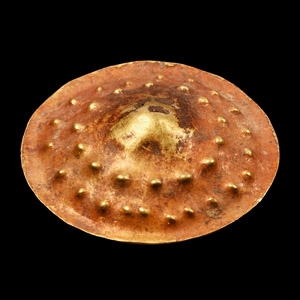
Viking Age Miniature Gold Shield Boss
9th-12th century A.D.Sold for (Inc. bp): £286
A miniature sheet-gold domed shield boss, embellished with repoussé concentric dots orbiting a larger central dome. 10.2 grams, 18 mm
Acquired 1980-2015. Ex Abelita family collection. -
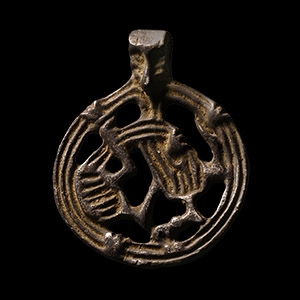
Viking Age Silver Gripping Beast Pendant
Late 10th-early 11th century A.D.Sold for (Inc. bp): £182
A silver Scandinavian pendant of Riddarholmen type with integral loop; the openwork plaque with banded border and four panels, internal stylised zoomorph with hatched panel to the hip, gripping three-fingered hands to the body and border, two detailed feet, clearly visible facing mask below the loop with pellet eyes. 4.51 grams, 29 mm
Private collection formed in Europe in the 1980s. Westminster collection, central London, UK.
This type of pendant was also widespread in the historical Rus region, centred on Kiev. -
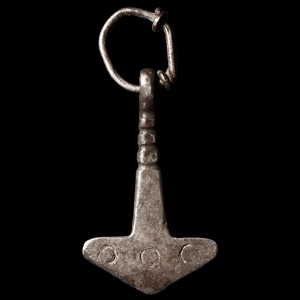
Viking Period Silver Hammer Pendant
8th-10th century A.D.Sold for (Inc. bp): £546
A bifacial silver hammer pendant with notched detailing to the handle and a horizontal trio of annulets to the blade; free-running silver ring with overlapping coiled arms. 2.23 grams, 33 mm
Acquired in the late 1990s-2000. Property of an East London gentleman.
