
Loading, please wait...
LOT 0325
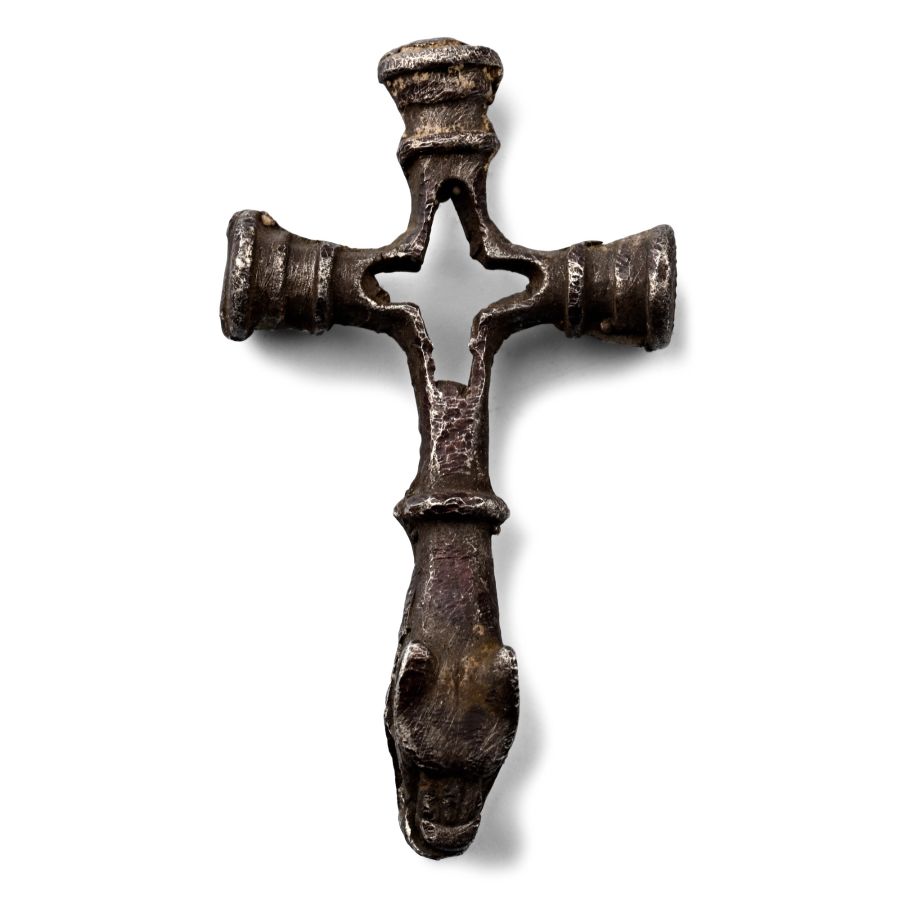
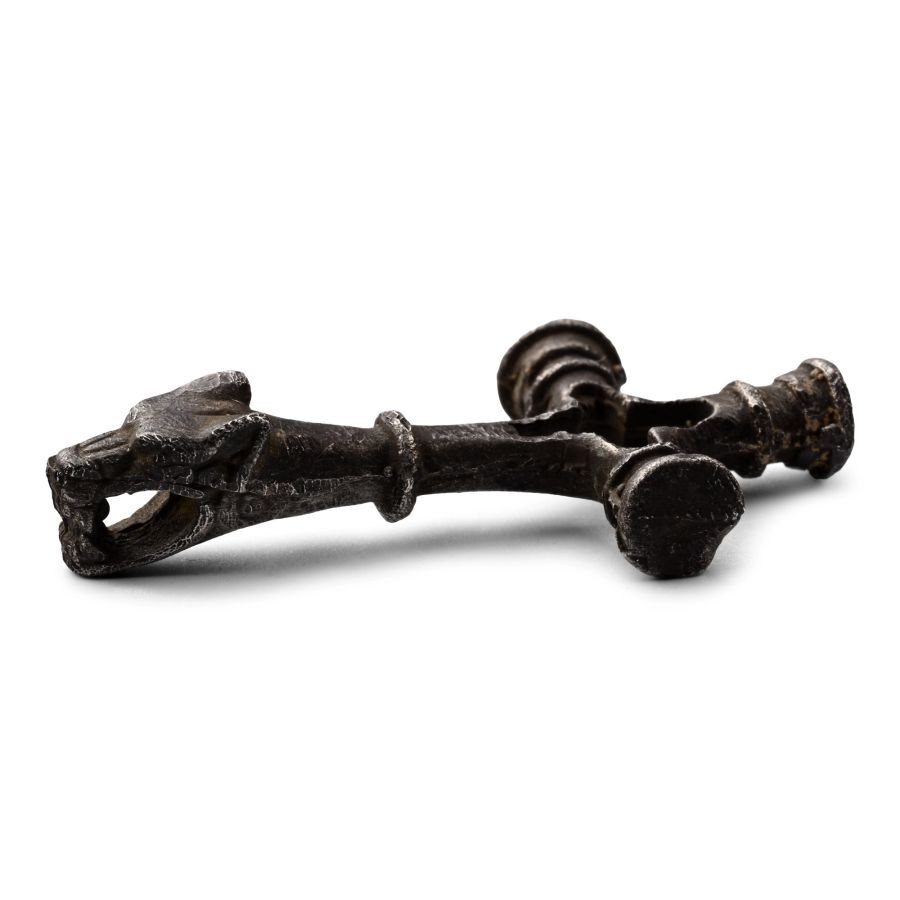
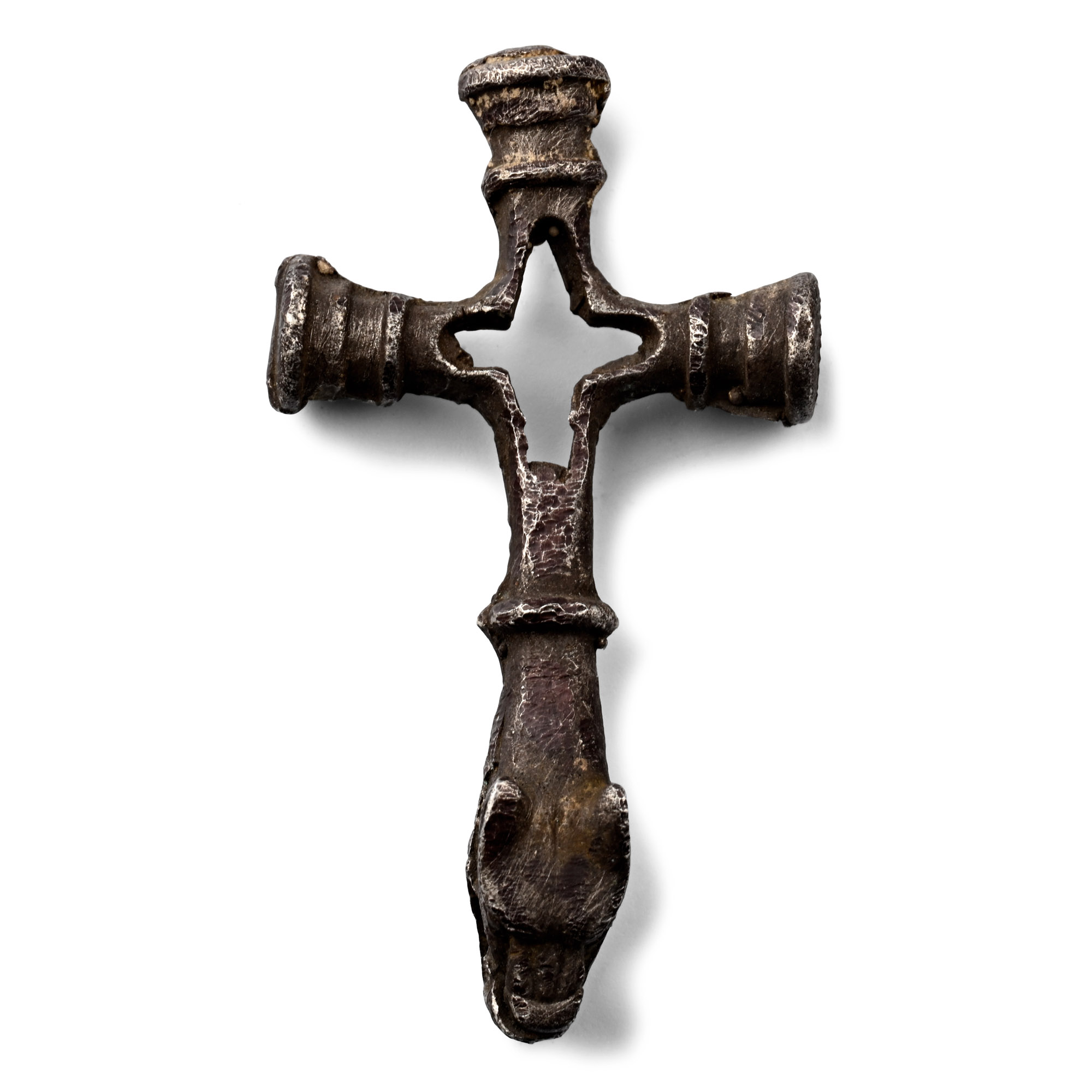
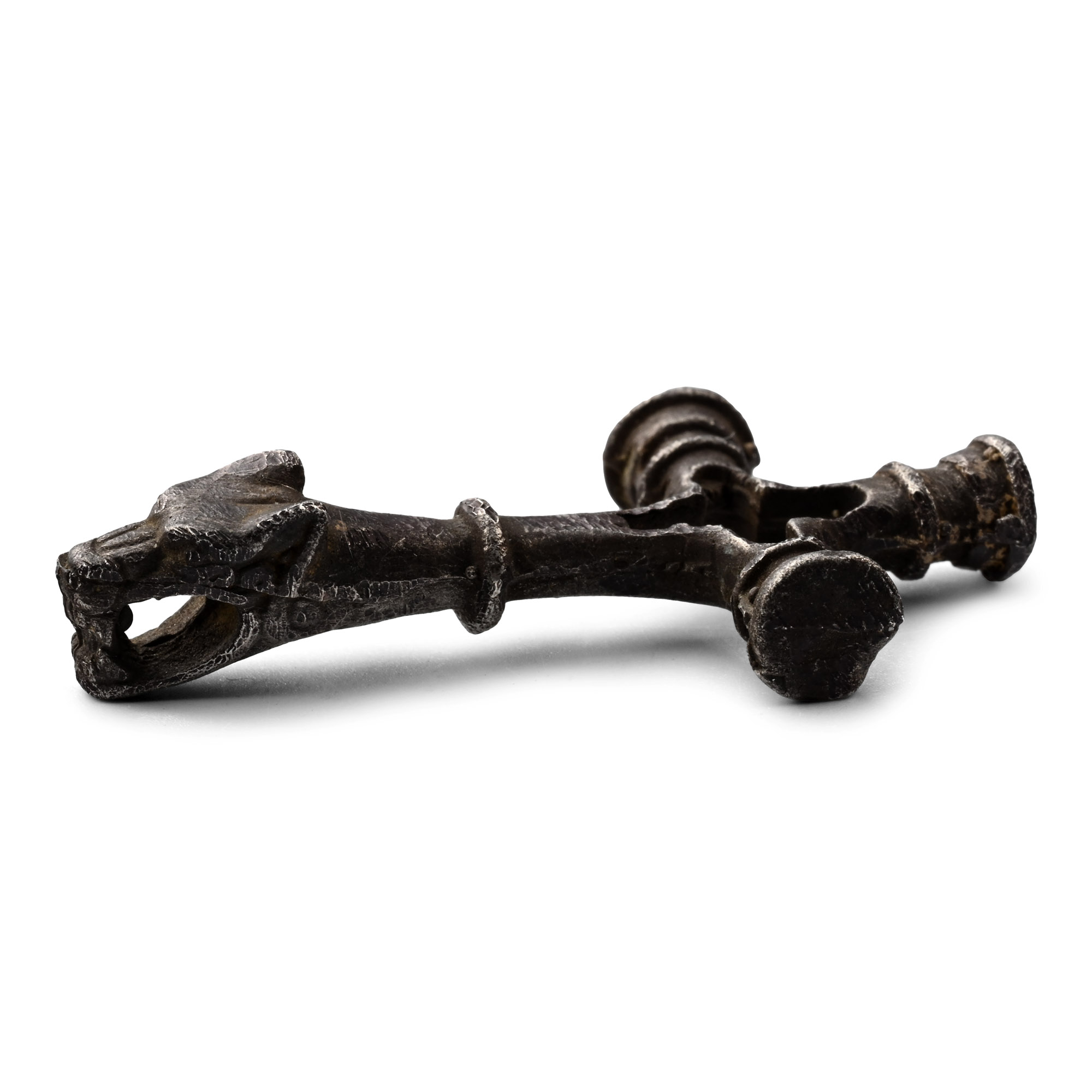
Viking Age Silver Cross Pendant with Head of a Beast
11TH-12TH CENTURY A.D.
1 5/8 in (7.88 grams, 40 mm).
In Romanesque style, cruciform with openwork cross at centre, three oval terminals and a fourth modelled as a hound's head, the beast's mouth forming the suspension loop. [No Reserve]
ProvenanceAcquired on the UK art market.
Property of an East Anglian private collector.
This lot is accompanied by an illustrated lot declaration signed by the Head of the Antiquities Department, Dr Raffaele D'Amato.
Cf. Graham-Campbell, J. & Kidd, D., The Vikings, London, 1980, item 45, for similar silver pendant from Foss, Iceland; cf. Weidenfeld and Nicolson ed., English Romanesque Art 1066-1200, Hayward Gallery, London, 1984, 248-254; cf. TimeLine Auctions 21/2/17, lot 400, for similar.
FootnotesThe original function of this rare and unusual pendant remains elusive. The use of expensive materials and the fine and detailed casting indicate that it would have been a highly prized object. The fusion of Christian and pagan religious motifs is typical of Iceland where the worship of the old gods continued into the 11th century. The Christian cross was used as a symbol of the new faith but the pendant also includes elements of pre-Christian motifs. Comparable objects appeared in an exhibition of English Romanesque Art 1066-1200, held at the Hayward Gallery, London, 5 April - 8 July 1984. The catalogue for this exhibition illustrates numerous small metal and gilded articles with similar grotesque terminals- No. 254 illustrated a late 12th century finial from a shrine, which is in the Victoria and Albert Museum (M.25 1962).
CONDITIONTimeLine Auctions follows a vetting process to ensure the authenticity and legality of all items, reinforcing our commitment to integrity and responsible trading. Each antiquity, antique, and coin lot undergoes thorough examination by a vetting committee of at least ten external specialists, professional trade association members, scientists, and archaeologists: Our Vetting Process
AUCTIONS:
TimeLine is a leading auction house specialising in antiquities, ancient art, collectables, natural history, coins, medals, and books. Our auctions offer museums, collectors, historians, and enthusiasts the opportunity to acquire unique and historically significant pieces.
-

Pre-Viking Gold Aroma Bucket Pendant
4th-7th century A.D.Sold for (Inc. bp): £780
Miniature drum-shaped vessel with strap handle, beaded wire bands to the bottom and sidewall, polished red stone insert to the base. 1.28 grams, 19 mm
From the private collection of a London gentleman, from his grandfather's collection formed before the early 1970s. This lot is accompanied by an illustrated lot declaration signed by the Head of the Antiquities Department, Dr Raffaele D'Amato.
Pendants in the form of miniature buckets have been found in a number of pagan Anglo-Saxon and Viking contexts and are generally made of bronze or iron, with gold examples being rare; three gold examples were found with the hoard from Hoen, Norway. Bronze bucket amulets have been found at Driffield in Yorkshire, and Vimose bog in Denmark, among other places. In form they represent wooden buckets bound with bronze or iron bands which have been found in Anglo-Saxon and Viking graves and are believed to have held mead or ale and were used to replenish the cups from which warriors drank. As amulets they probably represent the ecstatic power of alcoholic drink and the role of women as the dispensers of these precious beverages. -

Anglo-Scandinavian Viking Bronze Plate Brooch with Beast Facing Back
9th-11th century A.D.Estimate: £150 - 200 (+bp*)
Opening Bid: £75
Disc brooch with low-relief regardant beast motif within a segmented border; catchplate and pin-lugs to the reverse. 9.51 grams, 31 mm
Found Yoxford, Suffolk, UK, circa 1980. This lot is accompanied by an illustrated lot declaration signed by the Head of the Antiquities Department, Dr Raffaele D'Amato. -

Viking Age Gold Elfshot Pendant
9th-11th century A.D. or earlierSold for (Inc. bp): £780
Comprising a D-shaped gold cap with integral loop above, inset knapped flint blade. 1.64 grams, 57 mm
From the collection of a late Japanese collector, 1970s. This lot is accompanied by an illustrated lot declaration signed by the Head of the Antiquities Department, Dr Raffaele D'Amato.
This amulet was believed to offer protection against 'Elfshot'. The attack of elves was believed responsible for mysterious suffering in men and livestock: sudden shooting pains localised to a particular area of the body, such as in rheumatism, arthritis or muscle stitches or cramps. Elves were thought to shoot darts or arrows where such pains had no obvious external cause. Belief in elfshot persisted into the 20th century in rural areas, and as proof country folk would sometimes find small arrowheads (the remains of Neolithic or Mesolithic flints, or naturally-occurring spear-shaped stones) that were believed to be the magical weapons that caused the afflictions. Belief in elfshot began in the Pagan Germanic period.
