
Loading, please wait...
LOT 0264
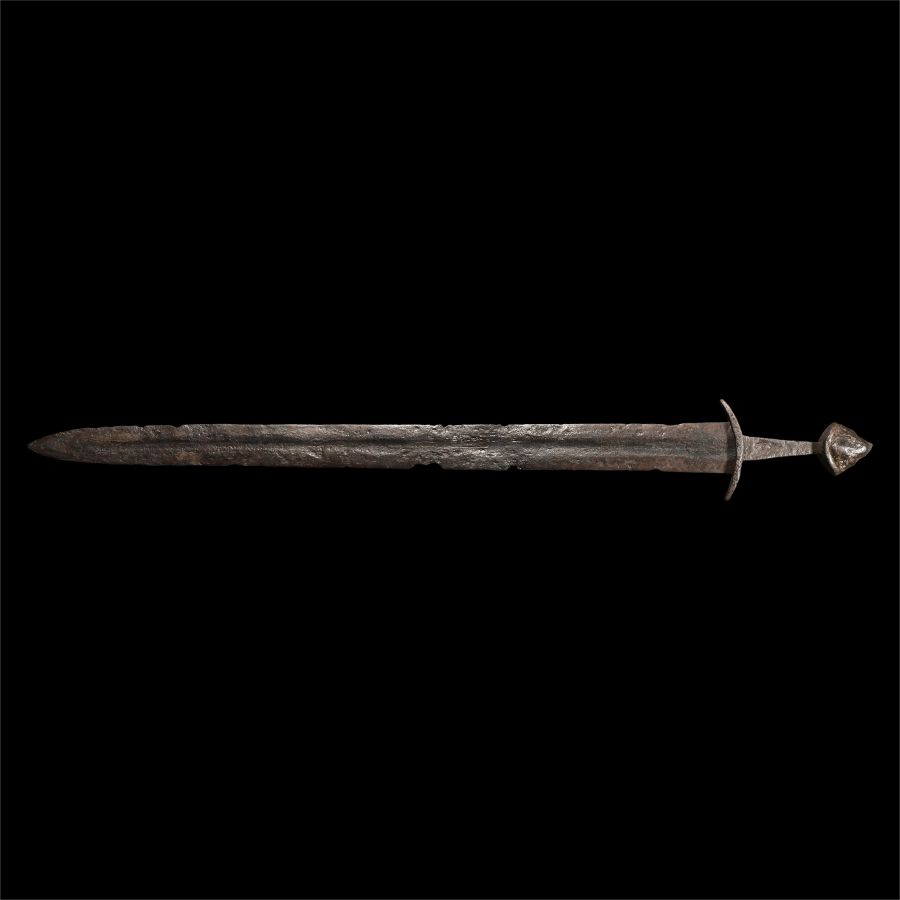
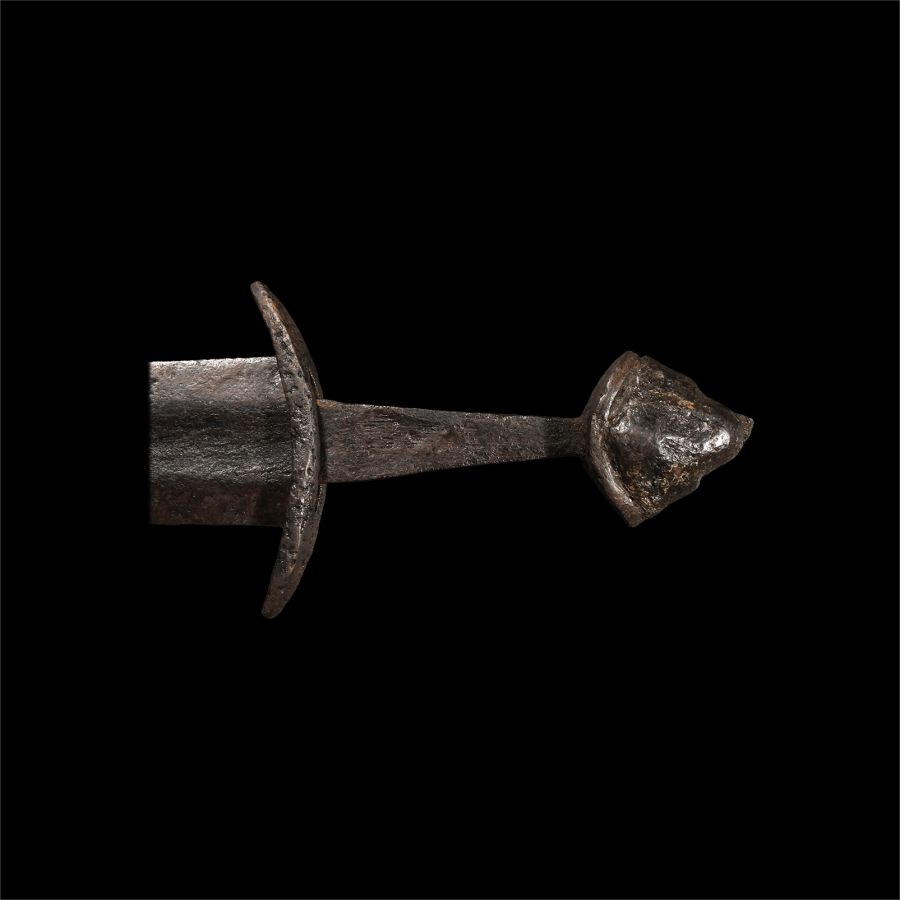
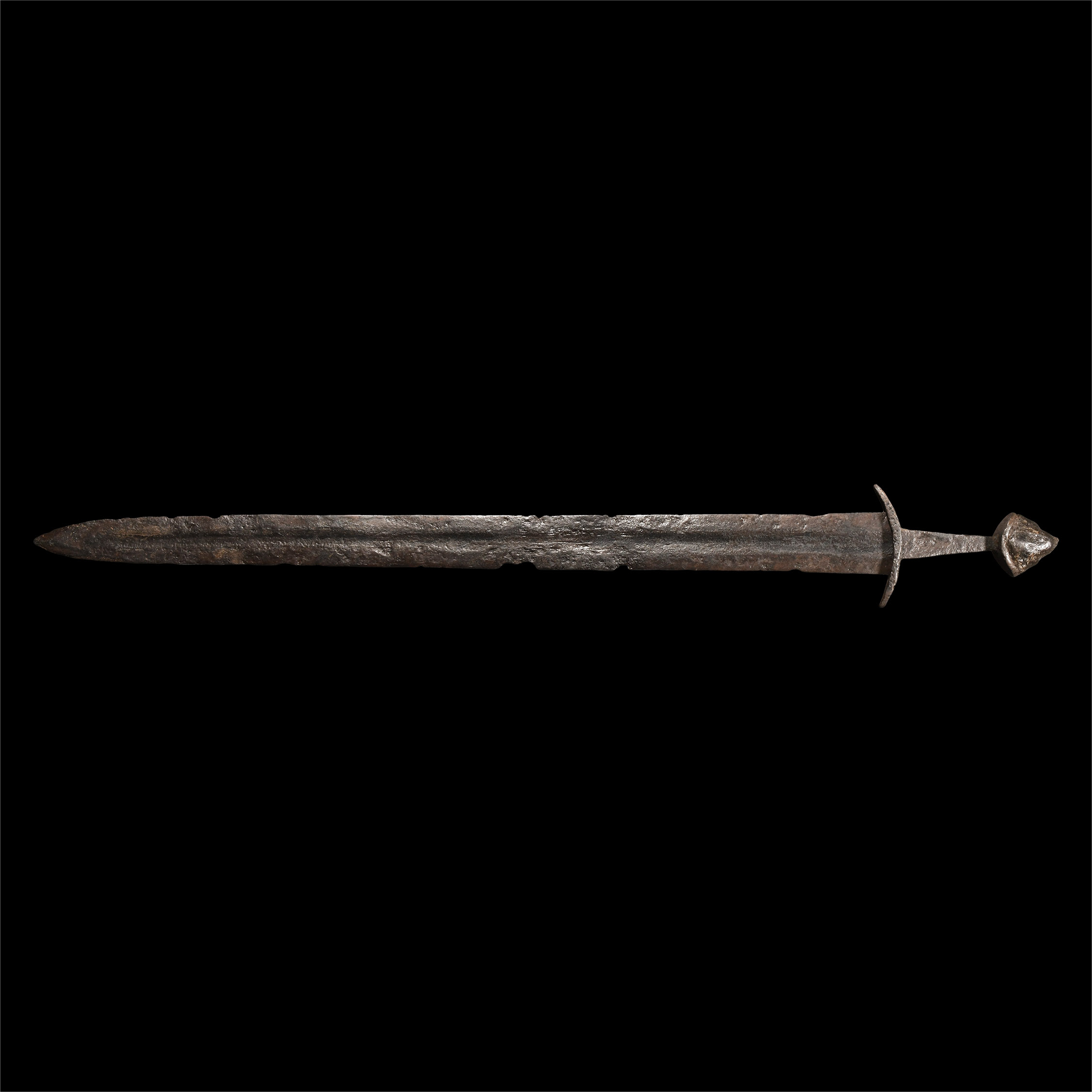
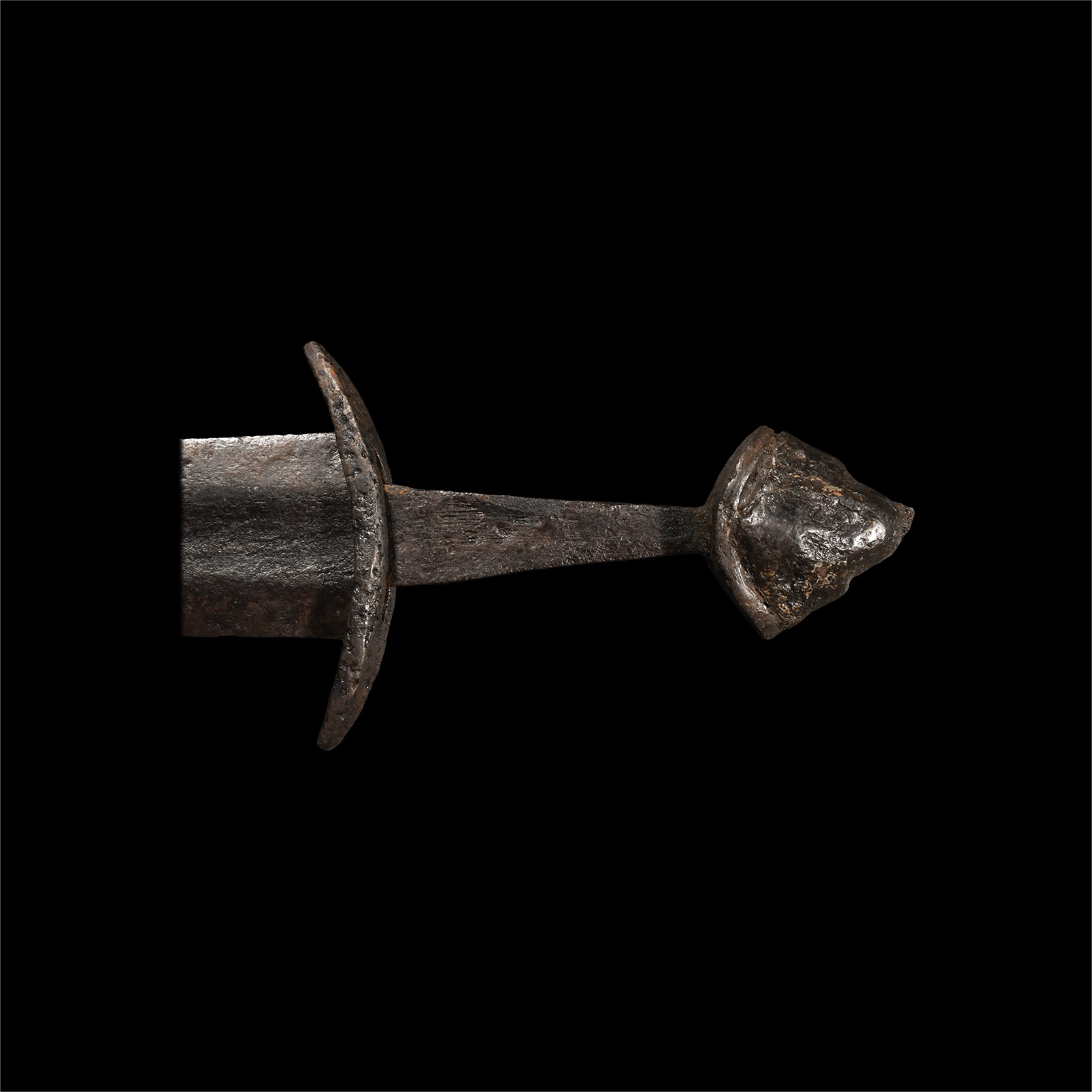
Viking Age Iron Sword with Cocked Hat Type Pommel
10TH CENTURY A.D.
35 1/2 in. (996 grams, 90 cm).
Petersen Type L variant with double-edged pattern-welded blade (waving pattern) showing evidence of being employed, tapering fullers and hefty tang; boat-shaped lower guard, cocked hat pommel with traces of silver inlay; some restoration.
ProvenanceFrom the private collection of a London gentleman, from his grandfather's collection formed before the early 1970s.
Accompanied by an academic report by Dr Raffaele D’Amato.
This lot has been checked against the Interpol Database of stolen works of art and is accompanied by search certificate number no.11816-206858.
Cf. Petersen, J., De Norske Vikingsverd, Oslo, 1919; Oakeshott, R.E., The Archaeology of the weapons, London, 1960; Wilson, D. M., ‘Some neglected Late Anglo-Saxon swords’, in Medieval Archaeology, 1965, 9 (1), pp.32-54; Peirce, I., Swords of the Viking Age, Suffolk, 2002; Żabiński, G., ‘Viking Age Swords from Scotland’, in Acta Militaria Mediaevalia III, Kraków, Sanok, 2007, pp.29-84; the sword finds good parallels in various similar Viking age specimens: a sword in the Bergen Museum (no.2605), a sword at the British Museum (1912, 7-23 1), a sword in the Musée de l’Armée, Paris (JPO2262), all published by Peirce (2002, pl.II, pp.74-76); also the Wensley hilt sword belongs to this classification (Wilson,1965, pp.42ff., pl.VIIa); another occasional find of this typology has been excavated in Wales in 2004, a chance discovery in the garden at Hawarden (NWM inv. 2007.4H).
FootnotesThis sword shows evidence of beautiful pattern-welding. The great curvature of the hilt, stronger than any other type of Viking swords, characterises the typology of L swords. This is clearly visible on the specimens from Dolven and Nedre (Stokke) published by Petersen (1919, figs.94-95).
CONDITIONTimeLine Auctions follows a vetting process to ensure the authenticity and legality of all items, reinforcing our commitment to integrity and responsible trading. Each antiquity, antique, and coin lot undergoes thorough examination by a vetting committee of at least ten external specialists, professional trade association members, scientists, and archaeologists: Our Vetting Process
AUCTIONS:
TimeLine is a leading auction house specialising in antiquities, ancient art, collectables, natural history, coins, medals, and books. Our auctions offer museums, collectors, historians, and enthusiasts the opportunity to acquire unique and historically significant pieces.
-
.jpg)
Viking Iron Danish Type Broad Axehead
9th-10th century A.D.Sold for (Inc. bp): £2,211
Featuring flanges to the socket, a rectangular butt and cheeks with shorter upper and longer lower edges. 334 grams, 15.5 cm
From the private collection of a London gentleman, from his grandfather's collection formed before the early 1970s. -
Roman Whetstone Sword Sharpening Stone
1st-4th century A.D. or laterSold for (Inc. bp): £20
Roughly wedge-shaped with one broken edge and one chamfered. 280 grams, 92 mm
Found Berkshire, UK. -
Luristan Bronze Sword Blade
1st millennium B.C.Sold for (Inc. bp): £221
Comprising a narrow leaf-shaped blade with midrib and lateral channels, rounded shoulders, short tang with attachment hole. 445 grams, 45.5 cm
Ex German collection, Cologne, formed 1980s-1990. The Kusmirek Collection, UK.
The metalworking techniques used in making bronze weapons in early Iran were very complex. Surfaces were often finished in repoussé work, and some of the weapons were chased, others engraved. The function of the ridges here was not only decorative, however, but principally to reduce suction and thus allow the blade to be withdrawn speedily. The ruling elites of warrior horsemen were buried in the graves with their weapons and horses which are the main sources of the Luristan and North-Western bronze weapons.
